OSHA warns restaurant employers about safety risks for young workers
Young restaurant workers are often put on the fastest, riskiest tasks first, and weak training can turn a busy shift into an injury, a citation, and a staffing hole.
The tasks young workers are most likely to be mishandled
In restaurants, the danger usually shows up in the jobs that look routine: cooking on a hot line, cleaning around sharp tools, carrying food through crowded dining rooms, taking deliveries, working drive-thru, prepping ingredients, serving tables, and closing the dish area. OSHA’s restaurant young-worker guidance is built around those everyday assignments because that is where new hires are most likely to get hurt when training is rushed or supervision is thin.
That matters because restaurants and other eating and drinking businesses employ 11.6 million people in the United States, and nearly 30% are under 20. In other words, this is not a side issue for a handful of teen hires. It is a core labor reality for an industry that leans heavily on first-job workers, student workers, and seasonal staff who may not know the difference between a manageable task and a hazard they have not been trained for yet.
For young employees, the biggest problem is often not attitude or effort. It is experience. A host may not know the safest way to move through a crowded expo line. A busser may not realize how quickly a wet floor turns into a fall risk. A teen cook may not understand why a slicer, mixer, or hot surface needs more than a quick verbal warning before use. OSHA’s point is simple: if the job is being handed off to someone new, the instruction has to be real, not improvised.
Why weak onboarding becomes a business problem fast
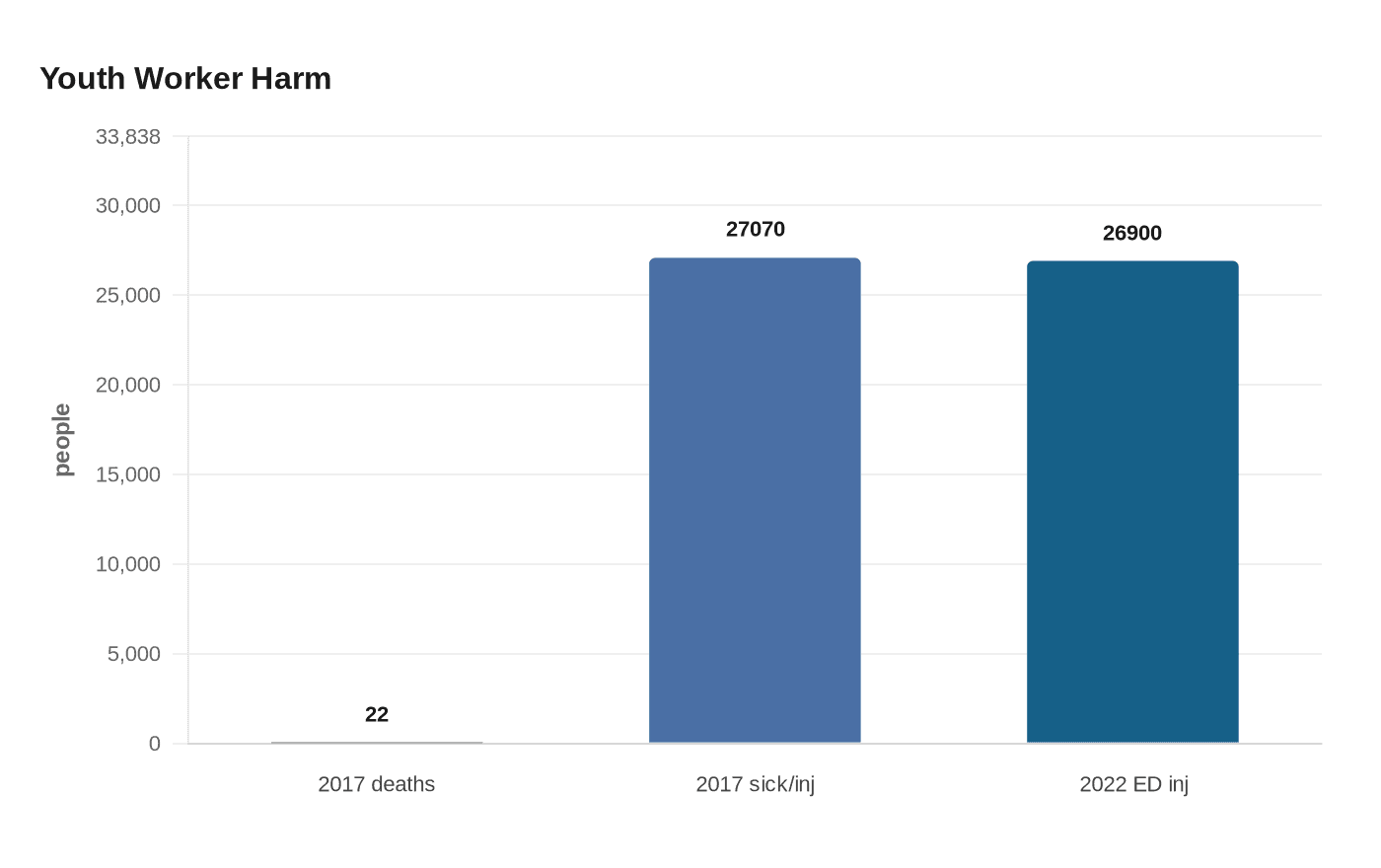
OSHA says young workers suffer a disproportionate share of injuries and fatalities, especially in the first year on the job. The agency reported that in 2017, 22 youths under 18 died from work-related injuries and another 27,070 were sickened or injured. That is not just a safety statistic. In a restaurant, it can become a missed shift, a workers’ comp claim, a scramble to cover the line, and a service breakdown right when the dining room is full.
The service industry ranks highest among U.S. industries for injury among workers ages 16 to 19, which helps explain why restaurant managers should treat onboarding as a risk-control task, not just a scheduling task. If a new hire is put on a grill station, a delivery run, or a dish pit without close supervision, the cost can ripple through the whole shift. One injury can slow ticket times, create burnout for the rest of the crew, and force managers to choose between sending someone home or stretching a short staff even thinner.
CDC and NIOSH add another layer to the picture: young workers have high rates of job-related injuries, and little or no prior work experience plus a lack of safety training contribute to those injuries. The numbers show the risk has not gone away. In 2022, there were about 19.4 million workers under age 25, and an estimated 26,900 emergency-department-treated injuries among 15- to 17-year-olds. For restaurant operators, that means the same staffing model that depends on young labor also has to protect it.
What OSHA’s guidance is really telling managers to do
The value of OSHA’s restaurant eTool is that it translates safety into restaurant language. It covers the work people actually do: cooking, clean-up, delivery, drive-thru, food prep, serving, and other tasks that can become hazardous when a new employee is placed in motion before they are ready. For managers, the practical lesson is to slow down the first few shifts, pair new workers with someone experienced, and make sure the person doing the training actually knows the job.
That kind of structure matters in a business where labor shortages, high turnover, and burnout often push managers to “just get somebody on the schedule.” The wrong shortcut is to assume a young worker can learn by watching once or by being corrected after a mistake. In restaurants, that approach can turn into a cut, burn, spill, or collision on a floor already under pressure from lunch rushes, takeout volume, and split-second service timing.
OSHA also reminds workers that they have a right to working conditions that do not pose a risk of serious harm. That is especially important in restaurants, where young workers may feel pressure to say yes to whatever is asked of them, even if they do not fully understand the task. A first-job employee should be able to ask for instruction before handling equipment, moving through a dangerous area, or taking on a job that feels outside their training.
The child labor rules restaurants cannot ignore
The Labor Department’s restaurant child-labor fact sheet makes clear that its guidance applies to restaurants and quick-service establishments employing workers under 18. That matters because the safety question is not only about general caution. It is also about whether the assignment is legally allowed in the first place. Employers who ignore that line can turn a staffing decision into a compliance problem, a citation, and a much bigger headache during an already busy shift.
Federal guidance says workers under 18 generally may not operate meat slicers or power-driven meat-processing machinery in restaurants and delicatessens. It also says they may not use vertical dough or batter mixers, and there are limits on driving motor vehicles for work in many circumstances. Those restrictions are easy to overlook in a kitchen that is used to cross-training everyone on everything, but the fact that a task is common does not make it permissible for a minor.
There is also an age-based distinction that matters for scheduling. Federal guidance says 16- and 17-year-olds may perform non-hazardous jobs for unlimited hours, while workers 18 or older may perform any job. That means the question is not just who is willing to work the shift. It is who is allowed to do the work safely and legally, without forcing the rest of the team to absorb the fallout if something goes wrong.
What the industry should take from the numbers
The broader message from OSHA, CDC, NIOSH, and the Labor Department is that young-worker safety in restaurants is not a narrow compliance story. It is a labor story, a training story, and a service-quality story all at once. Restaurants are often a first employer, which means managers are shaping how someone learns to work under pressure, handle equipment, and speak up about hazards.
For restaurants trying to keep service steady, the safest path is also the most operationally sensible one: assign young workers only to tasks they are trained and legally allowed to do, supervise them closely at the start, and do not confuse speed with readiness. In an industry where one bad shift can blow up labor costs, stall service, and knock out the next day’s schedule, safety is not overhead. It is part of keeping the restaurant open and staffed.
Know something we missed? Have a correction or additional information?
Submit a Tip