Restaurant labor laws, wage, scheduling rules reshape worker hours and pay
Restaurant compliance is no longer one handbook deep: wage, tip, schedule, and leave rules now change by city and state, and workers feel it in hours and pay.
One handbook is not enough anymore
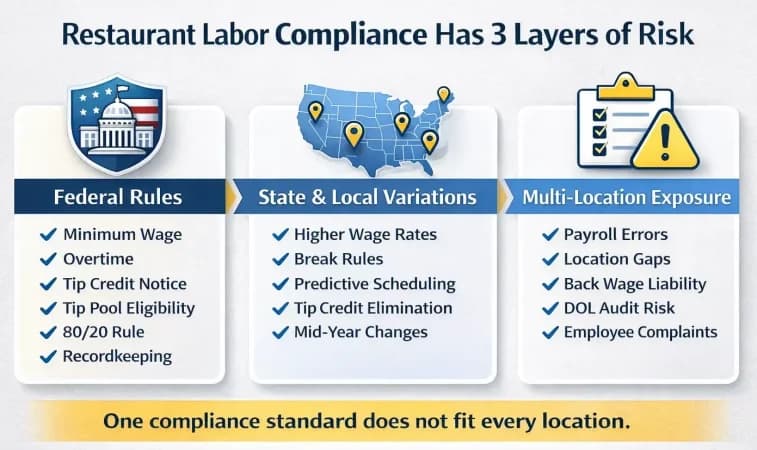
Restaurant labor law now works like a patchwork quilt, and that is exactly why copy-paste compliance keeps failing operators. The federal floor still comes from the Fair Labor Standards Act, but state, city, and sometimes county rules can add higher wages, tighter scheduling rules, leave rights, or different recordkeeping duties that change how a shift runs from one location to the next.
That matters on the floor. A server in one city may be able to predict next week’s hours well enough to hold a second job, while a line cook in another jurisdiction may need a longer break standard, paid leave, or a different tip policy than the same title in the next county. In a business built on thin margins and high turnover, one bad handbook can become a payroll error, a scheduling dispute, or a lawsuit.
The wage floor is federal, but the real number often is not
The federal baseline remains straightforward on paper. The Fair Labor Standards Act sets minimum wage, overtime, recordkeeping, and child labor standards, and federal law still allows a tipped cash wage of $2.13 an hour when tip-credit rules are satisfied, as long as tips lift pay to at least the $7.25 federal minimum wage.
That is where the uniformity ends. The U.S. Department of Labor’s tipped-wage tables for January 1, 2026 show that some states require tipped workers to receive the full state minimum wage before tips. Alaska, California, Minnesota, and Nevada are among the states that do not allow employers to lean on the federal tipped cash wage the way they can under federal law. Oregon uses regional minimum wages, which means the same job can trigger different pay obligations depending on where the restaurant sits.
For workers, that is not a technicality. It affects take-home pay, tip-credit math, and whether front-of-house and back-of-house compensation lines up cleanly. For managers, the safest rule is simple: always check the highest applicable wage, not the easiest one.
Tips, pooling, and the fight over who gets paid what
Tip rules remain one of the messiest parts of restaurant compliance because they sit at the intersection of pay equity, staffing, and culture. The Department of Labor says valid tip pools generally can include only employees who customarily and regularly receive tips. That means the people sharing in the pool are not interchangeable with every worker on the schedule, no matter how close they work to the pass or the register.
This is also where the politics of restaurant pay stay heated. The National Restaurant Association has argued for preserving the tip credit and tipping structure, saying tip wage legislation had been challenged in 17 states and three cities or counties in the prior year. It also said 75% of customers preferred the existing tipping system in a 2022 survey. Workers and advocates, including Restaurant Workers United, continue to push back because every tweak to tip rules can change the balance between front-of-house earnings, kitchen pay, and management control.
Scheduling rules can change payroll, not just the calendar
Predictive scheduling sounds like a staffing issue, but in restaurants it quickly turns into a wage issue. The Department of Labor says some state and local scheduling penalties may need special treatment under federal overtime regular-rate rules, which means a local late-change penalty or reporting premium can affect how overtime is calculated.
That is a big deal for multi-unit operators. A scheduling rule in one city can ripple through payroll, timekeeping, and labor forecasting, especially when a chain uses one central system for all locations. A manager who thinks they are only swapping a shift may actually be changing the overtime rate, the regular rate, and the cost of the week.
For workers, predictable scheduling can be the difference between holding a second job and losing it. For restaurants, it can mean fewer last-minute cuts, more cross-training, or more automation at the front counter when labor gets more expensive.
Leave, pregnancy protections, and the paperwork behind them
Paid leave and pregnancy protections are another place where a single handbook can fall apart fast. The Equal Employment Opportunity Commission says the Pregnant Workers Fairness Act applies to employers with 15 or more employees, and its final rule was issued April 15, 2024 and took effect June 18, 2024. That means covered restaurants must provide reasonable accommodations for pregnancy-related limitations unless doing so would create undue hardship.
In restaurant work, this can surface in very ordinary moments: a host who needs a stool, a server who cannot carry trays for a stretch, or a cook who needs a modified task list during a pregnancy-related restriction. The law does not erase the pressure of the floor, but it does require managers to treat those situations as compliance issues, not favors.
Paid leave rules can be just as consequential. When a worker gets sick or has a family emergency, leave policy determines whether that employee comes back or disappears from the schedule entirely. In an industry with high turnover, the difference between a retained worker and a vacancy can show up in service quality within days.
Teen workers bring extra risk, especially in kitchens
Restaurants hire minors more often than many other industries, which is why youth labor rules matter as much as wage rules. Department of Labor fact sheets for restaurants and quick-service establishments warn that workers under 18 cannot perform certain hazardous meat-processing tasks, including operating or cleaning power-driven meat slicers and similar equipment.
Those rules are not abstract, either. In February 2026, the Department of Labor announced an investigation involving an Aurora, Colorado restaurant where a 17-year-old allegedly loaded a trash compactor, a task federal law prohibits, and where 19 workers were denied overtime pay. That is the kind of enforcement action that lands directly on the dining room floor: one teenager on the wrong machine, one overtime mistake in the back office, and the whole operation is suddenly in legal trouble.
The scale of the industry makes these errors expensive
This is not a niche compliance issue. The National Restaurant Association projects 2026 restaurant and foodservice sales at $1.55 trillion and more than 100,000 added jobs. The industry is huge, and the workforce remains heavily exposed to wage pressure: the Bureau of Labor Statistics says food and beverage serving and related workers had a median hourly wage of $14.92 in May 2024, while the broader food-preparation-and-serving group had a median annual wage of $34,130.
Those numbers explain why even small rule changes matter. A few dollars in schedule penalties, a shift in tipped-wage treatment, or a new leave obligation can hit a worker’s paycheck hard and force operators to rethink labor models across multiple locations.
What operators need to do now
The compliance playbook is not glamorous, but it is becoming non-negotiable:
- Check the highest applicable wage in every location, not just the federal floor.
- Make sure tip pools only include employees who customarily and regularly receive tips.
- Track scheduling penalties carefully, because they can affect overtime calculations.
- Update handbooks whenever local leave, posting, or recordkeeping rules change.
- Train supervisors on minor labor limits before they put a teen on the wrong task.
- Keep records clean, because wage and hour disputes often start with timekeeping gaps.
The larger lesson is blunt: the same restaurant job can mean different leave rights, wage rules, posting duties, and recordkeeping obligations depending on the city and state. In 2026, labor law is no longer a background document in the manager’s office. It is part of the daily operating system, and restaurants that keep pretending one rulebook covers every store will keep paying for that mistake in hours, payroll, and staff turnover.
This article was produced by Prism’s automated news system from verified source data, official records, and press releases, then run through automated quality and moderation checks before publishing. The system is built and supervised by the people who set the standards it runs under. Read our full AI policy.
Did this article answer your question?