State-by-state minimum wages reshape restaurant labor costs and staffing plans
A server’s cash wage can still be $2.13 in some setups while others require the full minimum before tips. That gap can change payroll, schedules, and menu prices fast.
A wage chart can catch problems before payroll does
A server can still start at $2.13 an hour in the federal tipped-wage model, while other states require employers to pay the full minimum wage before tips even enter the picture. That gap is why a state-by-state wage guide is not just background reading, it is a pay-checker for anyone who works the floor or builds the schedule.
For restaurant workers, the job title is only half the story. A server in one market may be protected by a much higher wage floor than a server in another, and a manager hiring across state lines cannot assume the same labor rules will follow the person from one location to the next. The practical test is simple: if the state law is higher, that higher rate controls.
The federal floor is low, and many states have moved far beyond it
The federal minimum wage for covered nonexempt employees remains $7.25 per hour, unchanged since July 24, 2009. The U.S. Department of Labor says that when both state and federal minimum-wage laws apply, employees are entitled to the higher minimum wage. That rule matters in restaurants because the federal baseline is no longer the real pay floor in much of the country.
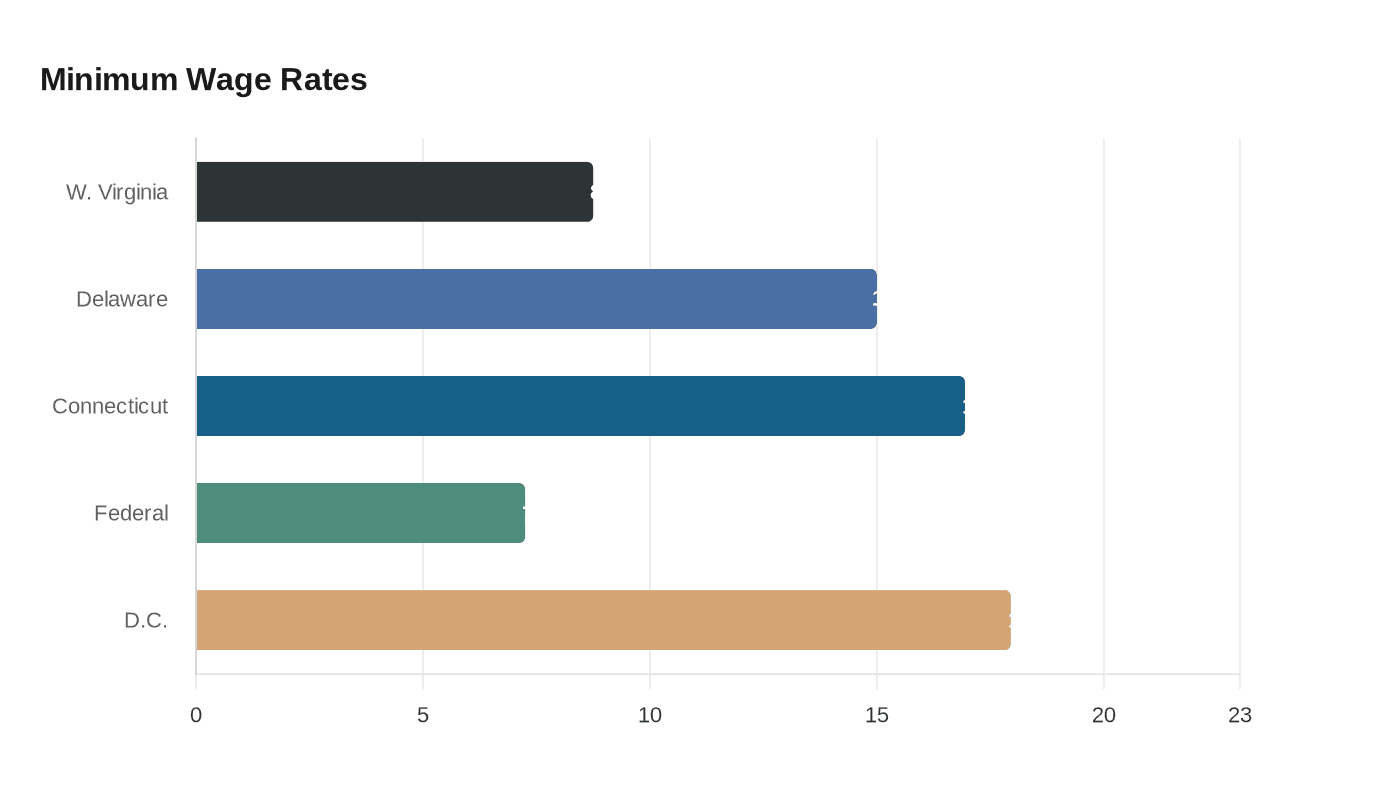
The spread across states is wide enough to change labor math in a single shift. The U.S. Department of Labor’s 2026 consolidated minimum-wage table shows state minimums ranging from $8.75 in West Virginia to $17.95 in the District of Columbia. The Department also lists examples such as Connecticut at $16.94 and Delaware at $15.00, a reminder that the national picture is now a patchwork, not a flat line.
The Economic Policy Institute says the federal minimum wage has not been raised since 2009, and its tracker was updated April 10, 2026. That long freeze has left states and localities to fill the gap on their own, which is exactly why a restaurant worker moving from one market to another can see a very different paycheck without changing roles, stations, or hours.
Tipped jobs are where confusion turns into underpayment fastest
Tipped labor is where restaurant pay gets most complicated. The U.S. Department of Labor’s minimum-wage guidance for tipped employees, last revised January 1, 2026, says the federal tipped cash wage remains $2.13 per hour. It also says some states require employers to pay tipped employees the full state minimum wage before tips.
That distinction matters on the dining room floor. A tipped server in a state that follows the federal model is paid one way; a tipped server in a state that requires the full minimum before tips is paid another. States such as California, Oregon, Washington, Alaska and Nevada are handled differently from the federal tipped-wage model, which means managers need to know the local rule before they write a schedule, and workers need to know it before they trust a paycheck.
This is where bad assumptions create wage theft claims and frustrated staff. If a restaurant transfers a server, bartender, or host from one state to another, the old pay setup does not travel automatically. The state rule does, and payroll has to match it.
When wages rise, restaurants usually move the costs somewhere else
Restaurants do not absorb wage changes in a vacuum. The National Restaurant Association says salaries and wages accounted for a median 36.5% of sales in 2024 at full-service restaurants, based on data from more than 900 operators nationwide. That is a large enough slice of the revenue pie that even modest wage changes can ripple through staffing plans, menu pricing, and the way a shift is run.
Toast says 82% of restaurants responded to minimum-wage increases by raising menu prices. Toast also reports that menu prices rose 4.1% year over year from 2023 to 2024, with the West posting 4.9% growth. In practical terms, that means minimum wage policy does not stay in HR or payroll. It shows up in the guest check, in labor targets, and in the number of bodies the restaurant keeps on the floor.
Operators feeling pressure from labor costs often respond by reworking service models, tightening labor controls, or looking for efficiencies elsewhere. For workers, that can mean leaner shifts, faster pacing, fewer closers, or a heavier reliance on technology and tighter scheduling. The wage floor is not just a compliance line. It is a force that shapes how the dining room runs.
California shows how one state can stack extra rules on top of the base wage
California is a good example of how wage policy can get even more layered. The state’s fast-food minimum wage rules create an additional wage tier on top of the general statewide minimum, and the California Department of Industrial Relations says the Fast Food Council can raise that wage each year by up to 3.5% or the CPI increase, whichever is smaller.
For workers, that means the same restaurant job can carry different pay rules depending on whether the concept falls under the fast-food framework. For managers, it means that one staffing plan may not fit another location, even inside the same state. A wage chart is only useful if it tells you which layer applies to your specific job.
That kind of rule stack is exactly why restaurant teams need to check the law before they call a shift covered, before they post a pay range, and before they assume a transfer is a lateral move. In a business with high turnover, fast onboarding, and constant cross-training, those details are easy to miss and expensive to get wrong.
How to use a state-by-state guide like a pay-checker
The best way to use a wage chart is to turn it into a daily payroll filter. If you are a worker, it should tell you whether your hourly rate matches the law where you actually work, not where the company is headquartered. If you manage a multi-unit operation, it should be part of every hiring, transfer, and scheduling decision.
- Check the state minimum wage first, then compare it with the federal $7.25 floor.
- If you are tipped, confirm whether your state uses the $2.13 federal cash wage or requires the full state minimum before tips.
- When you work across state lines, do not assume the same shift rules, tip credit, or pay structure follow you automatically.
- If your restaurant is in a higher-wage market, expect labor costs to affect staffing, menu prices, and coverage decisions.
The broader workforce numbers explain why this matters so much. The Bureau of Labor Statistics says food and beverage serving workers had a median hourly wage of $14.92 in May 2024. The National Restaurant Association projects the industry will employ about 15.9 million people in 2025. That is a huge labor market, and it is built on a wage system that still changes sharply from one state to the next.
In restaurant work, pay policy is never abstract for long. It lands in a server’s paycheck, a line cook’s staffing ratio, a host stand’s schedule, and a manager’s labor budget. A state-by-state minimum-wage guide is useful because it shows the real cost of the job before the restaurant makes the mistake for you.
This article was produced by Prism’s automated news system from verified source data, official records, and press releases, then run through automated quality and moderation checks before publishing. The system is built and supervised by the people who set the standards it runs under. Read our full AI policy.
Did this article answer your question?