Understaffing stalls restaurant growth, limits service, and cuts sales
One missing shift can mean slower tables, fewer open hours, and lost sales. The labor crunch has become a hard business constraint.

Understaffing is now a daily P&L problem
One missing team member can cost hundreds of dollars in a shift, and that is before you count the tickets that back up, the guest complaints that rise, and the prep that gets pushed to tomorrow. The National Restaurant Association’s new hiring and staffing report makes the case that understaffing is no longer a scheduling headache, it is a growth cap, a service drag, and a sales leak.
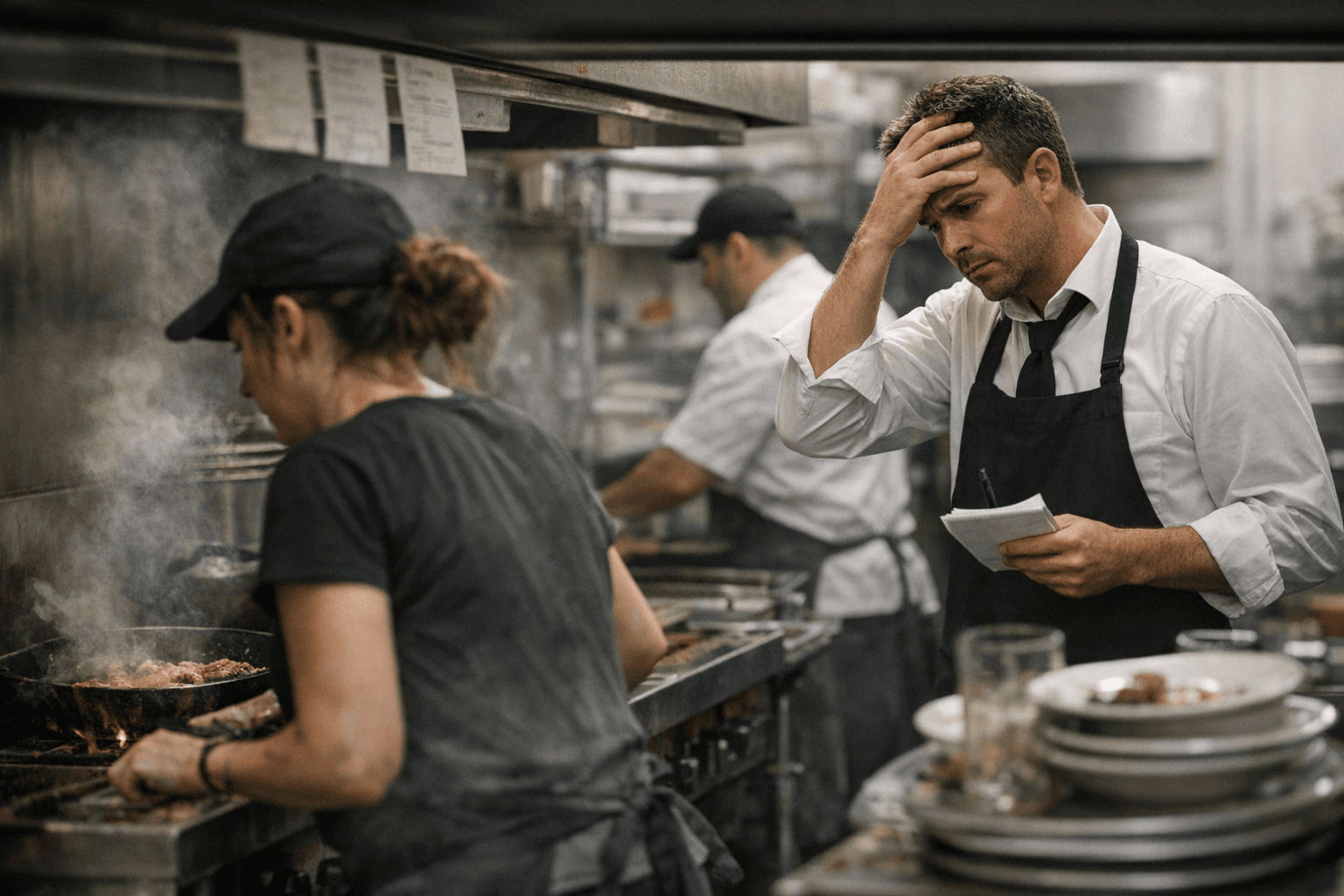
That is the part workers already feel on the floor. A thin host stand stretches waitlists. A short kitchen slows ticket times. A bartender covering extra stations runs out of bandwidth fast. When staffing gaps turn into missed sales and exhausted crews, the problem stops looking like a temporary labor shortage and starts looking like an operating model that is breaking down in real time.
The business damage is visible, not abstract
The strongest number in the report is also the simplest: nearly 8 in 10 short-staffed operators said understaffing significantly limits their ability to grow and succeed. Nearly half of understaffed restaurants could not operate at full capacity. That means the issue is not just whether a restaurant can open its doors, but whether it can actually use the dining room, the line, and the bar the way it is built to.
The ripple effects are blunt. The report says 43% of understaffed restaurants postponed expansion plans or modified menus, 34% reduced hours, and 1 in 5 closed on days they would normally be open. For workers, those choices show up as fewer shifts, tighter sections, trimmed prep lists, and more pressure to do more with fewer hands. For operators, they show up as lost seat turns, lower check totals, and a weaker ability to capture demand when it is actually there.
That is why understaffing is no longer something a manager can hide behind the phrase “we are short today.” If a restaurant cannot staff the station, it cannot serve the table at the pace guests expect. If it cannot cover the host stand, the wait gets longer. If it cannot keep the line fully manned, the ticket board starts to pile up. The revenue loss is not theoretical, it is built into the shift.
The clock on hiring is part of the problem
The National Restaurant Association says hourly positions take an average of 16 days to fill, while manager or salaried roles take 46 days. That lag matters because restaurants do not pause while hiring catches up. Tables still turn, delivery orders still hit, prep still has to get done, and one open slot can cascade through the whole service.
The real squeeze is that new hires do not become fully productive right away. Hourly employees take an average of 31.8 days to become net positive, while managers and salaried staff take 72.2 days. Some leadership roles can take 3 to 6 months before they pay back the business. In plain terms, a new hire is not just a body in the building, it is a near-term cost before that person becomes a contributor.
That timing helps explain why understaffing can feel permanent even when recruiting improves. By the time one round of hires is trained, another wave of turnover or growth needs opens up. The result is a constant tradeoff between service quality and labor strain, and workers are the ones who absorb the gap when managers decide whether to cut labor, cut hours, or keep the kitchen running hot.
The industry is recovering unevenly, and full-service is still behind
There is better news in the numbers, but it is uneven. Eating and drinking places added 21,500 jobs in March 2026 and 18,500 jobs in the first quarter of 2026. As of March, that part of the industry was 76,800 jobs above its February 2020 peak. The broader restaurant workforce is more than 15.7 million jobs, and eating and drinking places make up about 80% of that total.
But full-service restaurants are still not back to where they were. As of February 2026, full-service employment was 207,000 jobs, or 3.7%, below pre-pandemic levels. That gap matters because full-service spots are the places where labor intensity is highest, service expectations are widest, and the pain of one empty shift is most visible to both guests and staff.
This uneven recovery helps explain why staffing feels different from one concept to another. A quick-service operation with a tight menu and more automation can sometimes absorb gaps differently than a full-service dining room juggling servers, bussers, hosts, bartenders, and line cooks. The same labor market can look healthy on paper and still leave a full-service manager short every night at 6 p.m.
The pandemic reset the rules, but not the math
The current strain did not begin with the latest report. Restaurant Business reported in 2025 that recruitment and retention had improved to near pre-COVID rates, but labor costs were still more than 30% higher than four years earlier, and operators were still struggling to make the numbers work. That is the gap the industry has been living with ever since the pandemic changed both staffing levels and worker expectations.
McNellie’s Group in Tulsa, Oklahoma, is one reminder of how severe that reset was. Elliot Nelson furloughed about 1,000 employees in March 2020 when indoor dining was shut down. The point is not just historical drama. It is that many restaurants spent years rebuilding only to find that labor is still expensive, difficult to keep, and hard to replace quickly when it walks out the door.
That is why the new report links staffing to onboarding quality, manager effectiveness, and smart technology. The logic is straightforward: restaurants that train better, supervise better, and use systems that reduce friction are more likely to keep people longer and reach productive staffing levels faster. For workers, that can mean steadier schedules, better prep coverage, and less of the chaotic scramble that comes when a shift is one call-out away from collapse.
What operators are really being forced to solve
The most important shift in thinking is that staffing is no longer just an HR function. It is a growth strategy, a guest-experience strategy, and a sales strategy. If a restaurant is open but under capacity, it is not really fully open. If it trims hours, changes menus, or shuts on days it should be serving, the labor problem has already become a revenue problem.
For crews on the ground, that reality is visible in every service. It shows up when cooks are stretched across too many stations, when bartenders are asked to cover more than one zone, when hosts are juggling a long waitlist with too few hands, and when managers are forced to choose between protecting labor costs and protecting the guest experience. The industry can keep calling it a shortage if it wants. On the floor, it looks more like a constraint that is still deciding who gets sat, who gets cut, and how much money walks out the door.
This article was produced by Prism’s automated news system from verified source data, official records, and press releases, then run through automated quality and moderation checks before publishing. The system is built and supervised by the people who set the standards it runs under. Read our full AI policy.
Did this article answer your question?