2026 wage map shows Taco Bell pay varying by state and city
A Taco Bell crew member in California can face a very different legal wage floor than one in Georgia, and that gap is widening again in 2026.

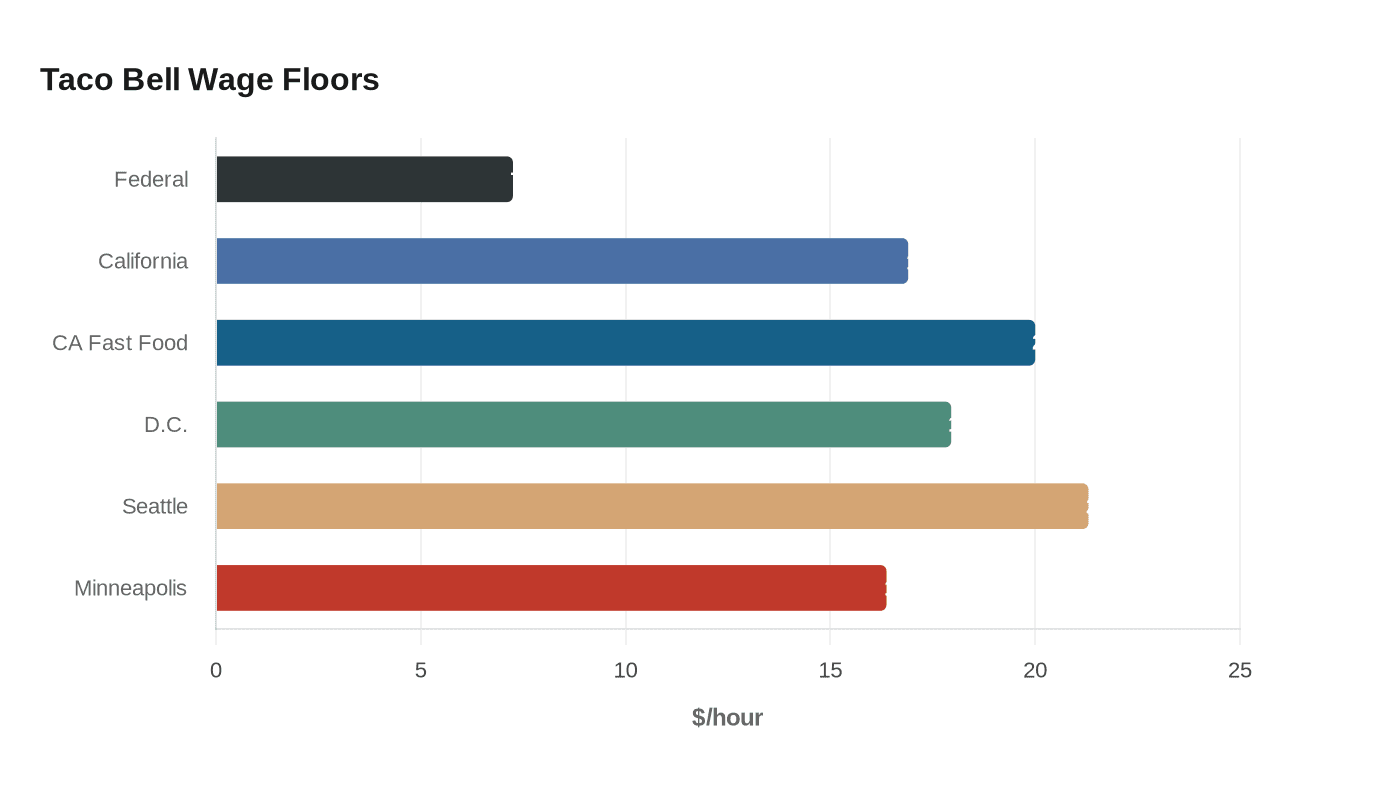
A Taco Bell crew member in California now works under a very different legal wage floor than a crew member doing the same shift in Georgia or Wyoming, and that gap is starting to shape transfer requests, hiring offers and retention plans inside the same brand. The U.S. Department of Labor says the federal minimum wage is still $7.25 an hour, unchanged since July 24, 2009, but California’s general minimum is $16.90 in 2026 and its fast-food floor is $20 for covered restaurants.
That split is not staying confined to California. National Employment Law Project said minimum wages rose on January 1 in 19 states and 49 cities and counties, with another 4 states and 22 localities set for later increases. CBS News reported that 22 states and 66 cities and counties were on track to raise wages in 2026, while USA Today said 60 of those jurisdictions would reach or exceed $15 an hour for some or all employers. In practice, that means a Taco Bell applicant can walk into one market facing a $16.94 floor in Connecticut, $17.95 in Washington, D.C., $21.30 in Seattle or $16.37 in Minneapolis, while nearby states such as Georgia, Oklahoma and Wyoming still generally defer to the federal $7.25 minimum.

For store leaders, the bigger shift is administrative as much as financial. Multi-state operators have to track location-specific wage data, post the right notices, and build scheduling and overtime assumptions around local law instead of assuming one national pay standard fits every store. A crew member who is paid a few dollars above minimum in one market may be undercut by a state or city increase in another, which can erase the room that shift leads and trainers often count on when they move up from base pay.
California has become the most watched benchmark in fast food. Its $20 minimum for covered fast-food restaurant employers took effect on April 1, 2024, and it is now a live comparison point for operators weighing staffing levels, turnover, prices and automation. More than 8.3 million workers were expected to benefit from minimum-wage hikes across 19 states, with roughly $5 billion in added earnings, underscoring how quickly wage pressure is spreading beyond a handful of coastal markets. For Taco Bell, the wage map now reads less like a national standard and more like a patchwork of local rules that can change how stores hire, hold onto workers and pay for the same job from one city to the next.
This article was produced by Prism’s automated news system from verified source data, official records, and press releases, then run through automated quality and moderation checks before publishing. The system is built and supervised by the people who set the standards it runs under. Read our full AI policy.
Know something we missed? Have a correction or additional information?
Submit a Tip