National Restaurant Show spotlights AI tools reshaping Taco Bell operations
Taco Bell’s AI shift is already in the stores. The question for crews is not whether tech arrives, but whether it makes shifts easier or simply faster.
AI is no longer a demo piece for Taco Bell
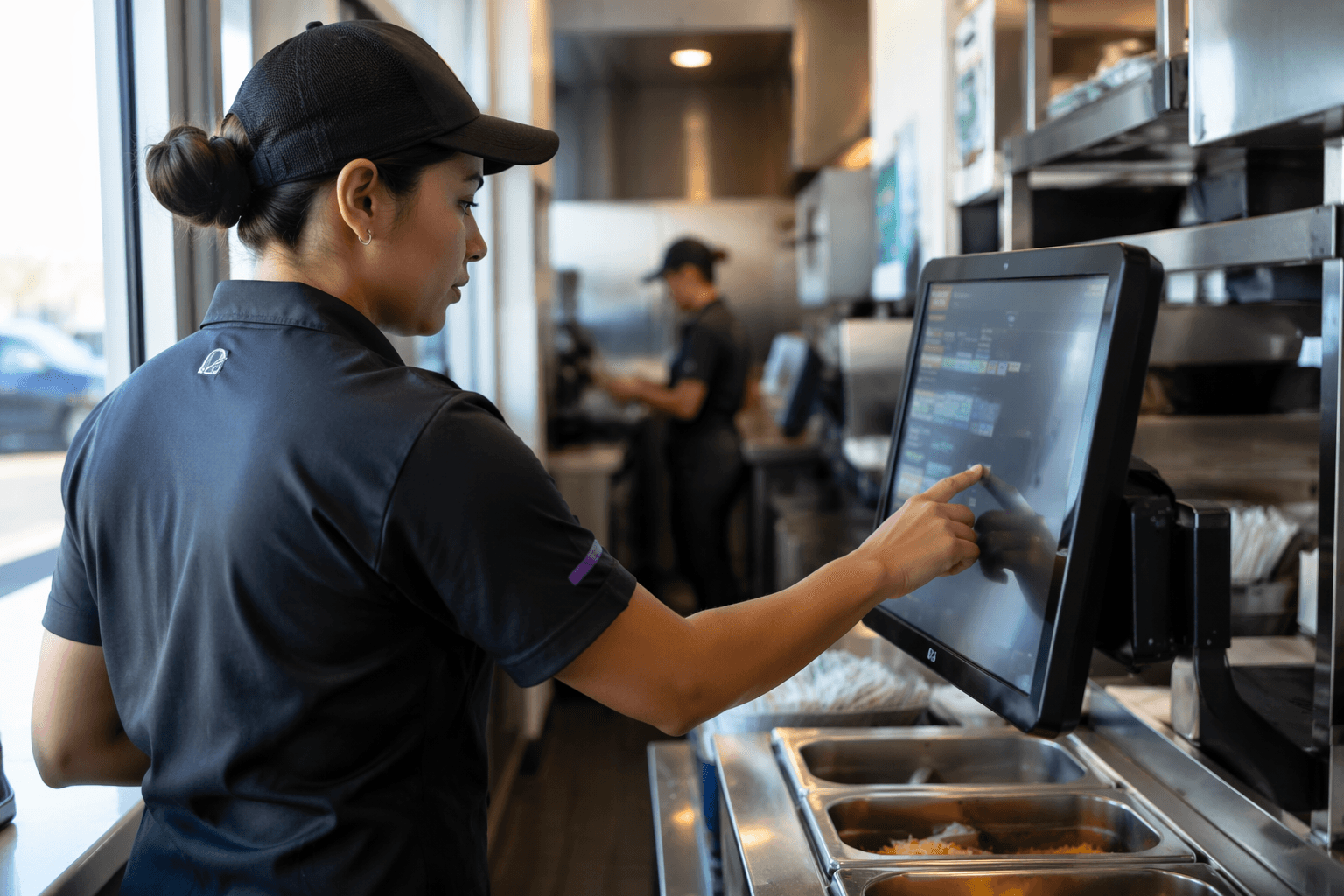
At the National Restaurant Show in Chicago, the big takeaway was not that restaurants are experimenting with AI. It was that AI has moved into the operating model, touching ordering, payments, customer relations, kitchen management, maintenance, labor optimization, delivery, inventory, and loyalty. For Taco Bell workers, that means the future is not some distant robot kitchen. It is a store where speed, accuracy, and consistency are increasingly managed through software, screens, and automated workflows.
That matters because Taco Bell has spent years building toward this. The brand is already one of the clearest examples of a fast-food chain using digital tools to shape how stores run, how teams are staffed, and how much work gets pushed onto the line versus handled by technology. The restaurant tech on display in Chicago looked less like a surprise and more like a preview of the pressure points crews already know: drive-thru pace, order accuracy, device upkeep, and the constant need to keep service moving when multiple channels hit at once.
Which tasks are most likely to be automated
The tools on the show floor pointed to a fairly clear pattern. Some of the most routine parts of restaurant work are the easiest to automate or partially automate, especially when they involve repeated decisions or predictable flows. That includes conversational voice ordering, biometric verification, digital menu management, payment processing, loyalty prompts, and some kitchen-routing functions. Robotic food prep may get the headlines, but for a Taco Bell team the more immediate change is often less dramatic and more practical: fewer manual steps in taking, routing, and updating orders.
Byte by Yum! shows how broad that shift already is. Yum! Brands introduced the platform on February 6, 2025, as an AI-driven SaaS system for Taco Bell and its sister brands. It covers online and mobile ordering, point of sale, kitchen and delivery optimization, menu management, inventory and labor management, and team-member tools. In plain terms, that means tasks once handled by a manager walking the floor or a crew member juggling screens can now be pushed into a connected system.
For workers, the promise is not that AI replaces the whole job. It is that the most repetitive parts of the job may be absorbed into the software stack, freeing some time and cutting some mistakes. The catch is that once the software takes over the easy pieces, the remaining work often gets more complex, not less.
What still falls on crew and shift managers
The show review made a point that should sound familiar to anyone who has run a busy Taco Bell line: the real test is whether a tool works in a live restaurant under pressure. A system can look impressive on a demo table and still fall apart when the lobby is full, the drive-thru is stacked, mobile orders are piling up, and a machine needs troubleshooting.
That leaves a lot of work in human hands. Crew still have to handle exceptions, fix order mistakes, manage customizations, clean and reset equipment, and keep guests moving when technology slows down instead of speeding up. Managers also have more on their plate. They are the ones who have to decide whether a new tool actually simplifies operations, whether it improves visibility, and whether it survives the real-life mess of a lunch rush.
The labor side matters too. Byte by Yum! includes labor management, which means scheduling and staffing decisions are becoming more data-driven. That can help a shift manager avoid undercutting a busy day, but it can also raise expectations. If the system says a store can handle more volume with fewer hands, the pressure can shift from “find enough people” to “get more out of the people you have.”
Taco Bell is already deep into the rollout
This is not a company waiting to see whether the technology works. On July 31, 2024, Yum! said Voice AI was already in more than 100 Taco Bell U.S. drive-thrus across 13 states, with hundreds more targeted by the end of 2024. Yum! said the system had been fine-tuned and tested for more than two years before the wider rollout. Lawrence Kim, Yum!’s chief innovation officer, and Taco Bell chief digital and technology officer Dane Mathews framed the technology as a way to improve both team-member and consumer experiences while reducing wait times and improving order accuracy.
Taco Bell’s kiosk story goes back even further. Deloitte Digital’s case study said the company tested a kiosk in one store, learned from customer preferences and usability, and then planned to roll the concept to more than 6,500 locations by 2020. The goal was not just self-service for its own sake. It was to free staff to focus more on kitchen efficiency and guest service while customers handled more of the ordering experience themselves. Rafik Hanna, in that case study, described the model as letting customers explore and customize meals while team members focus on making food and servicing the restaurant.
That long arc helps explain why Taco Bell’s 2025 numbers matter. The company said 2024 operating profit hit $1 billion for the first time, digital sales rose 32% to $6 billion, and total locations reached 8,757 after 347 gross-new openings across 25 countries. Taco Bell also said it was moving ahead with R.I.N.G. The Bell, short for Relentlessly Innovative Next-Generation Growth. In other words, the business is not treating tech as a side experiment. It is treating tech as part of growth strategy.
What this means for labor pressure, not just labor savings
The most important question for workers is whether AI lowers the strain on a shift or simply raises the output target. The answer, so far, looks like both. Voice ordering and kiosks can cut some repetitive labor and improve consistency. Inventory, labor, and kitchen tools can make managers more informed. But the company still expects the store to move faster, handle more channels, and keep the guest experience smooth.
That is why speed remains the real benchmark. QSR Magazine reported in October 2025 that automated voice ordering was live in 600 Taco Bell restaurants, and that Taco Bell had led the QSR Drive-Thru Report in speed of service for five straight years, with an average drive-thru time of 256.81 seconds. Those numbers show what the technology is really for: not just reducing effort, but protecting pace.
Yum! says it has more than 61,000 locations worldwide, and it called itself NVIDIA’s first AI restaurant partner in March 2025, underscoring how much scale sits behind these tools. For Taco Bell, that means the next phase of AI is not about replacing the crew. It is about redefining what the crew is expected to handle, and how much throughput a store is supposed to deliver with every shift.
This article was produced by Prism’s automated news system from verified source data, official records, and press releases, then run through automated quality and moderation checks before publishing. The system is built and supervised by the people who set the standards it runs under. Read our full AI policy.
Know something we missed? Have a correction or additional information?
Submit a Tip%2Fstory1%2F2712091%2Fcdae282a9f57fd1d1304b80820f661139187.jpg&w=1920&q=75)