Hadley Trader Joe’s Crew Organized After Cut to Retirement Contributions
In June 2022 long-tenured crew members at the Trader Joe’s in Hadley, Massachusetts organized after learning the company had scaled back its retirement contribution, a change that reignited broader concerns about staffing, workplace injuries, and wages lagging behind inflation. More than 30 percent of nonmanagement staff signed union cards and employees moved toward a National Labor Relations Board petitioning process, raising questions about benefits, safety and labor relations at the store and beyond.

On June 9, 2022, crew members at the Trader Joe’s location in Hadley, Massachusetts began an organized effort after discovering the company had reduced the level of its retirement contribution. The cuts, employees said, represented a significant rollback from a long-standing practice of company contributions that had historically amounted to about 15 percent, and they became the immediate catalyst for an organizing drive led by long-tenured staff.
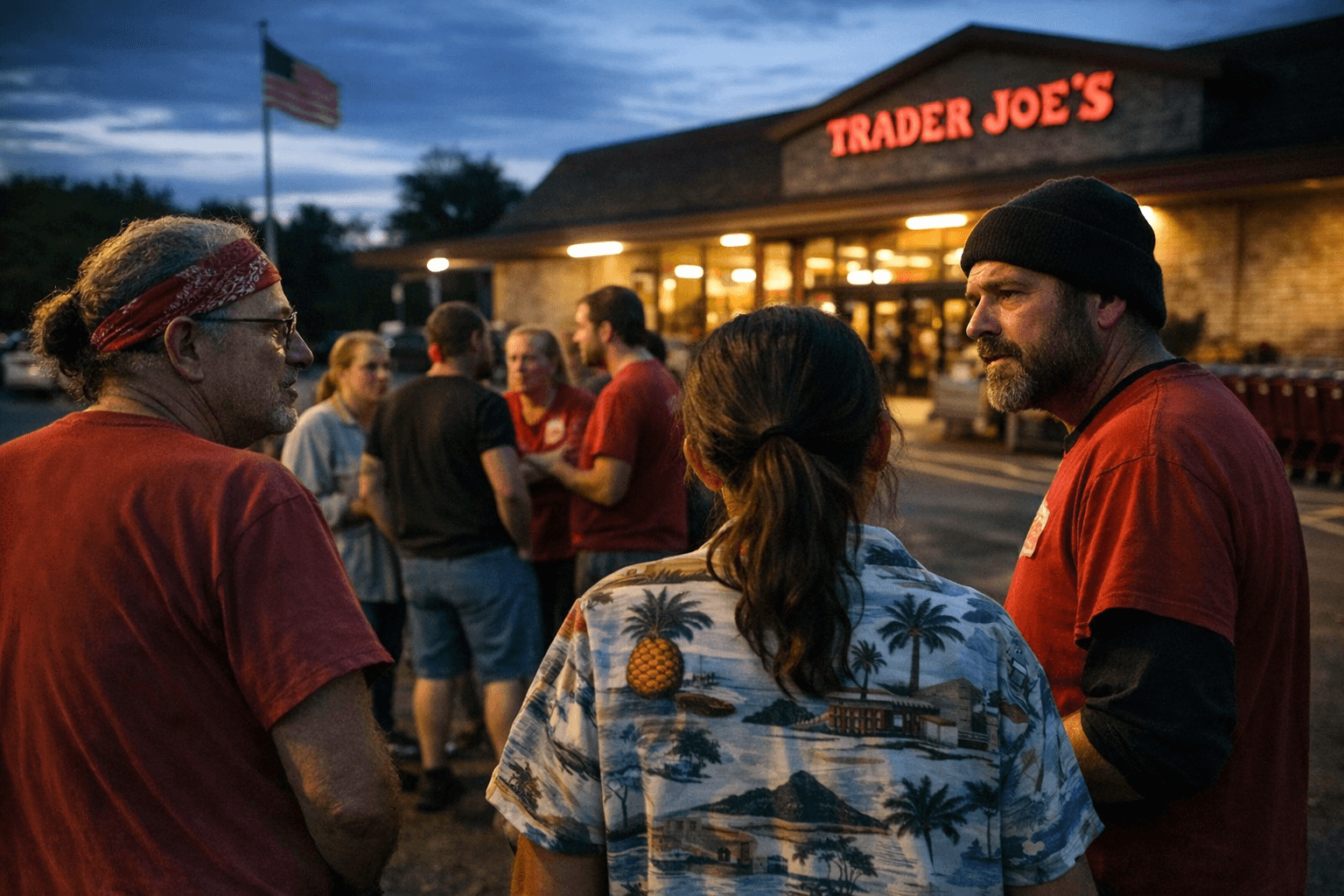
Organizers described the move as part of a broader set of grievances. Alongside the retirement change, workers cited chronic understaffing, a rise in workplace injuries and wages that had not kept pace with inflation as central motivating factors. The combination of benefit reductions and day-to-day working conditions prompted nonmanagement employees to collect union authorization cards; more than 30 percent of that group signed cards during the initial campaign.
The drive advanced into formal steps commonly used by workers seeking collective representation, with employees preparing to engage the National Labor Relations Board for a petitioning process that can lead to an election. Management at the store responded with warnings about visible union insignia, including restrictions on wearing union pins. Those warnings heightened tensions on the sales floor and underscored the practical risks crew members weighed when deciding to organize.
The Hadley effort reflected a wider pattern in retail and foodservice workplaces, where recent years have seen renewed union interest at companies such as Starbucks and Amazon. For workers, the Hadley campaign illustrated both the potential leverage that organized labor can provide in bargaining over benefits and the personal stakes involved in stepping forward. For management, the episode highlighted how benefit adjustments and operational pressures can trigger labor unrest even at companies with reputations for strong crew relations.
If the petitioning process had led to a union election and eventual recognition, collective bargaining could have opened the door to restoring retirement contributions or negotiating alternative compensation or safety improvements. Even without a formal union, the organizing push aimed to draw public attention and increase pressure on company leadership to reconsider the benefit changes and address staffing and safety concerns.
The Hadley organizing drive showed how a single policy change, in this case a scaled-back retirement contribution, can cascade into a broader labor campaign, reshaping workplace dynamics and forcing both employees and employers to confront unresolved questions about compensation, benefits and worker safety.
Know something we missed? Have a correction or additional information?
Submit a Tip