March JOLTS Data Signals Mixed Labor Market Outlook for Trader Joe's Hiring
Retail trade layoffs jumped 72,000 in February while national hires fell to 4.8 million, giving Trader Joe's Captains a wider applicant pool this spring but a trickier retention math.

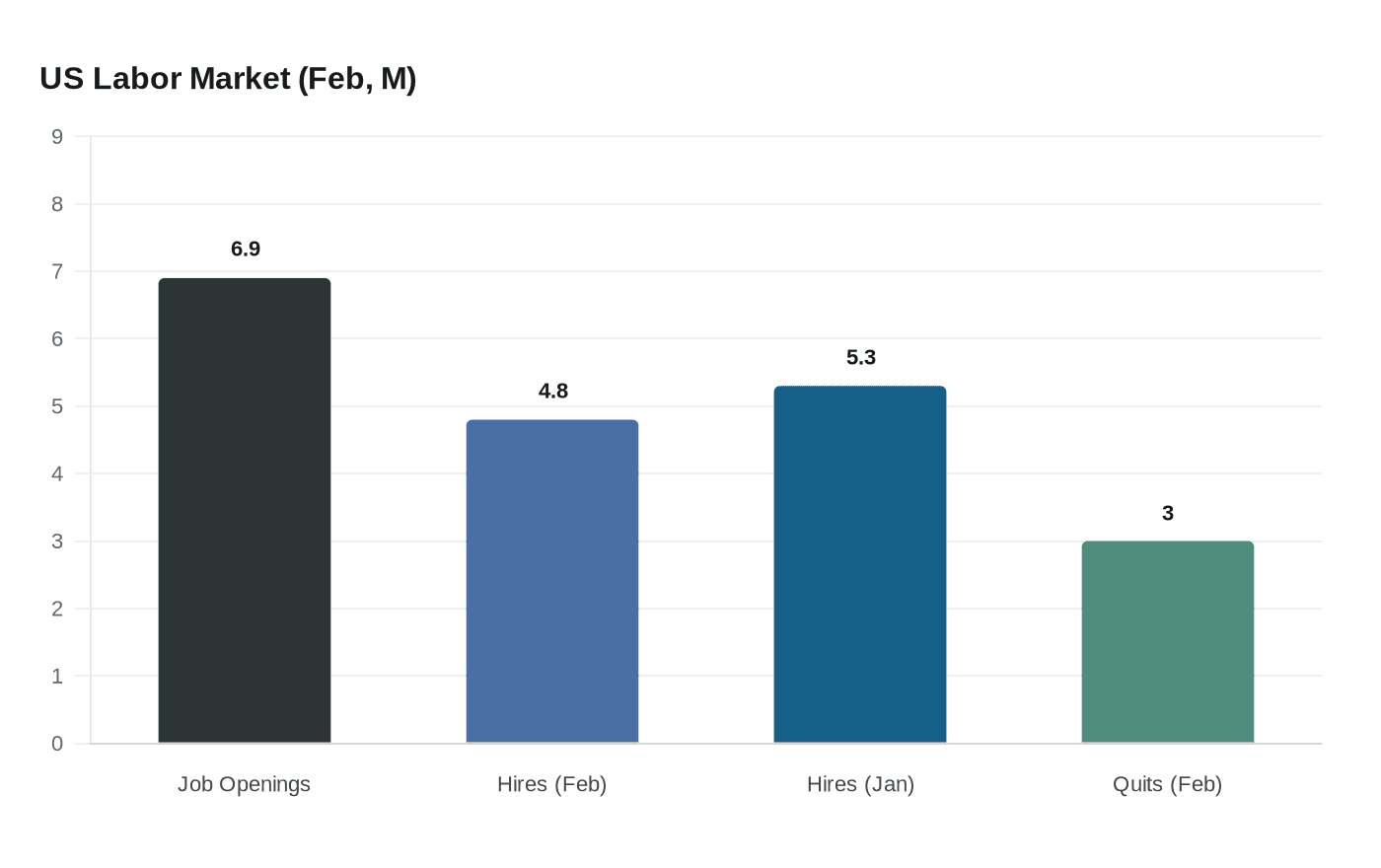
The Bureau of Labor Statistics dropped its March 31 JOLTS report, and the headline number for grocery retail isn't the 6.9 million total job openings sitting across the U.S. economy. It's the widening gap between openings and actual hires, and what a spike in retail-sector layoffs means for who's walking into a Trader Joe's job fair this month.
Nationally, hires fell to 4.8 million in February, down nearly 500,000 from a January figure the BLS revised upward to 5.3 million. That puts the openings-to-hires gap at roughly 2.1 million, meaning employers are posting jobs faster than they're filling them. For Captains weighing whether to run a large hiring class or hold steady, that ratio is a critical pressure point: it signals competitors haven't stopped looking for workers, even as fewer people are being brought on board. Hiring activity is also down 387,000 over the prior year, reinforcing a "low-hire" cadence that typically lengthens time-to-fill for front-line roles.
The more actionable number for Trader Joe's store-level planning is the 72,000 jump in retail trade layoffs and discharges recorded in February. That surge, the sharpest industry-level discharge move in the release, is pushing a fresh wave of experienced retail workers into the applicant pool just as Trader Joe's enters its spring triangle of new-store openings, product drops, and extended seasonal hours. Retail openings also ticked up 24,000 from January to February, confirming that the sector is still adding positions even while shedding workers elsewhere, a pattern that compresses the window stores have to act on qualified candidates before competitors snap them up.

The national quits reading tells a different story. At 3.0 million, quits were little changed and remain below January levels after falling 157,000 over the month. A declining quits rate generally signals that workers feel less confident about finding a better job elsewhere, which is a retention tailwind for Trader Joe's. Crew who might have tested the market during the post-pandemic hiring surge are staying put in February's climate. That dynamic reduces the risk of scheduling volatility from unexpected walkouts but does not eliminate the overtime pressure that comes with any store running lean while a new hire class is in training.
District teams tracking these numbers should weigh the divergence carefully. More applicants from retail layoffs means larger candidate pools, but those candidates arrive mid-season, when training bandwidth is already stretched. Stores that let hiring outpace their training capacity historically see turnover accelerate within 60 to 90 days of a large hiring class, precisely the window that would overlap with summer schedule builds. Captains in growth corridors where openings remain elevated against local unemployment should consider smaller, more frequent hiring classes rather than waiting for a single large event, comparing regional JOLTS figures against actual applicant flow before committing to an advertising spend on weekend-only or part-time-minimum-hours postings.
The next JOLTS release, covering March 2026 data, is scheduled for May 5. By then, the spring staffing picture will be clearer, but the February signals already point toward a market where Trader Joe's above-market pay and predictable scheduling remain genuine differentiators, not just talking points, in a retail sector where layoffs and hiring are moving in opposite directions at the same time.
This article was produced by Prism’s automated news system from verified source data, official records, and press releases, then run through automated quality and moderation checks before publishing. The system is built and supervised by the people who set the standards it runs under. Read our full AI policy.
Did this article answer your question?