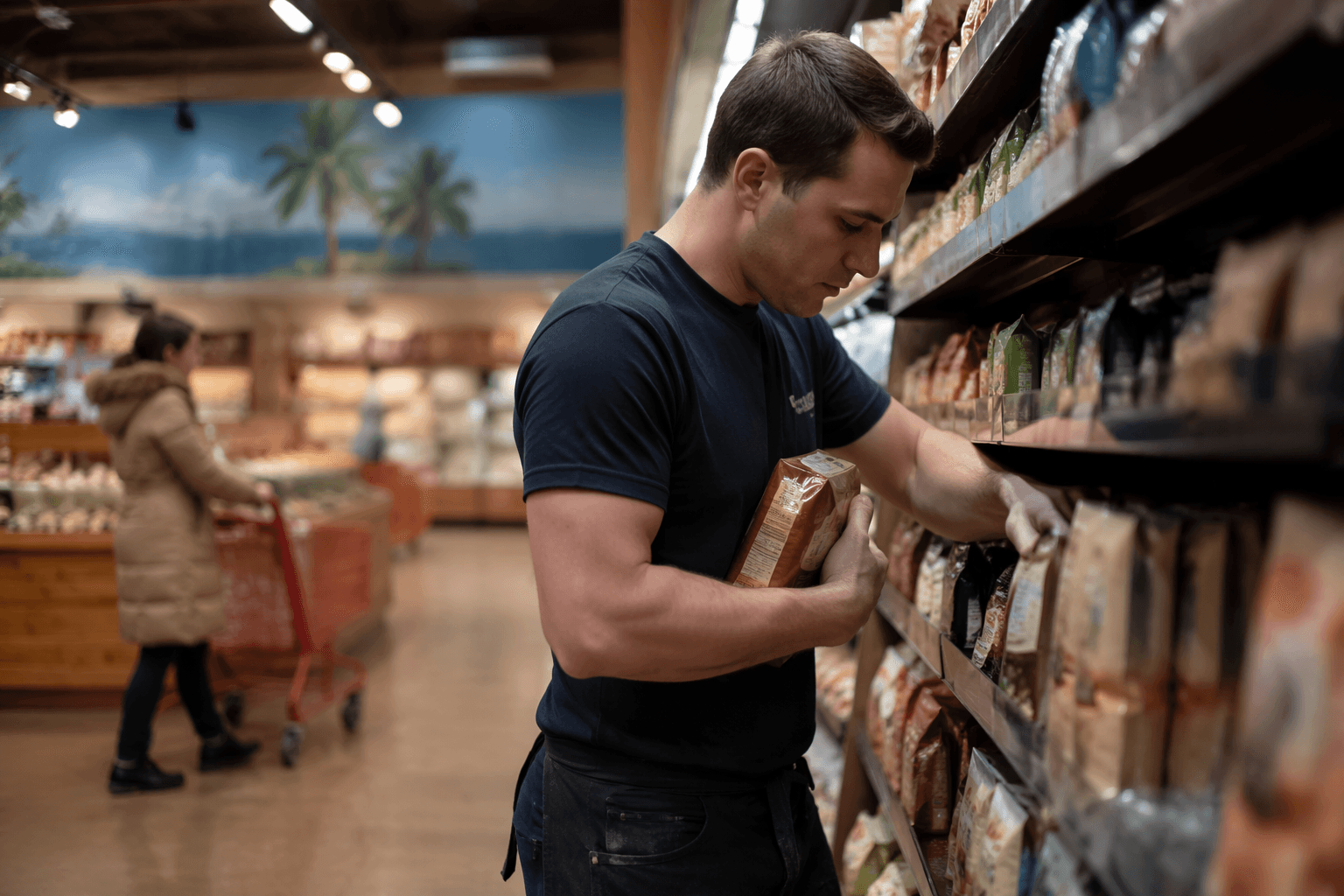
Wharton report spotlights Trader Joe's labor strategy, staffing, training, automation
Wharton’s grocery labor report says staffing, training, and automation have to be designed together. For Trader Joe’s, that lands directly on scheduling, cross-training, and the store floor.

Trader Joe’s physical-store model makes one thing hard to dodge: staffing, training, and automation are not separate decisions. The Wharton report on grocery labor is useful here because it treats labor as an operating system, not a line item, and that is exactly how a Trader Joe’s store succeeds or fails.
What the Wharton report is really saying
The report, published in final form in June 2024, looks at evolving store labor practices at leading, mostly grocery retailers. Its big takeaway is not abstract theory. It centers on practical problems like setting staffing levels, reducing labor through process improvement and automation, training, backroom-to-shelf replenishment, e-commerce fulfillment, and leadership.
Three themes run through it. First, labor market conditions have been difficult and are unlikely to get easier soon. Second, grocers need to rethink their approach to online grocery. Third, labor should be treated as an asset to leverage, not just a cost to bear. For anyone managing a store, the message is blunt: the labor model has to be built to withstand demand swings, not just minimize hours on paper.
That matters because the report is really describing how stores function minute by minute. If staffing is too thin, a spill, a rush, or a sudden product move can unravel the whole floor. If automation is rushed in without training, it can create more work instead of less. If onboarding is weak, the store loses the ability to cross-train people fast enough to keep service standards high.
Why Trader Joe’s is a direct test case
Trader Joe’s sits in a different lane from the big grocery chains that built omnichannel fulfillment armies. It says it does not sell products online, does not offer curbside pickup or delivery, and does not work with third-party delivery services like Instacart or Dumpling. That leaves the store itself as the entire customer experience, which makes labor decisions even more important.
The company’s careers materials describe its workforce as Crew Members, Merchants, Mates, and Captains. Mates are assistant store leaders who work alongside the Crew while providing training, guidance, and development. That structure tells you a lot about how Trader Joe’s thinks the store should run: the people on the floor are not just stocking product, they are actively managing service, speed, and morale at the same time.
This is where the Wharton framework maps cleanly onto daily operations. Crew scheduling is not just about filling a shift. It is about making sure the right mix of people is in place to cover checkout, product movement, customer questions, and recovery after a rush. Cross-training is not a nice-to-have. It is the difference between a store that flexes smoothly and one that freezes when one person calls out.
What breaks when labor is treated as a cost
A labor-as-cost mindset sounds efficient until the store gets busy. Then the hidden costs show up in missed replenishment, slower lines, weaker product knowledge, and fewer people available to solve problems before they spread. Trader Joe’s brand depends on a store team that can move quickly without making the customer feel rushed, and that requires enough labor capacity to absorb real-world variation.
The Wharton report’s emphasis on process improvement and automation is useful here too, but only if stores resist the temptation to treat automation as a substitute for labor discipline. At a specialty grocer like Trader Joe’s, automation cannot replace the human parts of the model that customers notice most: product recommendations, fast adaptation to new items, and the sense that the crew knows the floor well enough to guide shoppers.
That is why training budgets matter as much as headcount. If onboarding is compressed, cross-training gets thinner. If cross-training gets thinner, scheduling gets more brittle. If scheduling gets more brittle, customer-service expectations become harder to meet without burning out the same people over and over.
The broader grocery backdrop is changing the stakes
The report lands at a moment when grocery labor is being pulled in several directions at once. The Bureau of Labor Statistics noted that grocery stores came out of the pandemic with expanded services such as curbside pickup, online ordering, and self-checkouts. Accenture has also said grocers were facing rising energy, labor, and purchasing costs while inflation changed consumer behavior and pushed shoppers toward downtrading.
Trader Joe’s has largely chosen not to play the same game as omnichannel competitors, but that does not make the industry shifts irrelevant. If anything, they raise the bar for in-store execution. A chain that leans into a curated assortment and in-person service has to make sure labor is deployed where it creates the most value: on the sales floor, in the backroom, and in the handoffs between the two.
Scale makes that challenge real. Trader Joe’s said it had more than 500 stores in 42 states, and Grocery Dive reported that it started 2025 with 579 stores across 42 states and Washington, D.C., after opening 34 new stores in 2024. Growth like that means the labor model is not just a philosophy. It has to be repeatable across hundreds of locations.
Union fights show why the labor model is also a workplace issue
The labor strategy question at Trader Joe’s is not happening in a vacuum. The company has faced multiple union campaigns, and the first unionized store in Hadley, Massachusetts, voted to join Trader Joe’s United in July 2022. By November 2024, those workers still had not reached a contract, a sign that winning an election is only the first step in a much longer fight over standards, scheduling, and workplace control.
The National Labor Relations Board has also documented contested outcomes elsewhere. In Chicago, the tally was 70 votes for and 70 against the union, with challenges determinative. In Louisville, workers voted 48 for and 36 against. In Boulder, the union lost 66 to 94. Then in 2025, an NLRB administrative law judge ruled that Trader Joe’s East Inc. violated federal labor law by refusing to begin bargaining with Louisville workers.
Those cases matter operationally because they show how staffing, training, and scheduling become labor-relations issues the moment workers believe the store is running too lean or too rigidly. A store can have a polished customer experience and still create friction if the people delivering it feel they are absorbing too much risk without enough support. Trader Joe’s United, which describes itself as an independent labor union founded and powered by Trader Joe’s workers, has made that tension part of the company’s public story.
What matters for the floor now
For Trader Joe’s managers, the Wharton report is a reminder to treat workforce planning as a system. Staffing levels should match traffic and complexity, not just a labor budget. Training should prepare people to move between registers, shelves, and backroom tasks without losing the Trader Joe’s tone. Automation, where it exists, should reduce friction rather than push more work onto fewer people.
For crew members, the practical test is simple. If the store is well designed, cross-training makes the day easier, not harder. If it is poorly designed, every missing person ripples through the whole shift. Trader Joe’s has built its reputation on making a labor-intensive model feel warm, fast, and distinctive. The companies and stores that last are the ones that remember that labor is not the thing to squeeze until it disappears. It is the thing that makes the model work at all.
This article was produced by Prism’s automated news system from verified source data, official records, and press releases, then run through automated quality and moderation checks before publishing. The system is built and supervised by the people who set the standards it runs under. Read our full AI policy.
Did this article answer your question?