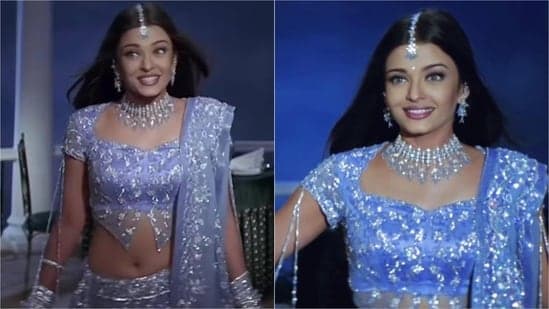
Aishwarya Rai’s lavender-blue Dil Ka Rishta lehenga remains a bridal icon
Aishwarya Rai’s lavender-blue lehenga still feels radical because it softens bridal drama without losing it. Neeta Lulla’s organza, sequins and custom jewelry make the look a blueprint, not a relic.
The color that still cuts through the bridal crowd
Aishwarya Rai’s lavender-blue lehenga remains so memorable because it refuses the usual bridal script. In a market still crowded with red, maroon and blush, this shade reads as polished, luminous and slightly surprising, the kind of color that looks expensive before you even notice the embroidery. Neeta Lulla’s genius was not just choosing a pastel, but giving it enough structure, sheen and ornament to feel ceremonial rather than soft-focus.
That balance is why the look has lasted. It is romantic, but not sugary. It has the emotional pull of a film moment and the discipline of couture dressing, which is exactly why brides still return to it when they want something different without abandoning grandeur.
Why the look still feels modern
The appeal of the Dil Ka Rishta lehenga is that it behaves like a bridal alternative, not a costume from another era. Lulla said the look became a bridal moodboard before Pinterest existed, and that description lands because the outfit functions like a template: color first, then texture, then restraint. The result is a palette that feels current in a season when brides are increasingly moving toward refined jewel tones, softer metallics and lighter handwork.
Aishwarya’s eyes, Lulla said, suited the color particularly well, and that matters more than it sounds. Lavender-blue is not a universal bridal default. It flatters when the wearer has warmth in the skin, clarity in the features, or a face that can carry cool tones without flattening out. That is why the palette works so well for brides who want something airy but not washed out, especially if they are drawn to elegance over overt saturation.
The construction details that make the lehenga work
The outfit’s staying power is rooted in construction, not just color. Lulla described the lehenga choli as being made in organza, a fabric choice that gives the look lift and translucence without making it flimsy. The kurti-like blouse structure, with its central slit, shapes the body in a way that feels deliberate and contemporary, keeping the silhouette from reading as overly conventional.
Then there is the embroidery, which is where the look earns its bridal credibility. Lulla said it used light water sequins in self colour, light blue and very light silver, a palette that lets the surface catch light without becoming noisy. That is the key lesson for modern brides: when the base tone is soft, the embellishment has to be controlled. Too much contrast would have broken the spell; too little would have made the lehenga disappear.
How to wear pastel jewel tones without losing bridal impact
Pastel jewel tones work best when they are treated like proper ceremony colors, not as a compromise. Lavender-blue has the depth of a jewel tone in a lighter register, which means it can carry a bridal look if the fabric and workmanship are substantial enough. Organza, fine sequin embroidery and a tailored blouse all help it register as occasion wear rather than party dressing.
- choosing jewelry that echoes the embroidery instead of competing with it
- using silver, pale diamond or pearl accents rather than heavy gold if the lehenga is cool-toned
- keeping the makeup polished and luminous, not overly bronzed
- letting the silhouette stay clean so the color and surface detail remain visible
The most effective styling approach is to let the color do the work and keep the rest disciplined. That means:
This is a look for brides who want softness with authority. It suits civil ceremonies, reception dressing, and even the wedding day itself if the setting is intimate, daylight-lit or designed around elegance rather than maximalism. The visual effect is less “look at the bride” and more “remember the bride,” which is a far more difficult thing to achieve.
The jewelry is part of the story, not an afterthought
One reason the lehenga still reads as complete is that Lulla did not stop at the garment. The jewelry was specially handcrafted in her atelier to complement the outfit, which is exactly how the best bridal looks are built. When jewelry is tailored to the embroidery, it can frame the face and shoulders without creating visual clutter.
That relationship matters especially for pastel bridal dressing, where the risk is always that the ensemble will look under-finished. Here, the handcrafted jewelry gives the lehenga its final authority. It turns the look from pretty to ceremonial, and that distinction is everything when you are trying to make a lighter palette feel worthy of a wedding stage.
Why this is more than a film reference
Dil Ka Rishta was released on January 17, 2003, directed by Naresh Malhotra and produced by Aditya Rai and Shabbir Boxwala under Target Films and Tips Industries Limited. But the lehenga outlived the film because it entered a different part of fashion memory: the bridal archive. Lulla described it as a look that launched a “Thousand Recreations,” and that phrase makes sense when you consider how often brides have borrowed its color logic and softened grandeur.
The Aishwarya-Lulla connection also predates this film moment. Earlier reporting notes that Lulla created Aishwarya Rai Bachchan’s pearl-encrusted mehendi lehenga and another outfit for her South Indian wedding ceremony in 2007. Lulla has said Aishwarya wanted her cultural roots reflected in her wedding look, and that the wedding outfit was woven especially for her. She also said the widely repeated Rs 75 lakh figure was not close to the real cost, a reminder that celebrity bridal mythology often grows larger than the garment itself.
A bridal icon because it solves a real style problem
What makes this lehenga endure is not nostalgia. It solves one of bridal fashion’s most persistent problems: how to look distinctive without looking disconnected from the ritual of getting married. Lavender-blue does that beautifully. It is gentler than red, cooler than blush, and more editorial than beige, which gives it unusual range across skin tones, settings and ceremony styles.
In a bridal landscape that often swings between tradition and spectacle, this look offers a third lane. It is cinematic, but wearable; custom, but accessible as an idea; iconic, but still useful. That is why Aishwarya Rai’s lavender-blue lehenga continues to feel less like a throwback and more like a blueprint for the bride who wants softness with a point of view.
This article was produced by Prism’s automated news system from verified source data, official records, and press releases, then run through automated quality and moderation checks before publishing. The system is built and supervised by the people who set the standards it runs under. Read our full AI policy.
Did this article answer your question?