Best Garment Steamers for Your Wedding Day, Ranked by Fabric Type
Wrong steamer on the wrong fabric can ruin a gown in seconds — here's exactly which machine to reach for, ranked by what your dress is actually made of.

There is no slower disaster in bridal prep than a steamer burn on a silk chiffon bodice thirty minutes before you walk the aisle. The fix isn't just having a steamer on hand; it's having the right one for what your dress is made of. Tulle and chiffon need barely a whisper of heat. Thick crepe and layered ball-gown skirts need power. And some fabrics, no matter what, should never meet steam at all. Consider this your fabric-first guide to the only steamer category where getting it wrong isn't an option.
Before you plug anything in, run the hidden-seam test: hold the steamer six inches from an inside seam allowance, release two short bursts of steam, and wait ten seconds. If the fabric puckers, beads with water, or changes sheen, back away and reassess your distance or setting. This thirty-second protocol has saved more gowns than any single product recommendation.
1. Conair Turbo ExtremeSteam Handheld: Best for Satin, Crepe, and Most Structured Bridal Fabrics
The Conair Turbo ExtremeSteam earns its Best Overall designation because it speaks every fabric's language. Powered by a 1875-watt generator with five steam settings ranging from delicate to supercharged turbo, it heats up in 40 seconds and delivers up to 20 minutes of continuous steam from a single fill. For satin, the delicate setting at a distance of 8 to 10 inches is the move: you get enough steam to release creases without the watermarks that plague brides who hold the head too close. For crepe, which can take more direct heat, step up to mid-range settings and work in smooth vertical passes from bodice to hem. The built-in 3-in-1 attachment includes a silicone band that helps you hold fabric taut while steaming, which matters enormously when you're working alone in a hotel bathroom. One firm rule: when you reach any section with embellishments or appliqué, lay a clean cotton cloth over the beading before you steam. The cloth diffuses the heat and captures condensation before it reaches glue adhesive underneath.
2. Rowenta X-Cel Steam+: Best for Heavy Fabrics, Layered Ball Gowns, and Destination Travel
Thick dupioni, heavy Mikado, and the kind of five-layer tulle ball gowns that arrive from the garment bag looking like they were packed in a suitcase by someone who actively disliked them: these are the jobs that expose the limits of low-wattage budget steamers. The Rowenta X-Cel Steam+ runs at 1600 watts with a steam output of 26 grams per minute and a heated ceramic-coated soleplate that brings near-iron efficiency without the contact damage. It heats up in 40 seconds and holds 190ml of water in a removable tank for 10 minutes of continuous steaming. For layered skirts, work from the innermost layer outward, lifting and steaming each tier rather than attacking the outside surface. The heated faceplate is a particular advantage here: gently placing it against a crease in a thick structured fabric transfers heat the way a handheld-only steamer simply cannot. Its 190ml tank is also refillable directly from a sink, which matters at venues where outlets are fifteen feet from the nearest counter. The one caveat for destination brides: the Rowenta's ceramic soleplate can spit water droplets at startup if you tilt the unit before it reaches operating temperature. Let it heat upright, release one test burst away from the gown, and then begin.
3. HiLife Steamer: Best for Delicate Fabrics Including Chiffon, Tulle, Silk, and Lace
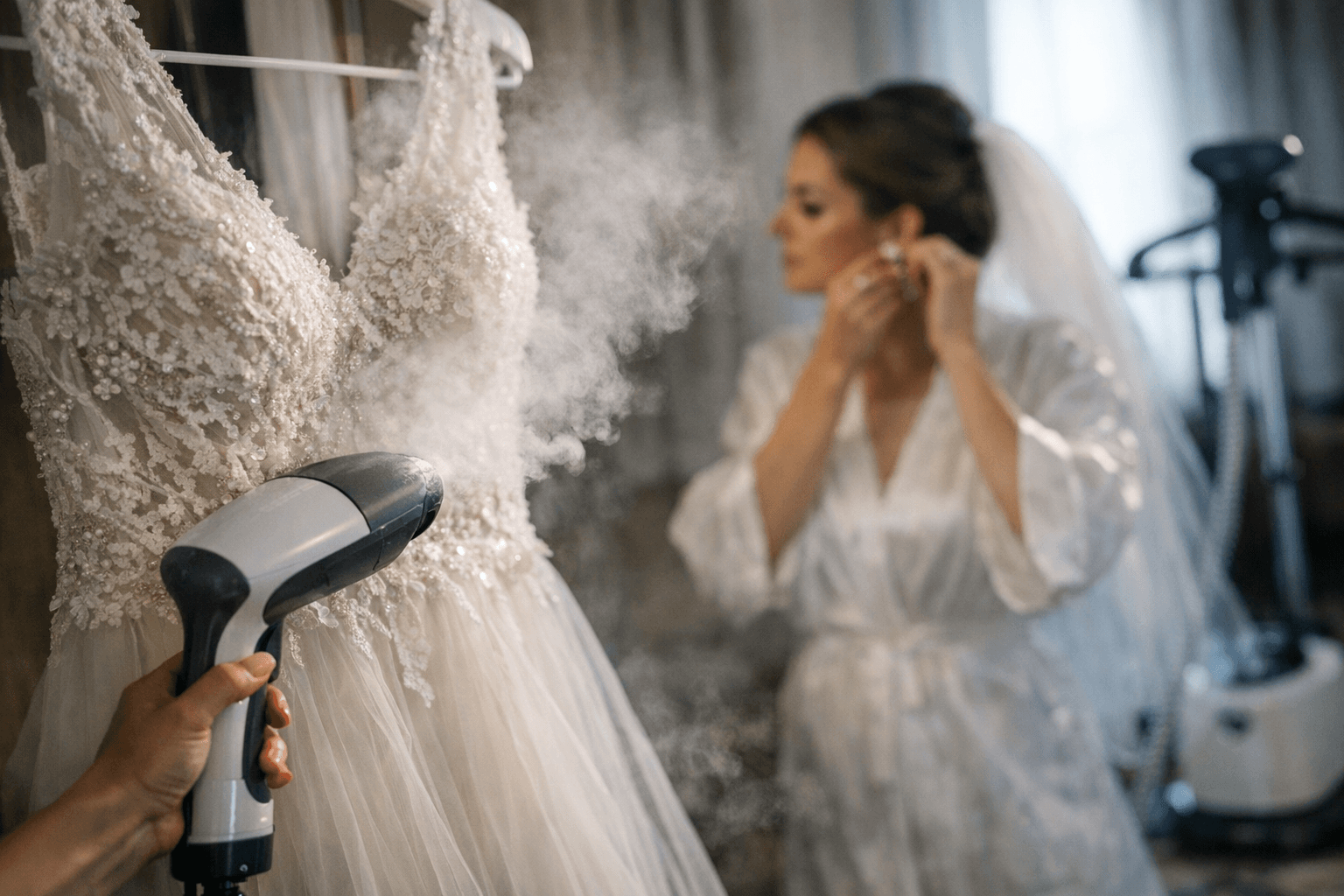
At 700 watts, the HiLife is the least powerful steamer on this list, and for the most delicate bridal fabrics, that is precisely the point. Chiffon, tulle, silk charmeuse, and fine lace do not need industrial heat; they need controlled, even moisture delivered from a safe distance. The HiLife's 240ml tank is the largest of the three picks here, offering more steaming time per fill, and it works across chiffon, silk, wool, cotton, linen, and nylon, covering the full spectrum of what a layered bridal gown typically incorporates. For tulle, hold the unit at least 12 inches away and use your free hand to gently fluff and separate the layers as you go — steam loosens the fibers but your hand does the actual reshaping. For lace, place a clean towel behind the panel to support its structure and steam in small circular passes rather than long strokes, which can distort the pattern. Delicate silk charmeuse needs a particularly light touch: use short bursts rather than continuous steam, and always keep the nozzle moving. One important note for destination brides: the HiLife is rated for 110 to 120 volt regions only, meaning it is not a safe pick for European or international venues without a proper voltage converter, not just a plug adapter.
The Do-Not-Steam List
Certain fabrics belong nowhere near a steamer, and the night before your wedding is not the time to learn this lesson the hard way. Sequined fabric is the most critical: direct steam can melt or warp plastic sequins, and glued sequins can detach when the adhesive softens. Velvet, including silk velvet, is another hard no unless you have a proper velvet board to steam against — direct steam without the board crushes the pile permanently. Taffeta, with its crisp hand and tight weave, watermarks on contact. Heavily beaded gowns with glued or hand-sewn embellishments should be steamed only by a professional bridal steamer if the beading is dense: the risk of loosening threads or weakening adhesive is too high for a DIY fix the morning of your wedding.
Veils, Timing, and the Professional Threshold
Veils need their own moment. Cathedral and chapel-length veils are more susceptible to wrinkling than most brides expect, especially those made from silk illusion or soft English net. Hang the veil vertically from a padded hanger at least 24 hours before the wedding if possible, and if it still needs steaming, work from the top edge downward using short steam bursts at a distance of at least ten inches. Never steam a veil laid flat — moisture pools and leaves rings. If your gown is a vintage couture piece, features silk velvet panels, or is so heavily embellished that you can't identify a safe test zone, skip the DIY entirely and budget for a professional bridal steaming service the morning of. A skilled alterations specialist can press a gown in 20 minutes with equipment and technique that no handheld unit can replicate. For everything else, the right steamer, the right distance, and the hidden-seam test are your safety net.
This article was produced by Prism’s automated news system from verified source data, official records, and press releases, then run through automated quality and moderation checks before publishing. The system is built and supervised by the people who set the standards it runs under. Read our full AI policy.
Did this article answer your question?