Bianca Jagger to Dua Lipa, the rise of suit brides
Bianca Jagger’s 1971 suit still reverberates because it gave brides permission to look like themselves. Dua Lipa’s Schiaparelli moment proves tailoring is now one of bridal fashion’s sharpest signatures.
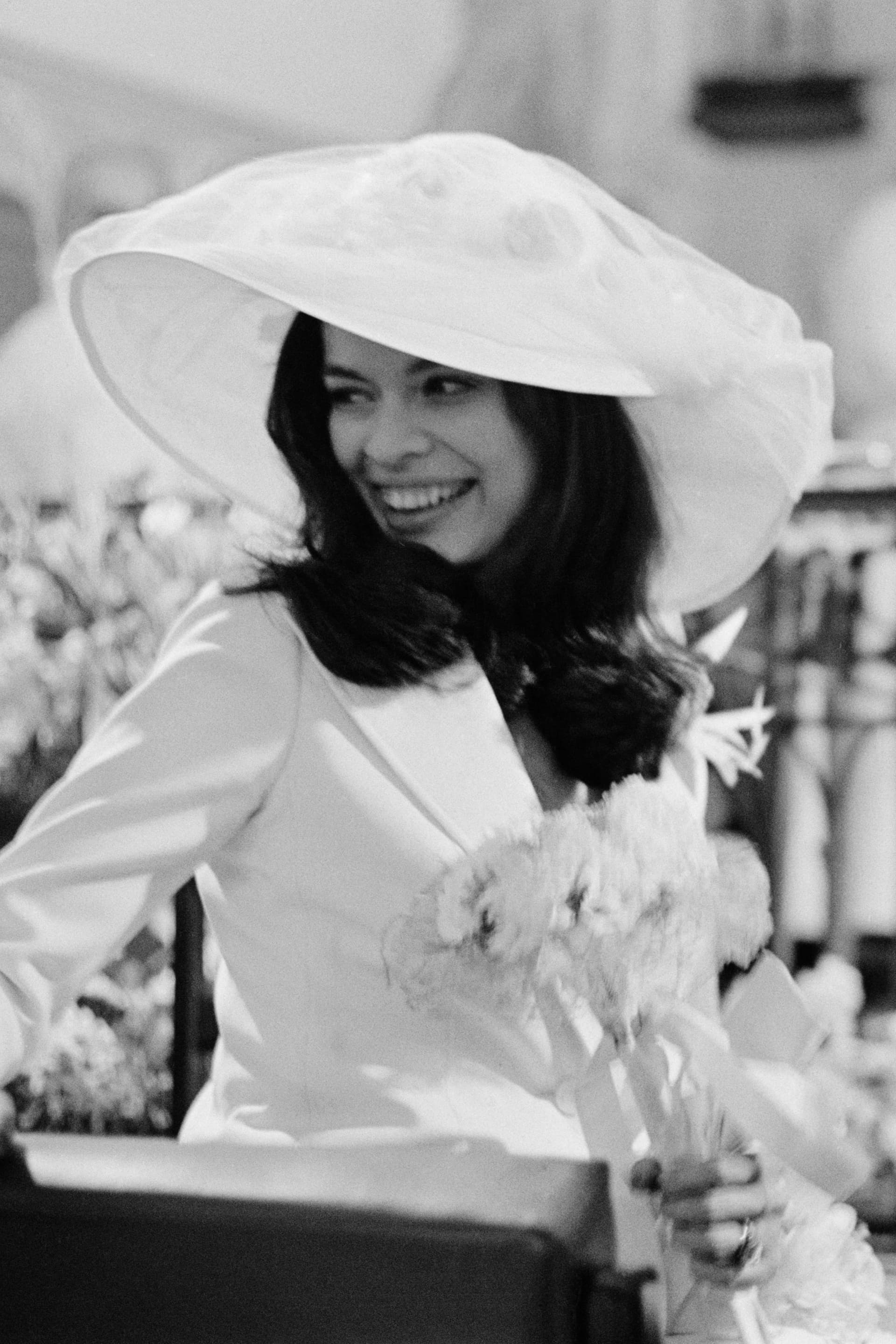
The modern suit bride has a lineage, and it begins with a woman who treated the wedding dress as optional. Bianca Jagger’s Saint-Tropez ceremony with Mick Jagger on May 12, 1971, in a Yves Saint Laurent wedding suit did more than break a rule: it rewrote the visual code of bridal glamour. More than five decades later, Dua Lipa’s custom Schiaparelli Haute Couture suit for her civil ceremony at Old Marylebone Town Hall in London on May 31, 2026, lands in that same register, where tailoring reads as identity rather than rebellion for its own sake.
The original disruption
Bianca Jagger’s wedding is still the blueprint because it was never shy about its own contradiction. The ceremony was a major media event from the start, and the look, whether remembered as a YSL Le Smoking-style tuxedo ensemble or as a piece caught in the long-running debate over whether Yves Saint Laurent or Savile Row tailor Tommy Nutter made it, became shorthand for nontraditional bridal dressing. That wrinkle matters: the argument over authorship only underlines how singular the image was, and how quickly it escaped the event itself to become a reference point.
What made the suit endure was not simply that it was white or tailored, but that it rejected the inherited script of bridal femininity. Bianca Jagger married in Saint-Tropez, not in a private studio or on a mood board, and the photograph of a bride in a suit moved from provocation to precedent. Long before bridal collections began treating suiting as a category, her look showed that a bride could choose sharp lapels, clean lines, and a decisive silhouette without losing the ceremony’s emotional charge.
Why the suit keeps returning
Bridal fashion returns to tailoring because it solves a problem that keeps changing with the bride. A suit can feel polished, sensual, and ceremonial at once, especially when it is cut with the precision usually reserved for red-carpet couture. It also offers a different kind of self-presentation: instead of borrowing the romance of a gown, it can project cool, authority, and ease.
That is why Harper’s Bazaar Arabia’s framing lands so cleanly. The most memorable brides, in this telling, are the ones who dress entirely like themselves. That idea has a commercial afterlife as well as a cultural one. Every time a high-profile bride chooses a suit, she expands the category of what is considered marketable bridal beauty, and every time a designer builds one with couture-level workmanship, the suit stops being a novelty and becomes a legitimate luxury proposition.
Dua Lipa and the new bridal silhouette
Dua Lipa’s London ceremony made the point with contemporary force. She married Callum Turner in a civil ceremony at Old Marylebone Town Hall wearing a custom Schiaparelli Haute Couture suit designed by Daniel Roseberry, and the connection to Bianca Jagger’s 1971 bridal tailoring was immediate. The reference was not subtle, and it did not need to be. The silhouette carried the same message as Jagger’s wedding suit: this is a bride who is not outsourcing her personality to a gown.
The Schiaparelli look also matters because it came through couture, not costume. A custom suit at that level turns tailoring into ceremony, with structure taking the place of volume and the line of a jacket carrying the emotional weight that a train or veil usually would. In bridal terms, that is a significant shift. The bride is no longer defined by tulle alone, but by cut, proportion, and the confidence to let a sharply tailored shape stand in for the entire fantasy.
The second look and the craft behind bridal spectacle
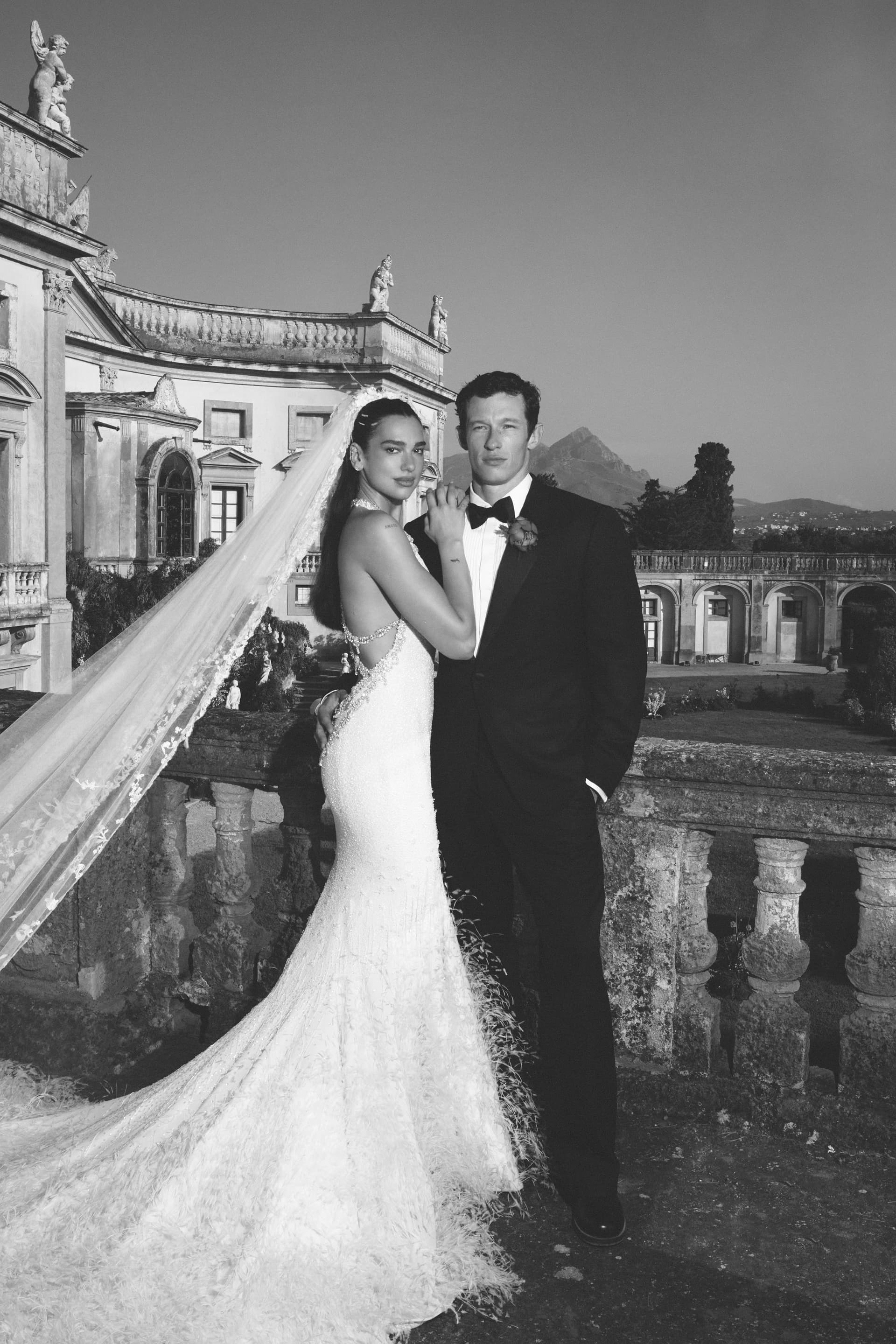
Lipa’s later images from Sicily widened the story rather than softening it. At Villa Valguarnera, she wore a custom Chanel Haute Couture wedding gown, a reminder that even the most suit-minded bride may still want a second act in full bridal register. The gown was made in Chanel’s Paris ateliers and required more than 1,000 hours of embroidery, including 480,000 hand-applied beads, 25,000 feathers, and a six-meter veil.
Those numbers are not just a flex. They show how bridal fashion now moves between two poles: the crisp authority of tailoring and the maximal labor of couture embellishment. Chanel’s gown, with its beads, feathers, and long veil, sits at the opposite end of the spectrum from the Schiaparelli suit, yet the two looks belong to the same modern bridal story. Both are exacting, both are authored by a major fashion house, and both insist that bridal dress can be personal without being conventional.
What the suit bride has changed
The long afterlife of Bianca Jagger’s suit is not about copying a single outfit. It is about the freedom that outfit made visible, and the fact that freedom keeps being renewed by new brides, new houses, and new celebrity moments. In 2026, Dua Lipa’s Schiaparelli ceremony showed that tailoring no longer reads as an anti-bride gesture. It reads as one of the most desirable options in the bridal vocabulary.
That shift has practical consequences for fashion, because every time a bride chooses a suit, she enlarges the market for bridal tailoring, sharp separates, and silhouettes that borrow from menswear without losing elegance. It also changes the emotional pitch of the wedding image itself. A suit can feel intimate, decisive, and unapologetically modern, which is exactly why it keeps resurfacing in celebrity weddings and couture collections alike.
How to read the modern suit bride
When the suit works in bridal fashion, it does a few things at once:
- It gives structure where a gown would give volume, using lapels, shoulder line, and trouser cut to define the body.
- It makes the bride’s personality the focal point, which is why Bianca Jagger’s Saint-Tropez suit and Dua Lipa’s Old Marylebone Town Hall look feel so linked despite the decades between them.
- It allows designers like Daniel Roseberry to treat tailoring as couture, not as a compromise.
- It leaves room for a second look, as Lipa’s Chanel gown in Sicily proved, so the bride can move from sharp minimalism to full ceremonial fantasy.
That flexibility is the real story. The bridal suit has survived because it is not a trend in the disposable sense. It is a repeatable idea that adapts to the woman wearing it, from Bianca Jagger’s 1971 wedding in France to Dua Lipa’s 2026 ceremonies in London and Sicily. The white gown still has its place, but the suit now has history, glamour, and enough cultural memory to keep returning whenever brides want something that looks less borrowed and more like themselves.
This article was produced by Prism’s automated news system from verified source data, official records, and press releases, then run through automated quality and moderation checks before publishing. The system is built and supervised by the people who set the standards it runs under. Read our full AI policy.
Did this article answer your question?