How to preserve your wedding dress like a museum heirloom
The biggest preservation mistake is waiting. Clean the gown fast, then box it like an archive piece before sugar stains, humidity, and light start doing damage.
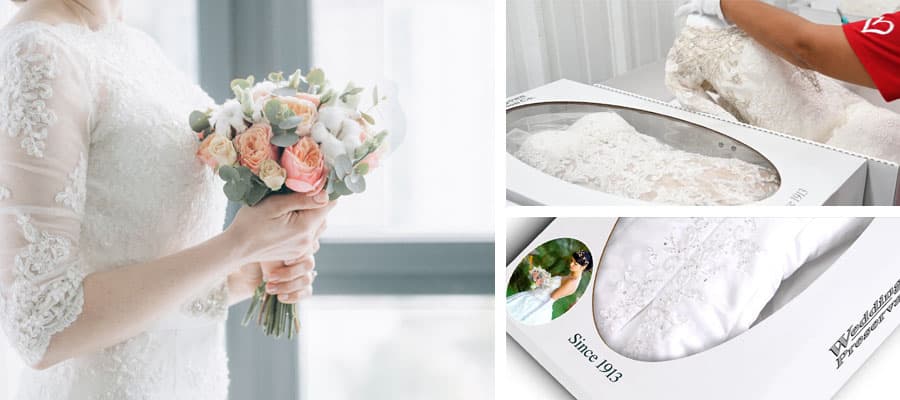
A gown can look spotless and still carry invisible sugar-based stains that brown over time. A careless fold, a burst of humidity, or a plastic container can start damaging the fabric long before the memory of the wedding fades.
Clean first, store second
The preservation clock starts the moment the dress comes off. The gown should go to a specialist within 1 to 2 weeks after the wedding for the best result, because old stains get harder to remove the longer they sit. At the Smithsonian Museum Conservation Institute, stain removal depends on the fiber type and finish, which is exactly why a wedding dress should be treated as a materials problem, not just a cleaning job.
A preservation-minded service is not just pressing and bagging a dress; it is cleaning it, checking for hidden staining, and then packaging it for long-term storage. The dress is often the most expensive item of clothing a bride owns, and preservation begins with professional cleaning, not storage.
What museum handling actually looks like
Museum conservation does not mean locking a gown away in some dramatic climate vault. It means boring, controlled conditions. Textiles should live in a clean, cool, dry, dark place with as little temperature and humidity fluctuation as possible, which immediately rules out attics and basements.
Smithsonian museums try to maintain collections at about 45% relative humidity, plus or minus 8%, and 70°F, plus or minus 4°F. Temperature, relative humidity, pests, and air quality all shorten the life of collections. For a wedding dress, the consumer translation is simple: keep it away from heat, dampness, and the kind of seasonal swings that come with storage spaces you never really visit.
Pack it like an archive, not a costume closet
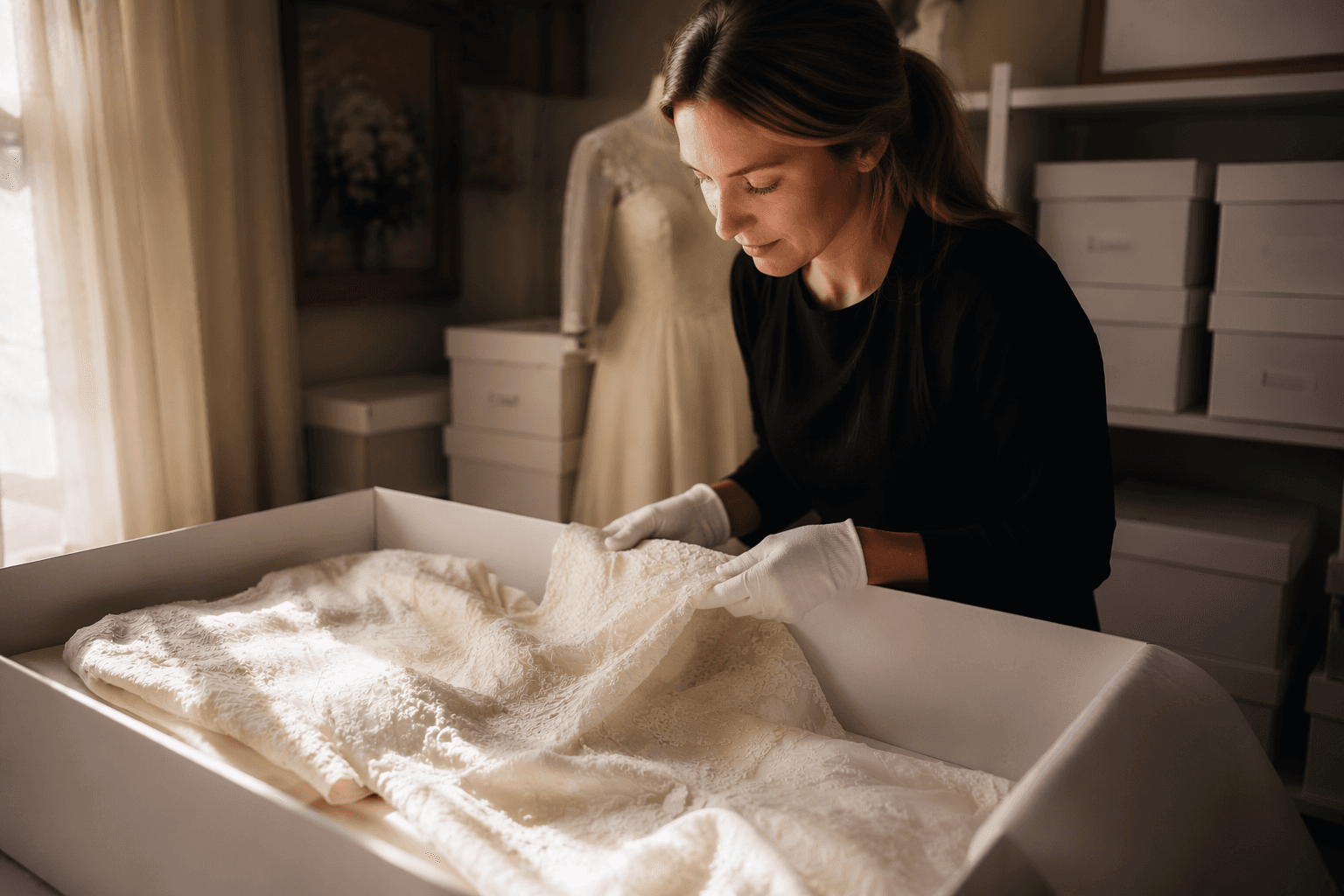
At the Smithsonian Museum Conservation Institute, textiles and costumes are often interleaved or rolled with acid-free tissue paper and stored in acid-free boxes to protect them from abrasion, handling, light, and dust. That is the preservation-grade standard, and it is much closer to how you would protect a paper archive than how most people think about clothing storage.
If folding is unavoidable, pad the folds with washed unbleached muslin or old sheets. That extra support keeps one hard crease from becoming a split in the cloth. Avoid direct contact with acidic paper, which can speed deterioration, and avoid airtight plastic containers, because trapped moisture can condense and damage the textile.
The Knot places the preserved gown in an acid-free, museum-quality chest. One current package also includes $1,000 shipping insurance and a lifetime warranty.
Choose the right tissue for the fabric, not the prettiest box
Neutral-pH, unbuffered acid-free tissue is recommended for general textile and costume storage, while buffered acid-free papers may be acceptable for cotton or linen but potentially harmful to silk or wool. That distinction matters because a wedding dress can be a mixed-material piece, and the wrong tissue can quietly do the wrong job.
If the gown is silk, wool, or built with delicate trim, unbuffered tissue is the safer default. If it is cotton or linen, buffered paper can be acceptable. For a dress with mixed construction, the smart move is not to guess by eye.
When to use a specialist instead of a standard cleaner
Use a specialist when the dress needs more than a routine wash-and-return treatment. That includes gowns with hidden staining, fragile fibers, or construction that does not like aggressive handling. At the Smithsonian’s Textile Conservation program, conservators work on clothing and other textile objects through examination, documentation, treatment, and preventive care.
A good specialist should inspect the dress before they clean it, document the condition, and think ahead to storage, not just the stain in front of them. That matters most for dresses with beadwork, lace, silk, or other delicate details that can be stressed by ordinary commercial cleaning. Once damage starts in those fibers, it tends to show up later as yellowing, distortion, or weak points at the fold lines.
The preservation checklist that actually holds up
The order matters, and it is not complicated:
1. Take the dress to a specialist within 1 to 2 weeks.
2. Make sure stains, including invisible sugar-based ones, are cleaned before storage.
3. Use neutral-pH, unbuffered acid-free tissue unless the fiber content clearly calls for something different.
4. Store the dress in an acid-free box or chest, not plastic.
5. Keep it in a cool, dry, dark place with minimal temperature and humidity swings.
This article was produced by Prism’s automated news system from verified source data, official records, and press releases, then run through automated quality and moderation checks before publishing. The system is built and supervised by the people who set the standards it runs under. Read our full AI policy.
Know something we missed? Have a correction or additional information?
Submit a Tip

.jpg&w=1920&q=75)