How to Pull Off Mismatched Bridesmaids Dresses with Effortless Cohesion
Mismatched bridesmaids done right isn't about freedom — it's about a tight design framework that makes variety look intentional, not accidental.
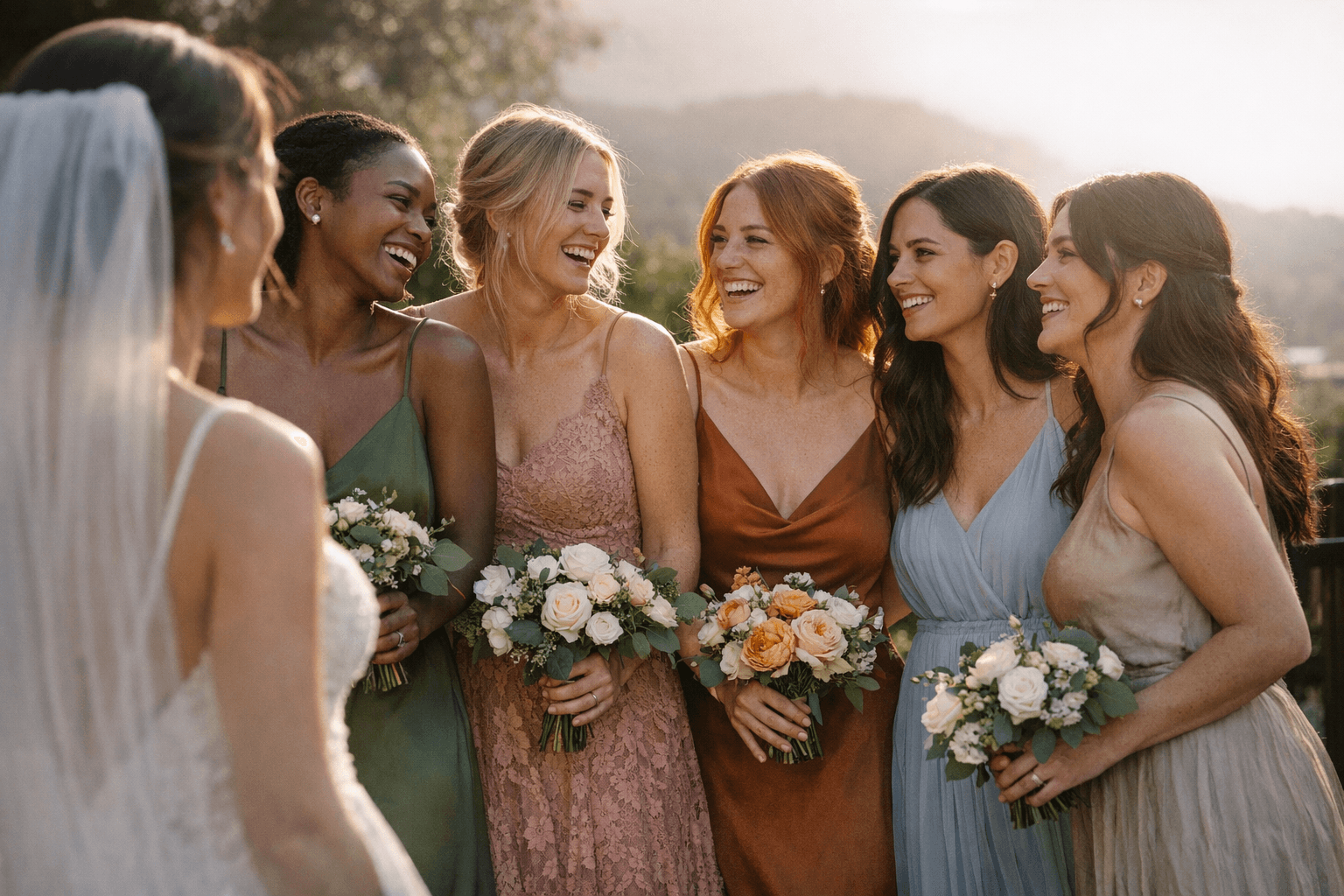
The mismatched bridesmaid moment isn't going anywhere. What started as a quiet rebellion against the rows-of-identical-dresses tradition has fully settled into the bridal mainstream, and for good reason: one dress rarely flatters a dozen different body types, budgets, or aesthetics. But here's the part nobody tells you upfront. The looks that photograph like a styled editorial are not the result of everyone just wearing whatever they want in vaguely similar colors. They are the result of a tight design system with a few firm rules and deliberate freedom inside them. Get that architecture right, and the variety takes care of itself.
Set Your Four Non-Negotiables First
Before your bridesmaids open a single browser tab, you need to define exactly four things: your palette range, your fabric family, your length rule, and one unifying detail. Everything else is up for grabs.
The palette range means choosing two to four colors that sit within the same tonal world. That could be varying shades of dusty blue, a sweep of warm earth tones from terracotta to rust, or a mix of jewel tones like sapphire, emerald, and deep plum. The key decision here is undertone direction: warm, cool, or neutral. Pick one and commit. Mixing warm coral with cool lilac with neutral sage introduces three competing undertone families, and the lineup will look like a mistake rather than a choice.
Your fabric family is equally critical. Fabrics need to stay within the same weight class. Chiffon pairs beautifully with tulle; satin works beside crepe. What doesn't work: pairing a heavy velvet with a featherlight chiffon. The visual weight becomes so uneven that no amount of color coordination can rescue it. If you want textural variation, keep the base fabrics in the same register and introduce difference through finish, like matte versus subtle sheen within the same fabric type.
Length is where a lot of mismatched looks quietly fall apart. Decide upfront whether you're committing to floor-length, midi, or an intentional mix. If you allow varying hemlines, make that decision deliberately and account for how the lineup will read in photos. One bridesmaid in a knee-length dress flanked by six floor-length gowns doesn't read as intentional variety; it reads as an oversight.
Your unifying detail is the thread that visually ties every dress together even when silhouettes differ. This could be matching shoes in a single nude or metallic, identical sashes or belts, the same jewelry metal, or a consistent neckline style. Dollhouse Bridesmaids nails this principle: if the dresses are mismatched, the accessories should be unified but with room for individual expression within that constraint. Choose the category of the unifier (shoes, sash, earrings), then let each person choose the specific style within it.
Give Everyone a Flattering Silhouette Within the Rules
Once your four non-negotiables are locked, the brief to your bridesmaids is simple: choose any silhouette that flatters you, in a color from the approved palette range, in the approved fabric family, at the approved length. This is where the system becomes genuinely freeing. An A-line gown, a wrap dress, a one-shoulder column, a strapless sweetheart, all reading in shades of dusty rose chiffon at floor length with silver strappy heels, create that rich, layered look without visual chaos.
If you want to go even further and allow varying colors and silhouettes simultaneously, Kennedy Blue's approach is the most practical: start with a firm palette of two to four harmonious shades, and require that at least one design element (waistline, neckline, or strap style) remains consistent across all dresses. Two variables in play at once (color and silhouette) is manageable. Three variables (color, silhouette, and fabric family) without strict guardrails tips quickly into chaos.
For parties where a maid of honor needs to stand out, Junebug Weddings offers a smart strategy: keep the rest of the party in neutrals or a consistent color family, then give the MOH a distinct hue or a print version of the palette color. It signals hierarchy visually without disrupting the overall composition.
Decision Checklist Before Anyone Orders
Run through this before a single dress is purchased:
- Have you defined your two to four palette colors with exact shade names, not just general descriptions? Document them. "Dusty rose" means fifteen different things across fifteen different brands.
- Have you ordered physical swatches from every retailer your bridesmaids plan to shop? Fabric colors read completely differently on a screen versus in natural light.
- Is your fabric family consistent in weight and finish across all planned dresses?
- Have you confirmed a length rule and communicated it clearly?
- Is your unifying detail (shoes, sash, jewelry) decided and shared before anyone shops for accessories?
- Have you accounted for the maid of honor's dress if she's meant to stand apart?
How Colors Read in Photos and How to Arrange Your Lineup
This is the part most guides skip, and it's where mismatched looks either sing or fall flat on camera.
First: always review swatch samples in natural light, not under the fluorescent overhead of a boutique fitting room. Colors shift dramatically between indoor artificial lighting, outdoor golden hour, and the flash of a camera. What reads as a cohesive family of dusty blues in a store can split into two visually unrelated shades the moment a photographer's strobe hits them.
For the actual lineup arrangement, the principle from Bella Bridesmaids is clean and effective: place your deepest tones at the ends or at the center of the group for a balanced composition. A gradient from light to dark (or dark to light) across the lineup reads as intentional and structured in photographs. Avoid clustering all your deeper shades on one side, which creates visual imbalance in wide shots.
When mixing prints and solids, always ensure prints are outnumbered by solids in the lineup unless you have a very specific vision and an experienced photographer. One or two floral or patterned dresses among a group of solids creates focal points; three or more competing prints become visual noise. Lee Chen advises starting with a print you love and pulling the solids from colors that appear within that print as a throughline, rather than choosing the print to match pre-selected solids.
The Most Common Cohesion Killers
Even well-intentioned mismatched looks get undermined by a short list of recurring mistakes:
- Too many undertones in play. Warm, cool, and neutral shades mixed together without a guiding direction is the single fastest way to make a mismatched lineup look accidental. Pick one undertone family and stay there.
- Mixed shine levels. A matte chiffon dress next to a high-shine satin next to a sequined gown creates a shimmer hierarchy that the camera will expose. If you mix shine levels, be deliberate: matte and subtle sheen work; matte and full sequin in the same lineup rarely do.
- Inconsistent hemlines without a plan. Varying hemlines can work, but only if the range is balanced across the group. One outlier at a dramatically different length from everyone else is the hemline equivalent of a sour note.
- Almost-matches. Two bridesmaids in dresses that are clearly meant to be the same shade but aren't, due to ordering from different retailers without swatch-matching, looks more like a mistake than a mix-and-match choice. Document exact shade names from each brand and request physical swatches before any order is placed.
Ordering, Budgeting, and the Timeline
The logistical side of mismatched dressing is where the real discipline lives. Order at least six months before the wedding. Production alone typically runs two to three months, and you need buffer for alterations, which for a diverse silhouette lineup could vary widely from person to person. Bella Bridesmaids recommends ordering all dresses as close together as possible, even when they're coming from different retailers, so arrival times align and fittings can be coordinated.
For budget alignment, the advantage of mismatched dressing is that bridesmaids can shop at different price points within the same palette and fabric guidelines. A $120 chiffon midi from one retailer and a $280 chiffon gown from another can read as equally intentional in a lineup if the color and fabric family match. The risk is the almost-match problem, which is why requesting swatches from every retailer before purchase is non-negotiable, not optional.
Schedule a group try-on once all dresses arrive. Seeing every dress together in person, in daylight, before the wedding day is the only reliable way to catch undertone clashes, shine level mismatches, and hemline imbalances while there is still time to address them. Bring venue photos to this try-on so you can assess how the palette reads against the actual backdrop where the party will be photographed.
The mismatched bridesmaid look at its best is not about loosening the rules. It is about being precise enough with the right four rules that the variation within them reads as curated, not careless. The brides who pull it off are the ones who give the most specific brief, not the most open-ended one.
This article was produced by Prism’s automated news system from verified source data, official records, and press releases, then run through automated quality and moderation checks before publishing. The system is built and supervised by the people who set the standards it runs under. Read our full AI policy.
Did this article answer your question?