Savannah Miller’s bridal spring 2026 blooms with sculptural florals
Savannah Miller turns garden romance into sculptural bridal volume, giving Spring 2026 the kind of texture, movement, and versatility salons can sell now.

Savannah Miller’s Spring/Summer 2026 bridal collection, Adorned in Reverie, takes florals out of the obvious and into something far more marketable: shape, surface, and motion. The June 11 gallery makes one thing clear immediately, this is not about sweet blossoms sprayed across a gown, but about turning the garden into structure, with layered textures, sculptural florals, and voluminous silhouettes that feel designed for a bride who wants romance with backbone.
A garden story with real contour
Miller said the collection began with the lush, blousy flowers in her garden and the ritual of tending the earth, and that grounding shows in the clothes’ tactile, three-dimensional feel. The floral reference is present, but it is never literal in a way that risks looking costume-like; instead, it reads as volume built from memory, as if petals have been translated into folds, gathers, and dimensional surface work.
That makes Adorned in Reverie especially relevant for Spring 2026 salons. The strongest bridal stories right now are not flat or purely nostalgic, but tactile enough to register in person and distinctive enough to stand out on a rack. Miller’s answer is to give florals a body, which is exactly what makes the collection feel commercially sharp rather than merely pretty.
Ballet gives the collection its movement
Alongside the garden inspiration, Miller points to ballet and its hypnotic fluidity and freedom, and that influence keeps the collection from becoming too static. Even the fuller shapes feel governed by motion rather than stiffness, which matters in bridal, where the difference between volume and heaviness can define whether a gown feels modern or merely decorative.
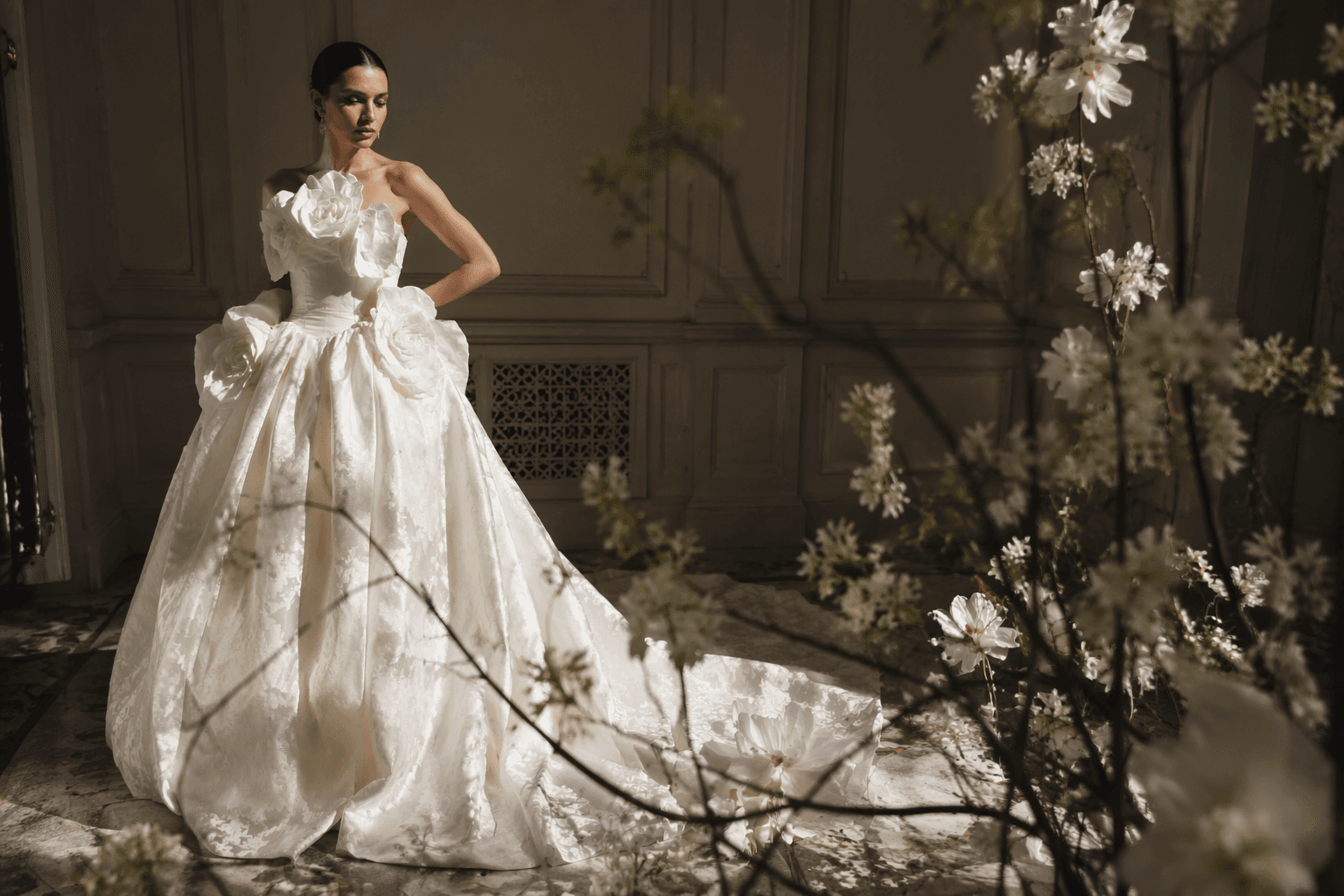
That sense of movement is one of the most persuasive parts of the collection for a bride shopping now. The look is romantic enough for the aisle, but the emphasis on fluidity suggests the dresses can live beyond the ceremony, especially for brides who want a single strong look that can carry them through reception photographs, dancing, and the inevitable close-up scrutiny of social media.
The bespoke collaboration signals where the line is headed
One of the smartest details in the collection is the collaboration with bespoke brides Ambar and Fran, whose gowns appear in the Spring/Summer 2026 lineup. That is not just a charming backstory, it is a retail signal. A label that can move comfortably between made-to-order intimacy and a broader salon offering usually has a better shot at speaking to multiple kinds of brides without losing point of view.
Ambar’s gown carries an especially elegant reference point, drawing inspiration from Sir John Singer Sargent and his flowing fabric studies. That nod matters because it frames the dress as painterly rather than merely decorative, a distinction that helps the collection feel more elevated and less trend-chasing. In practical terms, it also broadens the appeal: this is for the bride who wants her dress to feel considered, cultured, and a little bit artful, not just conventionally pretty.
What salons may actually buy into
The collection’s most commercially legible shift is in the way it treats silhouette. Voluminous shapes are certainly part of the story, but they are paired with enough textural nuance to keep them from reading as oversized for the sake of drama. That balance should make the line attractive to boutiques looking for gowns with a clear point of view that still serve real shopping behavior, especially for brides who want presence without costume.
Miller has long worked in a lane that mixes polish with edge. Lovely Bride describes the label as “part rock-and-roll, part 1930s glamour,” which remains a useful shorthand for the brand’s identity. That blend gives the collection range: there is enough softness for the classic romantic, but enough attitude in the styling language to interest the bride who does not want her dress to feel saccharine.
The price point reinforces that position. Lovely Bride lists the brand at about $1,750 to $5,000, which places Savannah Miller in a sweet spot for brides who want designer credibility without entering the most rarefied bracket of bridal pricing. For salons, that is the kind of range that can move both fashion-forward customers and more pragmatic shoppers who still want a dress with a point of view.
How Miller built the brand that now sells this mood so well
The Spring 2026 collection also lands as a mature statement from a designer who has spent years refining her bridal language. Miller launched her eponymous bridal line in 2016 after working with Alexander McQueen and Matthew Williamson, and in 2022 she expanded into bespoke bridal. That progression matters because it explains why the collection feels so fluent in both concept and commerce: it is the work of a designer who understands how a singular idea has to be translated into real-world buying.
Miller has also already proven that her bridal business can generate immediate demand. In a June 2025 interview, she said her first bridal opportunity came from a seven-piece capsule collection that sold out instantly, a detail that still reads like a blueprint for the brand’s appeal. Later bespoke clients including Danielle Copperman, Clara Paget, and Ambar Driscoll show how the line has attracted women with strong personal style and fashion visibility, the sort of names that quietly validate a label in bridal without turning it into a celebrity exercise.
Why the early U.S. trunk show matters
Elizabeth Cole Bridal’s May 23 to June 2 trunk show, the first U.S. access to the Spring/Summer 2026 collection, underscores the commercial momentum around Adorned in Reverie. In bridal, early trunk show placement often reveals where a collection is likely to resonate most, and Miller’s mix of sculpture, softness, and wearable drama seems calibrated for boutiques that want something romantic but not predictable.
What emerges from this collection is not a single viral dress, but a cleaner, more durable proposition: floral bridal made tactile, movement made visible, and volume made saleable. That is precisely the sort of direction Spring 2026 salons are likely to buy into, because it offers brides a fantasy that still feels like it belongs in a fitting room, not just on a mood board.
This article was produced by Prism’s automated news system from verified source data, official records, and press releases, then run through automated quality and moderation checks before publishing. The system is built and supervised by the people who set the standards it runs under. Read our full AI policy.
Know something we missed? Have a correction or additional information?
Submit a Tip