Weather-proof summer dressing, lightweight layers for heat and heavy rain
Summer dressing now needs a shell game: breathable layers, trainers and a jacket that can take a downpour without killing the look.

The brief
The smartest summer wardrobe right now is built for weather that cannot decide what it wants to be. Cold, clammy mornings turn muggy by lunch, then the commute home ends in thunderstorm energy, so the goal is not perfection. It is staying polished while the sky swings from sticky to soaked.
That is exactly why this capsule leans so hard on adaptability. The United Kingdom’s temperate maritime climate has always been changeable, but the Met Office says hotter air can hold more moisture, which is why summer showers hit harder than winter rain. Add in the fact that 2011 to 2020 was 9% wetter than 1961 to 1990, and six of the ten wettest UK years on record have landed since 1998, and the whole idea of “summer uniform” starts to feel outdated.
Build from the lightest layer up
Kitty McGee, Stylist’s executive fashion and beauty director, gets the formula right by stripping it back: “Go for comfy (always), lightweight and natural fabrics.” That is the whole point. Once you start piling on heavy layers, you do not look more prepared, you just look overheated, bulky and slightly defeated before the rain has even arrived.
The best base here is a lightweight knit, something with enough body to read as an intentional layer but enough breathability to keep you from steaming up. Natural fabrics matter because they move with the body and feel less synthetic when humidity spikes, which is the exact moment when summer dressing usually goes wrong. The knit should be the quiet piece in the outfit, not the hero, because its job is to temper temperature swings without making you sweat through your day.
This is where minimalist wardrobes usually win. A single well-cut knit in a neutral shade does more work than a stack of trend-driven extras, and it still looks good if the weather settles down and the jacket comes off.
Let the jacket do the hard work
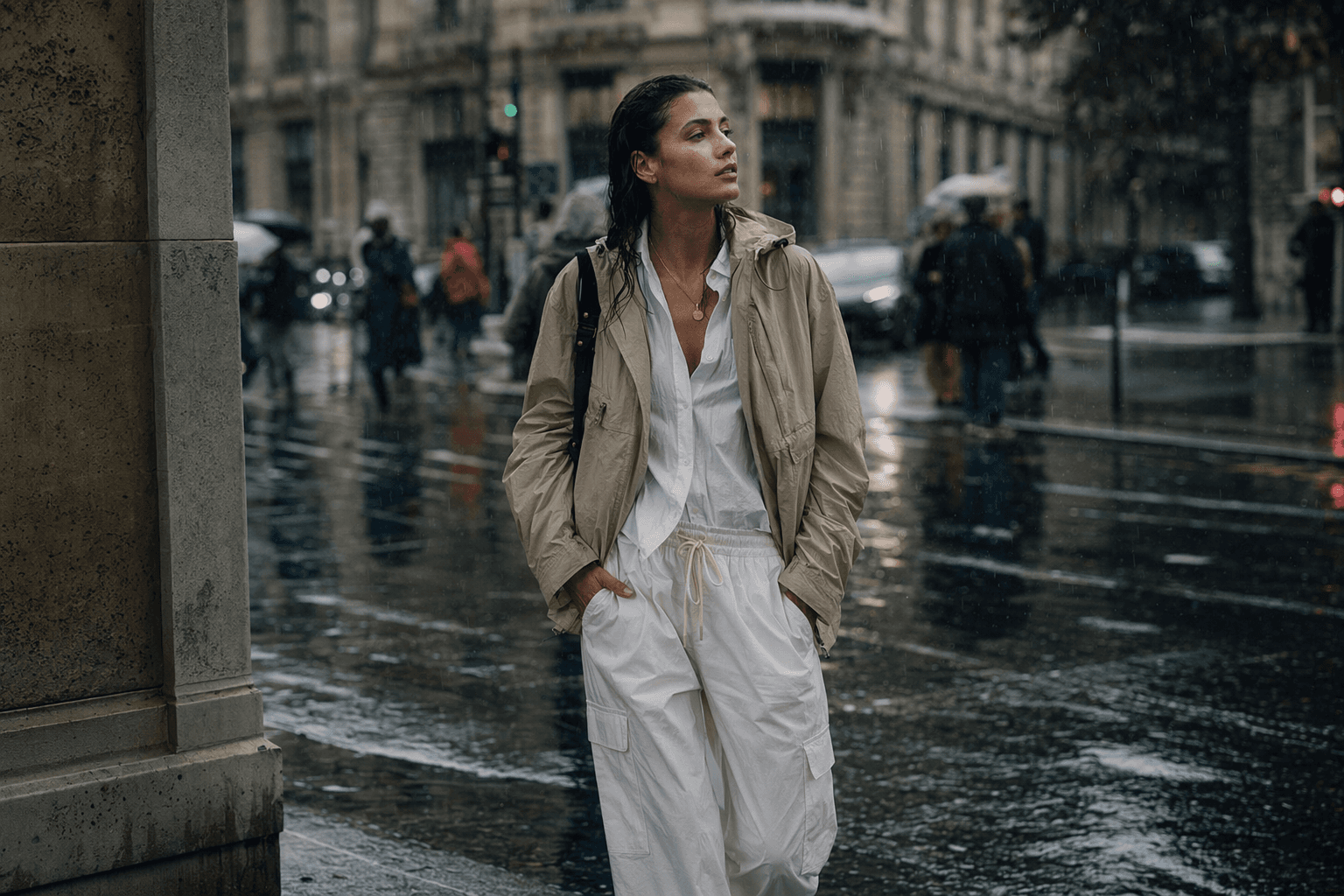
The technical jacket is the key piece, and not because it looks aggressively sporty. The point is that it acts as a weatherproof barrier, keeping the outfit clean when the afternoon turns damp and the rain suddenly has teeth. Stylist has been pushing this angle for a reason: technical jackets showed up on the spring/summer 2026 runways at Fendi, Loewe and Prada, and the mood has shifted from pure utility to something far more wearable in city life.
That shift matters. These jackets are not just for hiking or commuting anymore. Styled over tailoring and slip dresses on the catwalks, they now have enough fashion credibility to sit in a capsule wardrobe without looking like you grabbed the nearest emergency layer on the way out the door.
The best version is lightweight, sharp at the shoulder and easy to throw over whatever you are already wearing. Think of it as the piece that lets you keep a clean silhouette even when the forecast is messy. A shell or waterproof windbreaker in a restrained color keeps the outfit polished; too much hardware or overbuilt detailing starts to tip the look back into technical territory, which is exactly what this brief is trying to avoid.
Why trainers still make the most sense
Trainers keep the formula grounded. They give the outfit the practical footing it needs for wet pavements, surprise puddles and the kind of day where you might be inside, outside and on a tube platform before dinner. More importantly, they stop the technical jacket from taking over the whole look and making it feel like you are dressed for an outdoor expedition.
This is where the capsule really earns its keep. With a lightweight knit, a technical jacket and trainers, you can move through humid streets and sudden rain without changing your entire outfit plan. The silhouette stays easy and urban, which is what makes the formula feel modern rather than merely sensible.
The trick is keeping the trainers clean and uncomplicated. You want a pair that can sit beside a polished knit and a sleek shell without pulling the outfit too far into gym wear. The best wet-weather summer dressing never looks like compromise. It looks deliberate, even when it is doing practical work.
The climate context is not background noise
This is not just a styling mood board dressed up as advice. The Met Office says the UK has warmed by about 0.25°C per decade since the 1980s, and its latest annual climate stocktake says 2024 was the fourth warmest year on record. More intense individual showers and fewer weak rainfall events are expected as temperatures rise, which means summer rain is not just a drizzle problem anymore. It is more likely to arrive in heavier bursts.
That is why the category matters now. The old idea that summer dressing can be solved with breezy fabrics and a bare minimum of outerwear does not hold up when a humid afternoon can turn into a wall of water. The smarter response is to dress for volatility, not ideal conditions.
How to wear the formula without losing polish
The strongest capsule wardrobes always look calm, even when the weather is not. Start with the knit, add the technical jacket when the sky looks uncertain, and finish with trainers that can handle real streets, not just sunny sidewalks. Keep the shapes clean, the fabrics light, and the color palette restrained so the whole thing reads as chic rather than overprepared.
What makes this formula work is that it answers two problems at once. It protects against rain and humidity, but it also slots neatly into an everyday minimalist wardrobe, which is where most useful clothes live anyway. That is the sweet spot: practical enough for summer storms, polished enough that you never look like you dressed for the forecast instead of the day.
Know something we missed? Have a correction or additional information?
Submit a Tip