Carolyn Bessette's 'effortless' style set to have a major influence on 2026 bridal trends
eBay searches for Narciso Rodriguez and white slip dresses are up 15% year-on-year, and the FX series *Love Story* is behind it all.

Thirty years after Carolyn Bessette walked down the aisle of a remote Georgia chapel in a $40,000 Narciso Rodriguez bias-cut slip dress, searches for that dress's spiritual successors are surging. eBay data shows searches for Narciso Rodriguez and white slip dresses are both up 15% year over year, from January 2025 to January 2026. The catalyst is unmistakable: FX's *Love Story: John F. Kennedy Jr. & Carolyn Bessette*, executive produced by Ryan Murphy, has reignited fascination with one of the most iconic bridal looks of the modern era. For 2026 brides, this is less a nostalgia trip than a genuine directive: simplicity is back, and it's carrying the full weight of cultural authority behind it.
The Dress That Changed Everything
In 1996, Carolyn Bessette-Kennedy and John F. Kennedy Jr. got married outside a remote chapel on Cumberland Island, Georgia, with no paparazzi and no media circus. What she wore to that ceremony has never stopped reverberating through the industry. Among all of Bessette Kennedy's history-making fashion choices, including Yohji Yamamoto evening wear, Selima Salaun sunglasses, and a camel Prada coat that recently sold for $192,000, the ensemble that has gone down as her most iconic is her wedding look: a bias-cut, cowl-neck silk slip dress designed by her Calvin Klein colleague-turned-confidant Narciso Rodriguez.
Her simple white slip dress was made from silk and cut on the bias, with a scooping cowl neck as its only flourish. The look was finished with a silk tulle veil, crystal beaded Manolo Blahnik satin sandals, and a pair of sheer elbow gloves. There was no cathedral train, no Swarovski-encrusted bodice, no puff of tulle. The restraint was the statement. i-D magazine said the dress' simplicity "marked a departure from the era's voluminous princess dresses and solidified an emerging trend: the understated slip-style wedding dress." Vogue went further, declaring the gown may be "one of the most sought-after of all time."
Why 2026 Is the Year the Influence Peaks
The FX series carefully recreates Carolyn's wedding wardrobe, bringing renewed attention to the minimalist silk gown that changed bridal fashion forever. The show stars Tony-nominated actress Sarah Pidgeon as Bessette Kennedy and has been airing weekly to an audience that is, in significant part, encountering this particular brand of effortless style for the very first time. Since the series landed in February 2026, the American It-girl's quietly perfect Nineties minimalist wardrobe has become a point of obsession.
The cultural timing is sharp. Modern brands like The Row and Khaite explicitly credit Bessette's influence, and fashion experts note that she didn't simply follow quiet luxury trends: she originated them. In a bridal market that spent the better part of a decade piling on dimension, detachable trains, and sculptural 3D florals, the swing back toward considered minimalism feels less like a correction and more like an inevitability. The bride who wants to feel dressed rather than costumed has found her reference point.
The Silhouette: Bias-Cut, Satin, and Nothing Extra
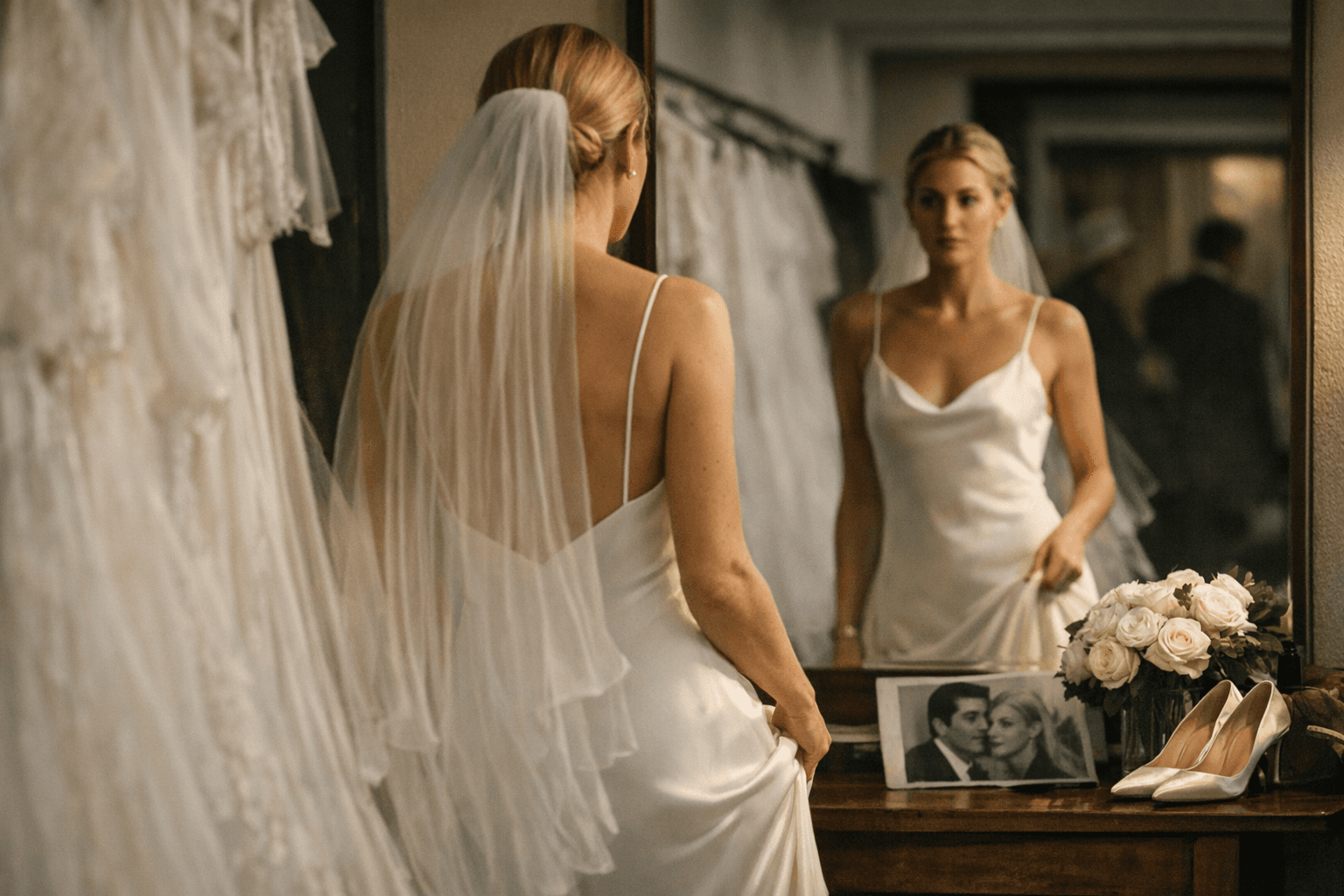
The defining shape of this movement is one that has appeared on bridal runways in cycles but never with quite this level of cultural endorsement. The bias-cut silk slip has remained a source of inspiration for generations of brides, and has been making waves again thanks to *Love Story*. The construction technique, cutting fabric on the diagonal grain, allows the fabric to skim and move with the body in a way that structured gowns simply cannot replicate. It is, by design, a silhouette that flatters through fluidity rather than engineering.
Fabric plays a central role in the trend, with high-quality crepe, silk satin, and modern mikado among the leading choices for minimalist wedding dresses in 2026. These are not fabrics that hide behind embellishment: they demand cut and craftsmanship to carry their weight. Satin, in particular, brings the luminous quality that made Carolyn's Rodriguez gown look almost lit from within in every photograph taken of it. The lushness of the material does the work that a ballgown's volume would otherwise do, creating presence without mass.
Kleinfeld Weighs In
At Kleinfeld Bridal, a barometer for where mainstream American bridal taste actually sits, the influence is being felt even among a clientele that has historically skewed more traditional. Kleinfeld's Director of Merchandising notes that while their customer is "more traditional," Carolyn Bessette Kennedy is still, as always, on the mood board. "Slip wedding dresses have become a staple in today's bridal landscape. Brides seeking a sleek, minimalist aesthetic often gravitate toward this effortlessly elegant silhouette," she says.
That framing matters. When a retailer known for stocking the full spectrum of bridal grandeur, from Pnina Tornai's crystal-encrusted confections to structured a-line classics, starts speaking openly about slip dresses as a category staple rather than a niche request, the trend has genuinely arrived. This is not a runway directive filtering slowly downward; it is a customer-driven shift that the industry is now ratifying.
The Ready-to-Wear Sensibility
What separates the effortless bridal movement from its closest predecessors is the way it borrows its logic from ready-to-wear rather than traditional bridal construction. Carolyn's style was always very Calvin Klein: simple clothes in clean lines, neutral colors, very little makeup, and famously, almost no jewelry. That is not a bridal formula, it's a dressing philosophy, and it's exactly the one that 2026 brides appear to be adopting wholesale.
The implications extend well beyond the dress itself. When the gown has no ornamentation to anchor the look, every other choice, the shoe, the veil, the hair, becomes more legible and more deliberate. Carolyn's barely-pinned bun, her borrowed clip from Jackie Kennedy Onassis, her understated lily-of-the-valley bouquet arranged by Rachel Lambert Mellon: each detail had space to register precisely because the dress demanded nothing of the eye beyond the quality of its drape. That editing instinct is what the current generation of brides is trying to channel.
How Designers Are Interpreting the Moment
The runways have taken note. Oscar de la Renta's Fall 2026 collection includes a study in both minimalism and grandeur: an A-line faille gown featuring a flattering high neckline with delicate spaghetti straps. Pronovias has positioned its Ribelia gown directly within this conversation, describing it as a reflection of "the effortless elegance that made Carolyn's wedding dress unforgettable." Lihi Hod's Daria gown, with its straight-neck boned bodice in luminous silk mikado, offers a more sculptural take on the same pared-back sensibility.
The common thread is an investment in fabric over decoration, and in silhouette over spectacle. These are gowns that age beautifully in photographs because they contain nothing that dates. They ask the wearer to be the focal point, not the dress. That, more than any specific cut or neckline detail, is Carolyn Bessette Kennedy's lasting gift to bridal fashion, and in 2026, with a whole new generation discovering her through a television screen, it has never felt more urgent or more relevant.
This article was produced by Prism’s automated news system from verified source data, official records, and press releases, then run through automated quality and moderation checks before publishing. The system is built and supervised by the people who set the standards it runs under. Read our full AI policy.
Did this article answer your question?