Central Saint Martins BA show spotlights six standout graduates in Peckham
Peckham gave CSM’s BA show a rawer frame, but the standout clothes were all about color, memory and protest, from Ukraine-rooted dress to bold knitwear.

Central Saint Martins’ BA Fashion show looked sharper in Peckham. Set inside Peckham Levels, a former 1980s multi-storey car park, the class of 40 final-year students turned six looks each into a 240-look argument for why this show still matters, even after 15 years at Granary Square. The relocation brought a larger audience and a less polished setting, which only made the strongest work feel more urgent, more immediate and more willing to take a side.
Peckham changes the frame
The move south of the river did more than alter the address. It stripped away a little of the institution’s inherited grandeur and replaced it with something closer to the mood of the clothes themselves: restless, experimental, and alert to the world outside the studio. The collections were shaped by science fiction, 19th-century ribbon samples, technology and memory, and the public vote gave the show a rare sense of shared taste rather than insider decree.
That matters at a school whose BA fashion stage has launched John Galliano, Daniel Lee, Stella McCartney, Tolu Coker and Grace Wales Bonner. The annual show still works as a talent engine because it is not just about finish, but about instinct, conviction and point of view. L’Oréal Professionnel’s partnership with Central Saint Martins, which began in 2001, has only sharpened that ecosystem by adding awards and bursaries to the mix.
Polina Kadilnikova turns displacement into dress
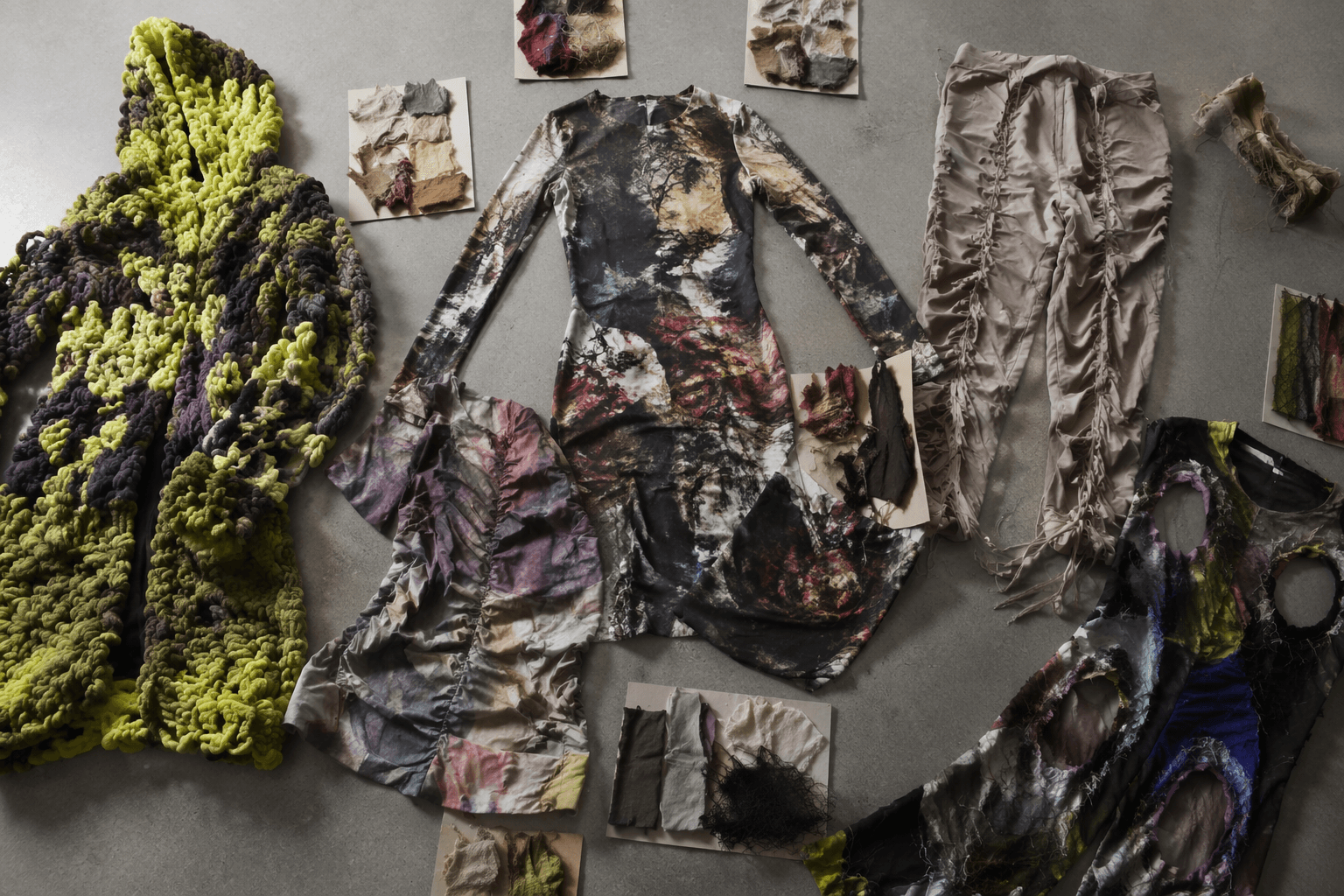
Polina Kadilnikova emerged with the kind of collection that makes the room go quiet. The Ukrainian womenswear graduate, who was born in Kharkiv and raised in Kyiv, won the L’Oréal Professionnel Young Talent Award 2026 and The Mandrake Hotel Scholarship for Casualties, a body of work that asks what happens to identity when home disappears. Her collection pulls from occupied territories to evoke the ache of peacetime memory and the violence of forced displacement.
What gives the work power is its refusal to flatten war into symbolism alone. Kadilnikova uses clothing to hold onto a place that is being erased, turning nostalgia into a material language rather than a mood board cliché. It is the sort of collection that belongs in a fashion school show, but also reaches beyond it because the emotional stakes are so clear.
Cameron Bisseck pushes Black femininity forward
If Kadilnikova’s work was about loss, Cameron Bisseck’s was about claim. The first runner-up said he wants to create a new vision of Black femininity, Black womanhood and Black culture, and that ambition gave his collection a charge that felt both personal and outward-looking. This is the kind of graduate work that reads as concept on the runway but also suggests a real design voice, one that understands representation as silhouette, attitude and edit.
Bisseck’s strength lies in the way he frames identity as something expansive rather than boxed in by trend language. There is a market afterlife here, because clothing grounded in cultural specificity can travel when the shapes are clear and the message is not overworked. In other words, this is not just idea dressing. It is the kind of point of view that can move from showpiece to wardrobe piece without losing its nerve.
Arora Nielson treats North London as an archive
Arora Nielson, the second runner-up, brought a gentler but no less pointed vision to the show. He described his collection as an homage to growing up in North London and to protecting the city’s multicultural “melting pot,” which gives the work a civic as well as personal dimension. Knitwear, in his hands, becomes less about comfort and more about belonging.
That is a useful shift, because it makes the collection feel current without leaning on obvious slogans. Nielson’s dreamier looks connect the emotional pull of place to a fabric language that can actually live in closets, not just on a runway. Knitwear has always been one of fashion’s easiest entry points into everyday style, and here it carries memory, geography and community at once.
The rest of the class leaned into memory, kitsch and protest
The show’s wider cast made the class feel less like a single mood and more like a chorus. Chi Wei turned to the jewellery box, then filtered childhood nostalgia for a family home through beadwork, citrus-orange crochet, a floral peacoat and a Hello Kitty bow pinned to a peter pan collar faux-fur jacket. The effect was playful, but not flimsy. It showed how kitsch can read as sophisticated when it is built with enough texture and control.
Danna Reyes went in the opposite direction, using Mexican maximalism to explore her roots in Laredo, Texas, and the unravelling of the American dream. War imagery ran through the collection, from a woven top that evoked a twin-towers war rug to bullets, barbed-wire shorts and dirty surfaces that referenced migration and border crossing. It was blunt, political and unsettling in the way the strongest student fashion often is.
Matteo Dunkley offered a different kind of precision. After changing direction just eight weeks before the deadline, he developed a technique of ironing wax pellets into Shetland wool, creating structure that could flex when wet and hold geometric shape once dried. His work was the most engineering-minded of the group, proving that innovation can be quiet and still feel radical.
What will travel beyond the show
Not every idea here will survive the leap into retail, and that is part of the point. The literal protest pieces, the war objects and the most pointed political gestures belong to the runway, where they can do their most necessary work. What will likely filter into mainstream fashion are the sharper, easier-to-wear echoes: saturated color, tactile knitwear, ribbon references, beadwork, strong prints and the feeling that surface can carry memory.
That is the real through-line from Peckham: not a neat story about a generation becoming commercial, but a clear visual direction for where influence is heading. Central Saint Martins still knows how to produce clothes that are too specific to be generic and too alive to be ignored, and in a market crowded with safe ideas, that remains the school’s most valuable export.
This article was produced by Prism’s automated news system from verified source data, official records, and press releases, then run through automated quality and moderation checks before publishing. The system is built and supervised by the people who set the standards it runs under. Read our full AI policy.
Did this article answer your question?