Comme des Garçons superfan unveils 25,000-piece archive in Paris
Jean-Denis Franoux opened a 25,000-piece archive in Paris, turning decades of private collecting into a public fashion authority. His Regarderobes debut spotlights rare Comme des Garçons and beyond.

Jean-Denis Franoux has turned three decades of quiet obsession into a fashion statement with real institutional weight. The collector, a Comme des Garçons superfan from eastern France, opened the first public chapter of his 25,000-piece archive in Paris with a three-day exhibition that began Thursday, April 24, 2026, and doubled as the launch of Regarderobes.
What makes the project feel bigger than a one-off display is its ambition. Regarderobes was created as an endowment fund to preserve Franoux’s collection of ready-to-wear pieces from the early 1980s through the late 1990s, while also supporting future exhibitions, a documentation center, and partnerships for conservation and education. In an era when archives increasingly shape how fashion history is written, Franoux is not simply showing clothes. He is building infrastructure around taste.
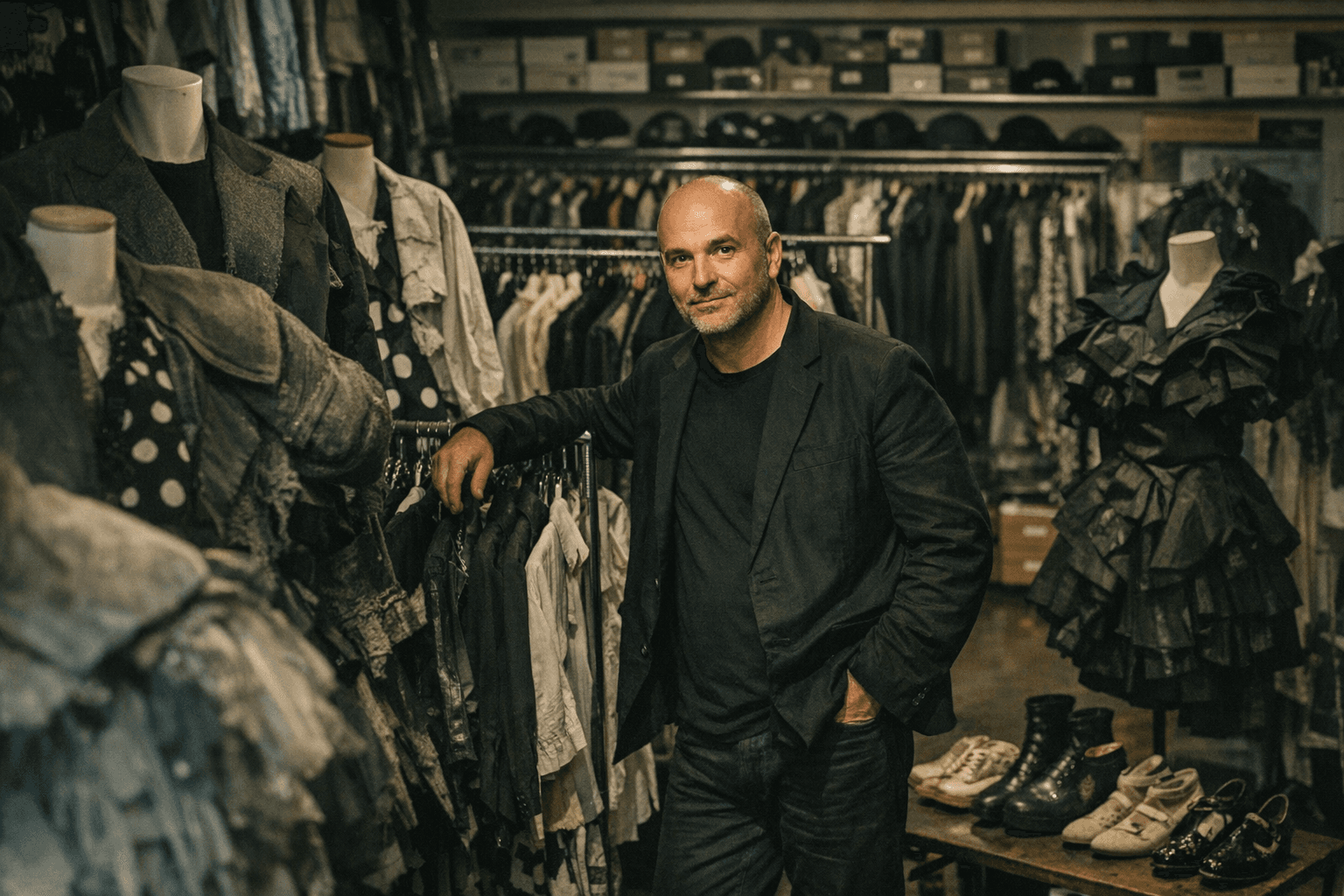
The preview itself underscored how sharp that taste is. The Paris presentation included about fifty foundational silhouettes, while another account described roughly 150 curated pieces in the show. Franoux’s eye has been especially trained on Comme des Garçons, Yohji Yamamoto, and John Galliano, names that still define the radical edge of late 20th-century dressing. The collection also reaches back to Cristóbal Balenciaga, which gives the archive a lineage that runs from couture rigor to the avant-garde deconstruction that followed.
The scale matters as much as the names. A 25,000-piece archive is no vanity closet; it is a body of work that can shift the way collectors, museums, and fashion houses think about preservation. Franoux’s emergence comes as fashion collecting has moved from private eccentricity to public cultural currency, and Paris has become the stage where these holdings are transformed into shared reference points rather than hidden trophies.
The comparison to Azzedine Alaïa is unavoidable. Alaïa’s private clothing collection reached 20,000 items by the time of his death in 2017 and later became the basis for major Paris exhibitions, including shows that placed his archive into the public conversation. Franoux now looks like a surprise contender for the title of the world’s biggest fashion collector, but the deeper story is less about size than authority: the person who preserves fashion’s rarest objects can end up helping decide which silhouettes endure, which names matter, and which histories are remembered in the first place.
Know something we missed? Have a correction or additional information?
Submit a Tip

