EXCLUSIVE: Tracee Ellis Ross Teams With French Brand Emmanuelle Khanh for Eyewear Capsule
Tracee Ellis Ross co-designed two oversized frames with French house Emmanuelle Khanh: the $700 acetate "Freedom" mask and the $505 "Truth" pilot, each in five colorways.

One accessory. That is the entire system. Put on the right pair of oversized frames and a white tee with straight-leg jeans stops reading as default and starts reading as a decision. Tracee Ellis Ross has built an entire public style identity on this principle, and she formalized it on April 7 with a two-style capsule for French house Emmanuelle Khanh that makes the archival case for the oversize frame as the most efficient tool in modern dressing. The frames draw from the house's archive as well as Ross's own lifelong love of eyewear; she has worn glasses since childhood, and her relationship with bold frames is less a styling choice than a foundational personal language.
The collaboration between Emmanuelle Khanh and Tracee Ellis Ross centers on two silhouettes. "Freedom" is an acetate mask design priced at $700, and the pilot-shaped "Truth" goes for $505, with each coming in five colorways. Produced in limited quantities in France and Italy, they are available at The Webster stores in Los Angeles, Montecito, and Palm Springs; New York's SoHo; and South Beach, as well as on the Emmanuelle Khanh website. The capsule draws directly from the house's archival DNA: Emmanuelle Khanh launched her first eyewear collection in 1971, and the oversize frame has been the house's signature register ever since.
Emmanuelle Khanh, a pioneer of French ready-to-wear in the 1960s who passed away in 2017, was best known for her signature oversized eyewear. She began designing anonymously as part of a generation of freelance stylists that also included Karl Lagerfeld, then launched her own brand in the Seventies alongside a new wave of design talents that included Jean-Charles de Castelbajac and Issey Miyake. The house she founded has operated for more than fifty years on the conviction that eyewear is not a finishing touch but a foundational statement. Eva Gaumé, the brand's current creative director, called the collaboration with Ross "a celebration of femininity in the boldest, most empowered way that resonates with the house's heritage and its contemporary spirit."
That heritage matters to what this capsule actually is. Ross has been a genuine admirer of the house long before any commercial arrangement existed; she publicly thanked the brand for "epic sunglasses" on Instagram, unprompted. The capsule reads less like a celebrity licensing play and more like the logical endpoint of a longer relationship with a specific aesthetic philosophy rooted in a French conviction that a good pair of glasses does not accessorize an outfit so much as authorize it.
The case for the oversize frame as an instant-polish tool is straightforward. It creates a single, commanding focal point, doing the work a statement necklace or a structured bag does but faster and at lower ongoing maintenance cost. The "Freedom" mask silhouette is especially effective over simple separates precisely because it creates contrast: the more stripped-down the outfit, the more the frame registers as a choice. Ross applies this principle consistently in her own public dressing, letting the eyewear lead and stripping everything else of competition. Campaign images from the collaboration show her doing exactly this, the frames undisputed, the rest of the look deferring.
Understanding which frame geometry works for a specific face is the difference between a pair of glasses that polishes a look and one that fights it. Oval and heart-shaped faces are the natural beneficiaries of the mask silhouette. The wide horizontal mass of "Freedom" complements soft cheekbones and balances a narrower chin without overpowering it. Square faces, defined by strong jawlines and prominent cheekbones, need a frame wide enough to match the jaw's width; the "Freedom" mask achieves this, and its curved lower edge softens the geometry in a way a sharper rectangle would not.
Round faces are better served by the "Truth" pilot. The downward-angled outer corners of a pilot silhouette introduce angular definition that a fully horizontal mask frame may not, adding apparent vertical length to a face that reads as circular. Long faces present the one real caveat with oversize mask frames: too much vertical height elongates. Check the "Freedom" frame's precise measurements carefully before committing. The "Truth" pilot, with its horizontal emphasis, is the more forgiving choice here.
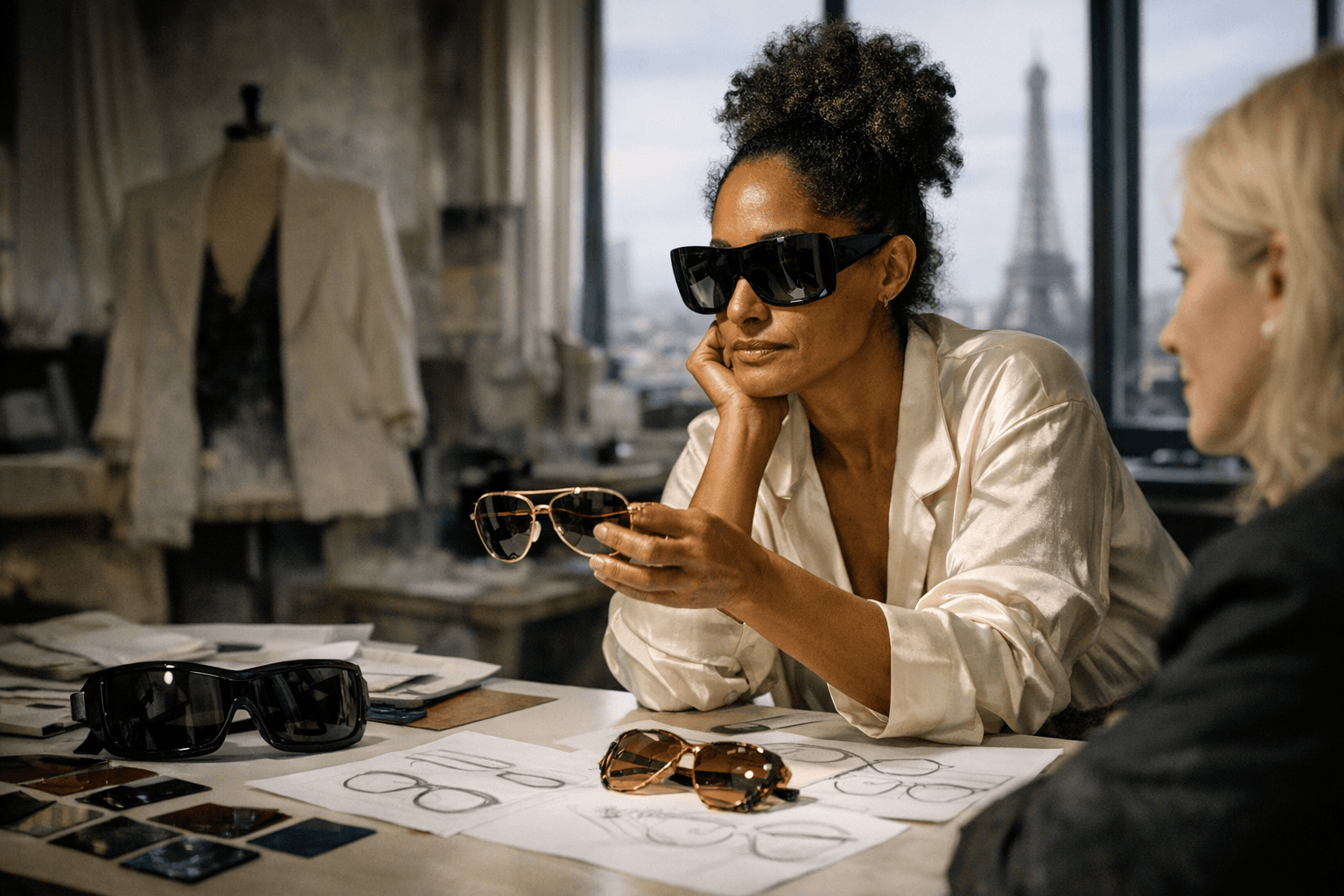
Nose bridge fit is the variable most people overlook. The "Freedom" mask, with its broad acetate construction, typically sits high on the face and requires a bridge with enough structure to hold the frame's weight without migration throughout the day. A lower or flatter bridge may find the fit unstable; the bridge width and any nose-pad configuration deserve close attention before purchasing. The "Truth" pilot's traditional saddle bridge is more accommodating across a wider range of bridge heights and profiles, which partly explains why the pilot silhouette has remained a reliable choice across decades of eyewear design.
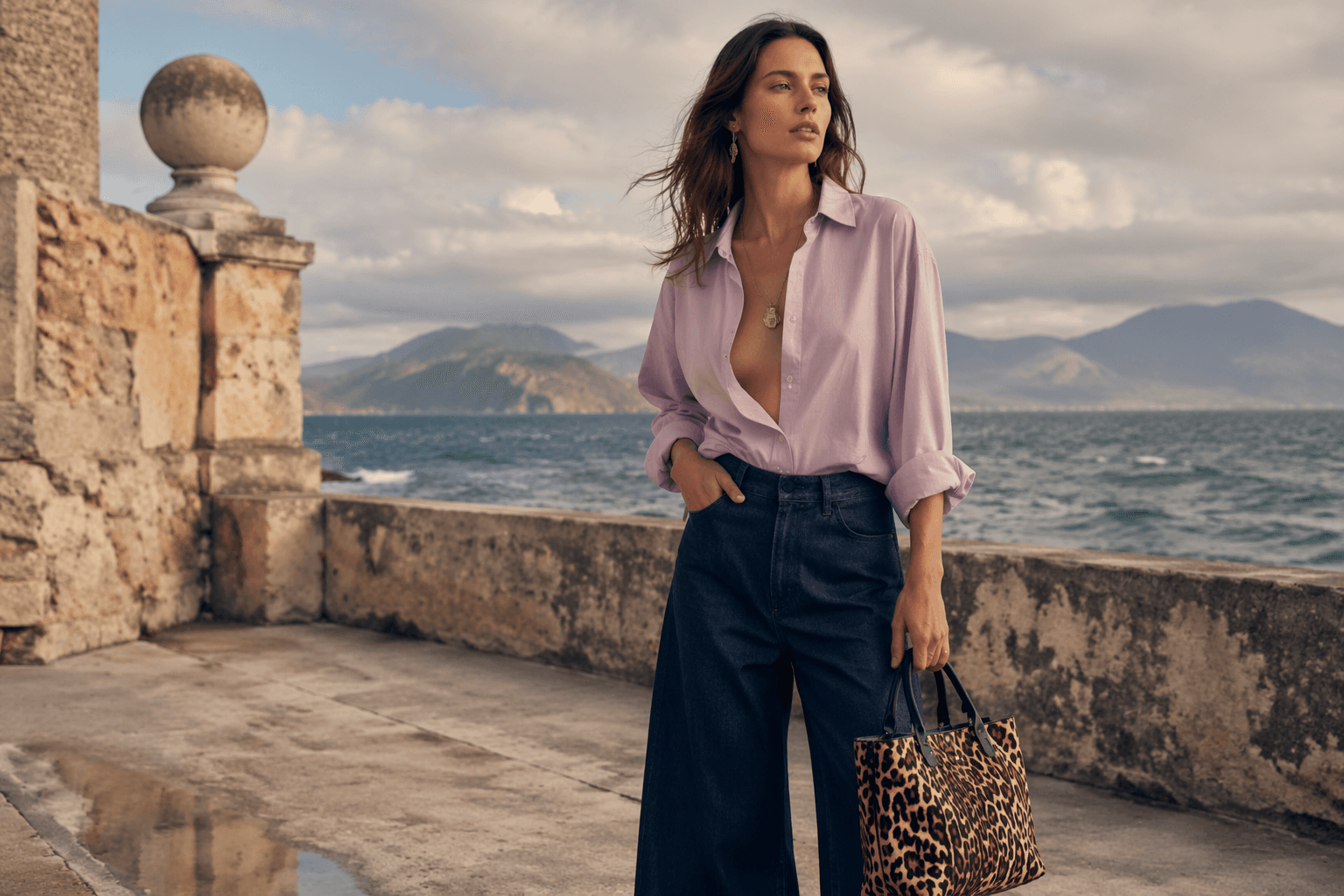
For the minimal formula, the logic is almost absurdly simple: a white tee, straight-leg jeans in mid-wash or dark indigo, leather loafers, and the most oversize frame you own. The constraint is that nothing else competes. Small plain hoops at most. No visible logo, no accessory pulling a second focal point. The glasses do all the communicating. Ross has worn this combination in roughly a thousand iterations and it photographs as intentional every time, which is the entire point of the formula.
For office dressing, "Truth" in a tortoiseshell or low-saturation colorway over tailored wide-leg trousers and a silk blouse earns more authority than a standard corporate blazer. The optical version without a tint signals that the wearer chose these glasses, that they are not a correction aid but a composition element. There is a specific register of office dressing that reads as thoughtful rather than merely compliant, and a pilot frame in a restrained colorway is one of its most reliable entry points, particularly when the rest of the outfit holds to clean lines and a limited palette.
For vacation, the formula is a bias-cut slip dress in a solid color, flat sandals, and "Freedom" in the most unexpected colorway of the five available. Resort dressing defaults to anonymous coordination. One sculptural oversize frame shifts the category entirely. Pack the slip dress and the eyewear and whatever else goes in the bag recedes.
At $700 for "Freedom" and $505 for "Truth," these are serious purchases, but the price reflects manufacturing in France and Italy and more than fifty years of archival oversize design history, not simply a celebrity endorsement. The Emmanuelle Khanh house was making the case for bold, oversize eyewear before most of today's fashion consumers were born. Other creative personalities and friends of the house, including Olivier Rousteing and Tracee Ellis Ross herself, have regularly worn the brand's frames. The collaboration formalizes what was already a long-running aesthetic alignment. Ross did not invent the oversize frame principle; she helped a new generation find the house that had been right about it all along.
This article was produced by Prism’s automated news system from verified source data, official records, and press releases, then run through automated quality and moderation checks before publishing. The system is built and supervised by the people who set the standards it runs under. Read our full AI policy.
Did this article answer your question?