Fashion Month's Top Five Beauty Trends, From Glossy Lips to Glass Hair
Glossy red lips replaced matte on runways at Tom Ford and Dolce & Gabbana, while glass hair and doll-skin porcelain finishes dominated Fashion Month's beauty story.
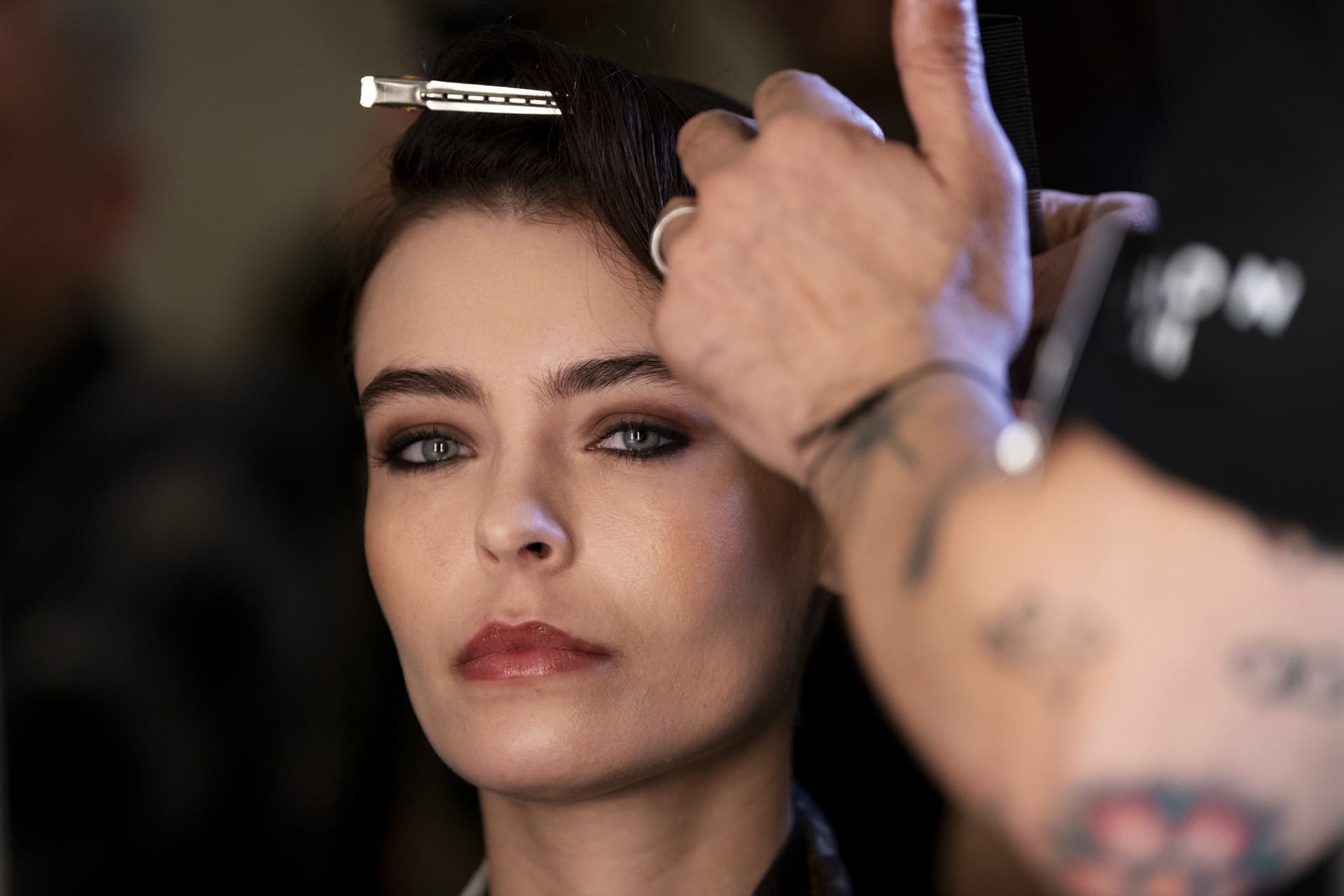
Fashion Month closed out with five beauty directives sharp enough to cut through the noise: a gloss-forward reinvention of the classic red lip, a porcelain doll revival, a lipstick-on-cheeks technique that changes how you think about blush, a renaissance of eye experimentation, and hair so sleek it reads as its own material. Here is how each trend landed, runway by runway.
1. Glossy red lips
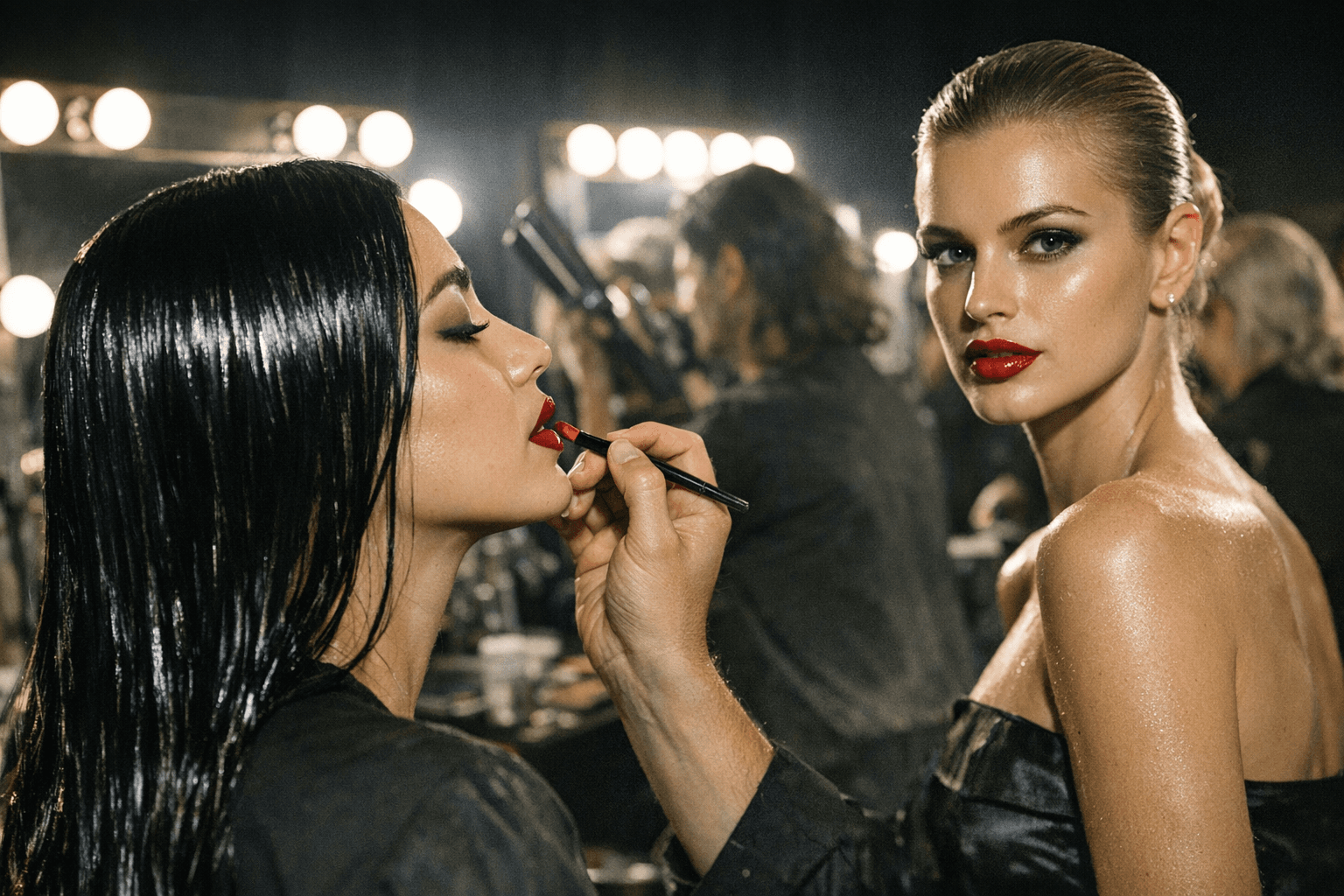
The red lip never truly left, but A/W 2026 handed it a new finish. Where previous seasons favored a flat, opaque matte, this season the color arrived in a high-shine gloss, softer and more sensorial on the mouth. Tom Ford, Lanvin, and Dolce & Gabbana all sent glossy red lips down their runways, and at Dreaming Eli, makeup artists layered the shade over a porcelain-pale base for maximum theatrical impact. The shift from matte to gloss sounds subtle, but on the runway it read as the difference between severity and seduction.
2. Doll-inspired porcelain skin
"Another, perhaps unexpected, trend this season was the return of doll-inspired beauty," as Theindustry Beauty put it, and the evidence was hard to argue with. At Dreaming Eli, skin was made white or kept pale and flawless, a finish that photographer Ian West captured in striking contrast to the models' dramatic red lips. Vivienne Westwood leaned into doll-like lips paired with theatrical silhouettes, while Chopova Lowena and Bora Aksu both worked with pale complexions and softly defined features that gave their looks something romantic and faintly surreal, as though the collections themselves were dreamed rather than designed. The overall effect echoed the runway themes of fantasy and theatricality that ran through each of those shows.
3. Lipstick as blush, in warmer tones
The most technically interesting backstage story of Fashion Month was the shift in how makeup artists approached cheek color, and it came with a product detail worth noting. At Simone Rocha, makeup artist Thomas de Kluyver abandoned traditional blush entirely. "The skin is a little bit rawer than it normally is," he told Vogue backstage, "we've actually taken the Stromboli lipstick from Byredo and dragged it down to the cheeks." The result was an undone, almost ruddy flush that felt lived-in rather than applied. At Erdem, makeup artist Fara Homidi took a softer route, using a light cranberry flush inspired by the "pink satins and red ribbons" in the collection. Zoom out and the shift becomes clear: as Sophie Smith reported in People, while mauve and pink tones dominated recent seasons, A/W 2026 moved decisively toward peach, apricot, and coral hues with warmer, more orange undertones.
4. Eye experimentation: white mascara and abstract liner
Two distinct but related trends emerged in the eye looks across Fashion Month, and both shared a willingness to reject the default. At Par Jane, every model wore white mascara, perfectly coordinated with an all-white collection, a choice the Observer described as directly contrasting "the usual everyday preference for black mascara and eyeliner." Giambattista Valli also worked with white eye makeup. The abstract eyeliner movement, particularly prominent at New York Fashion Week, offered a different kind of freedom: Helmut Lang showed delicate floating liners in varying colors, Eckhaus Latta went bolder with thick black outlines, and Concept Korea presented a dramatic cat-eye. At Jean Paul Gaultier, Thomas de Kluyver collapsed both impulses into one look, pairing a heavy-lined eye with an opaque, wet-look lip to create what Theindustry Beauty called "a striking contrast." Meanwhile, at Proenza Schouler, the directive was intentional imperfection: makeup that appeared artfully askew, smudged, or asymmetrical, matched to unconventional silhouettes.
5. Glass hair and structural parting
The hair complement to all this high-shine makeup was smooth, glass-like hair, a finish The Independent named as one of its five Fashion Month beauty benchmarks. The technique delivers strands that appear liquid: no flyaways, no texture, just a reflective, lacquered surface that treats the hair as an architectural element rather than an accessory. Alongside the glassy blowout, deep side parts with structured hairlines emerged as a recurring motif at New York Fashion Week, creating strong linear silhouettes that extended the geometry of the garments themselves. The effect was less about softness and more about intention: every line placed, every strand directed, beauty treated as draftsmanship. Metallic finishes in makeup ran parallel to this thinking, with chrome glints on lips, luminous eyeshadow, and high-shine nails appearing across multiple presentations, reinforcing that reflectivity was Fashion Month's defining sensory note from scalp to fingertip.
The throughline connecting all five trends is a preoccupation with surface and finish: gloss over matte, porcelain over skin, lipstick dragged where blush belongs, white where black has always been, glass where texture once lived. Fashion Month 2026 was not interested in the undone; it wanted to control exactly what kind of undone you were looking at.
Know something we missed? Have a correction or additional information?
Submit a Tip