Fendi’s Cruise 2027 turns archival cinema into polished wardrobe staples
Maria Grazia Chiuri recasts Fendi’s archive cinema as day-to-night luxury, with Roman imagery, pragmatic tailoring, and a sharper sense of house continuity.
Fendi’s Cruise 2027 turns archival cinema into polished wardrobe staples
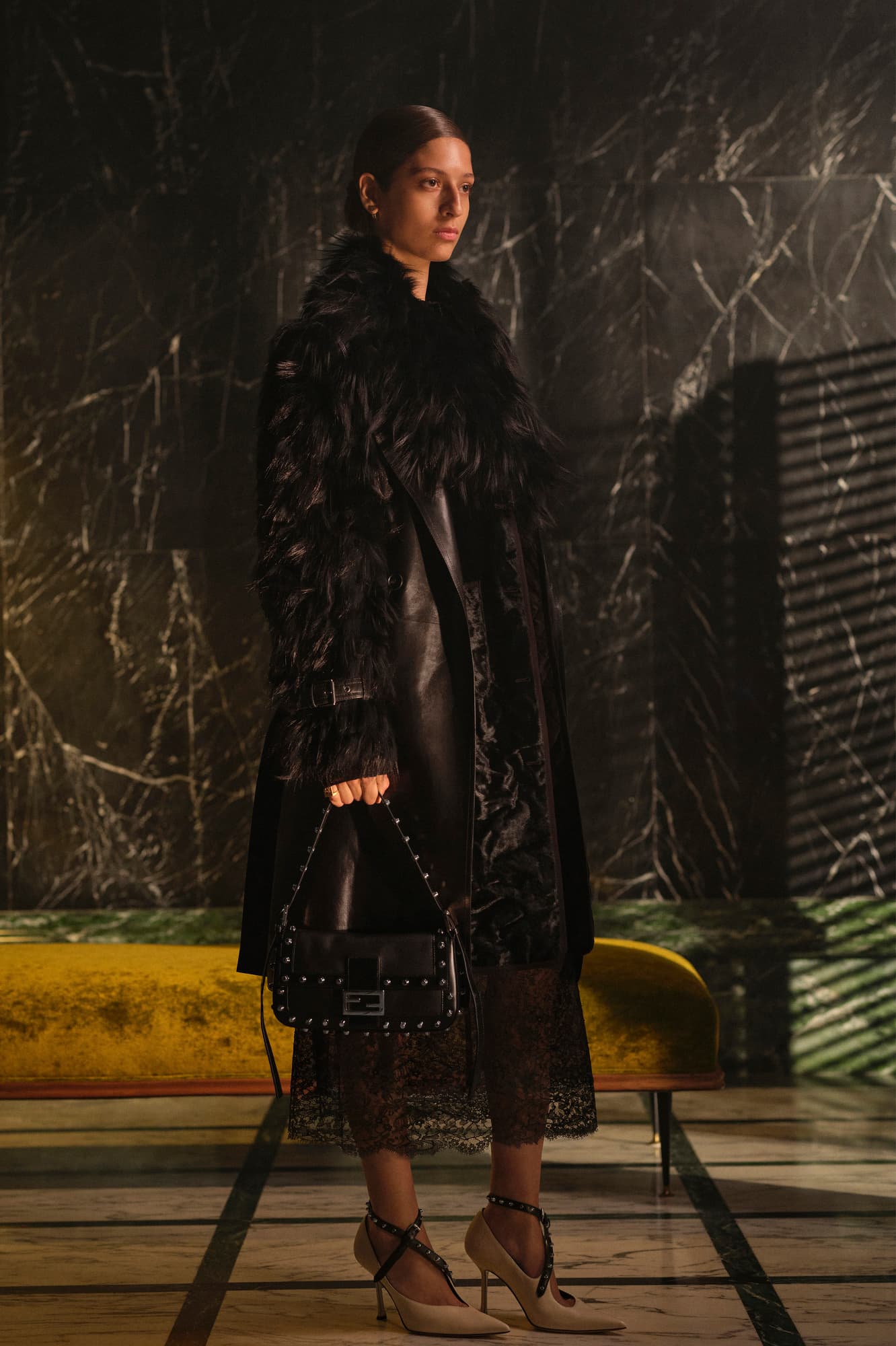
Maria Grazia Chiuri is using Fendi’s Cruise 2027 to do something the best luxury houses understand instinctively: make history feel newly wearable. Presented through a lookbook and the short film *Oltre lo Specchio* rather than a runway show, the collection treats Roman glamour as a working wardrobe, folding archival memory into floor-length trenches, double-breasted suiting, and Baguette bags with just enough shine to read evening.
What makes the collection distinctive is its calm confidence. Chiuri is not trying to out-spectacle Fendi’s past; she is editing it, pulling the house’s cinematic mythology into a more polished, commercially fluent present. The result feels less like a nostalgia exercise than a stewardship story, one in which archive references become a language for modern dressing rather than a museum display.
A Roman film, not a runway, does the heavy lifting
The collection arrived on May 27, 2026, without the drama of a catwalk. Instead, Fendi leaned into a lookbook and *Oltre lo Specchio* - “Beyond the Mirror” - a short film that sets the tone for the whole Cruise offering. Its protagonist, Suzie, a German tourist moving through Rome, becomes the device through which fantasy and reality blur, letting the house revisit its own mythology without locking the clothes into costume.
That choice matters. In an era when luxury brands increasingly mine their archives for emotion and authority, Fendi is opting for atmosphere over explanation. Architecture, marble corridors, mirrors, and sparse sound design do what a loud runway might have done more bluntly: they make the clothes feel embedded in place, culture, and memory. The effect is restrained, but never inert.
Chiuri’s return to Fendi reads like inside knowledge, not outside interpretation
This is Chiuri’s first Cruise collection for Fendi and her second collection overall for the house, following her Fall/Winter 2026 debut in February. That sequence gives the collection real narrative weight. She began her career at Fendi in the accessories department in the late 1980s, so the archive she is now revisiting is not borrowed heritage. It is part of her professional origin story.
That insider intimacy shows in the way she handles the house codes. The collection does not overstate the reference points; it assumes you know Fendi’s visual grammar and simply sharpens it. Parchment-colored materials, signature Baguette bags, and precise tailoring all feel like objects being returned to circulation, not reintroduced as relics. Chiuri’s earlier “Less I, more us” philosophy from her debut still hovers over the clothes, especially in the insistence on a shared wardrobe and on pieces that can move between people, occasions, and moods.
The wardrobe fantasy is practical, but never plain
The strongest clothes in Cruise 2027 are the ones that make utility look expensive. Floor-length trench coats bring sweep and authority without stiffness. Functional flared trousers and double-breasted suiting ground the collection in real life, while menswear counterparts reinforce the sense that these looks are meant to circulate, not sit in one category of the closet.
Even the evening pieces stay tethered to that idea of ease. Soft glamour replaces formal rigidity, so the collection glides from day into night rather than announcing a hard costume change. That is a savvy commercial move as much as an aesthetic one. Luxury consumers are increasingly drawn to clothes that can justify their price through versatility, not just fantasy, and Chiuri’s Cruise offering understands that perfectly.
The key pieces to watch
- Floor-length trench coats with a clean, architectural line
- Functional flared trousers that read polished rather than retro
- Double-breasted suiting and menswear companions built for shared styling
- Leather outerwear finished with plush collars
- Contrast-woven jackets that add texture without noise
- Fuzzy patchwork accessories that soften the collection’s sharper tailoring
- Sequined and leather-lined Baguette bags, including parchment-toned versions and studded finishes
The Baguette remains one of the clearest signals of where Fendi wants to sit commercially. In parchment-colored versions, and especially in the studded, leather-lined treatments, it becomes less a logo object than a tactile anchor for the collection’s palette. The sequined iterations add light, but the key is how controlled the sparkle feels. Nothing looks overworked.
Why the archive reference feels current, not trapped
The explicit nod here is to *Histoire d’Eau*, the 1977 short film commissioned by Karl Lagerfeld and widely regarded as the first fashion film. That lineage gives *Oltre lo Specchio* a lot to work with, but Fendi avoids the obvious trap of simply recreating the past. Instead, the new film uses the old one as a format and a mood, not a template.
That distinction is crucial to understanding Fendi’s current identity. The house is not selling archive mythology for its own sake. It is using cinematic heritage to clarify what Fendi stands for now: Roman polish, accessory authority, and a wardrobe that can feel both cultivated and plausible. In the broader luxury playbook, this is the move many brands are trying to make, but few execute with this level of visual restraint.
Rome remains the house’s most powerful stage
Fendi’s Cruise 2027 also sits inside a bigger Roman narrative. The house will stage Chiuri’s inaugural couture show for Fendi on July 9, 2026, in Rome, making it Fendi’s third couture show in the city. The earlier Roman couture presentations, in 2016 and 2019, already established how seriously the brand treats the capital as both symbol and setting.
The 2016 presentation at the Trevi Fountain marked Fendi’s 90th anniversary, while the 2019 show at the Temple of Venus came with a 2.5 million-euro donation toward restoration. That history matters because it shows how Fendi has long used Rome not just as a backdrop, but as part of its luxury argument: heritage, patronage, and spectacle folded into one brand story.
Crucially, Cruise 2027 feels like the bridge between those grand gestures and the house’s next phase. It is atmospheric without being theatrical, rooted in archive without being frozen by it. In the end, that is the real achievement here: Fendi makes the past look useful again, and in doing so, turns cinematic memory into a wardrobe strategy with commercial muscle.
This article was produced by Prism’s automated news system from verified source data, official records, and press releases, then run through automated quality and moderation checks before publishing. The system is built and supervised by the people who set the standards it runs under. Read our full AI policy.
Did this article answer your question?