Jackie Kennedy’s Givenchy wardrobe defined a landmark 1961 state visit
Jackie Kennedy turned a French state visit into a lesson in restraint, using Givenchy’s clean lines to project polish, authority, and diplomatic ease.
The wardrobe as soft power
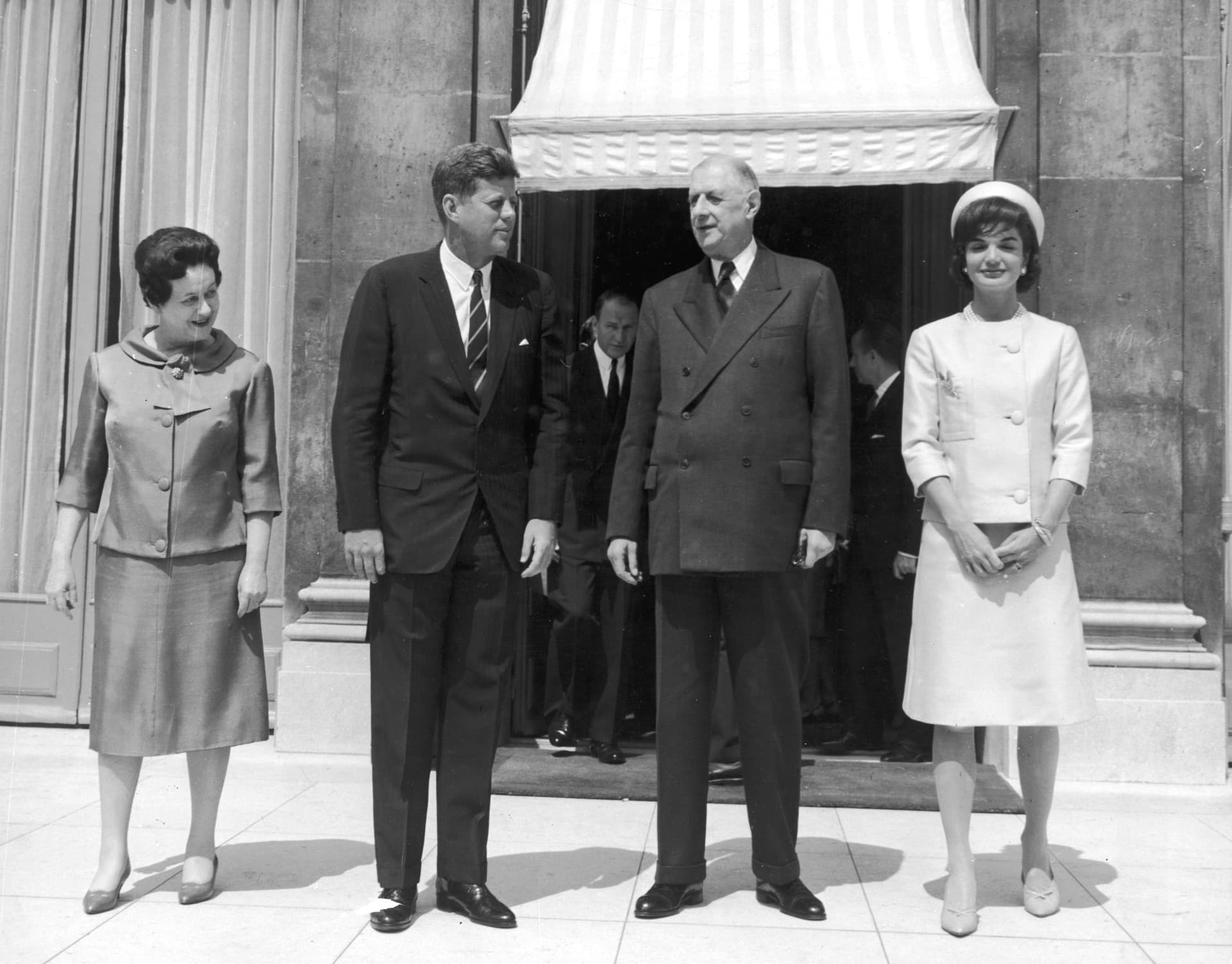
Jackie Kennedy understood that clothes could do more than flatter. They could steady a room, sharpen a message, and make elegance look like instinct. During the French state visit that ran from May 31 to June 2, 1961, she used Hubert de Givenchy’s precise, disciplined tailoring to turn a diplomatic trip into a masterclass in quiet authority.
That is what makes the story endure. The appeal was never excess. It was the opposite: clean lines, French couture precision, and a tightly edited wardrobe that made polish feel effortless. The result still reads like the modern template for high-impact minimal dressing, where restraint does the work that embellishment never could.
A French palace, a tightly managed itinerary
The visit itself was carefully choreographed. The John F. Kennedy Presidential Library and Museum preserves a Paris trip folder filled with itineraries, telephone directories, flight information, car assignments, hotel assignments, and commemorative booklets, a reminder that the whole trip was managed down to the smallest detail. In that kind of setting, clothing becomes part of the briefing.
The most symbolic stop came on June 1, 1961, at Versailles. The Château de Versailles confirms that Charles de Gaulle asked André Malraux to receive John F. Kennedy and Jacqueline Kennedy and oversee the cultural part of the visit. It was also the first official visit by an American head of state to Versailles since Woodrow Wilson in 1919, which gave the day a weight far beyond a single photo opportunity.
Then came the state dinner, the kind of event that turns dress into diplomacy. Secondary reporting and fashion-history accounts say about 150 guests attended, with a six-course meal served on Napoleon’s gold-trimmed china. The setting alone made every detail feel consequential, from the Hall of Mirrors to the evening gowns catching the light.
Why Givenchy mattered
Hubert de Givenchy was no outsider waiting to be discovered. The John F. Kennedy Presidential Library and Museum notes that he founded the House of Givenchy in 1952, debuted his prêt-à-porter collection in 1954, and introduced the Balloon coat and Baby Doll dress in 1958. By 1961, he was already one of Paris’s most influential couturiers, with a language of style built on line, proportion, and controlled ease.
That mattered because Jackie’s wardrobe for the visit was not simply beautiful. It was strategic. WWD’s retelling frames the commission as a landmark moment in French-American style history, and that is exactly right. An American first lady in French couture on French soil could have looked like an obvious provocation. Instead, it looked like fluency.
A later interview recap says Jackie initially worried about being dressed by a French designer for the state visit, and that fittings were done in secret. More than 10 or 15 pieces were made that way, which tells you everything about the operation behind the scenes. What looked effortless in public was actually an exercise in careful concealment, with every seam supporting the illusion of ease.

The pieces that still define the lesson
For the Versailles dinner, Jacqueline Kennedy wore a Givenchy gown. That choice anchored the evening in the kind of formal minimalism that does not need decoration to feel memorable. The drama came from line and posture, not from overload. In a room built for grandeur, she chose precision.
The next day, she changed into a Givenchy ladies’ gray suit for a Louvre tour with André Malraux on June 2, 1961. The same suit later appeared again in New York on September 21, 1961, when she wore it for President Kennedy’s address to the United Nations. That repeat wear is one of the most useful details in the whole story. It shows that real polish is not disposable. It is repeatable.
- Choose one sharply tailored piece with a clean shoulder and an unbroken line through the body.
- Favor a quiet color, such as gray, ivory, navy, or black, so the cut does the talking.
- Repeat the strongest pieces instead of treating each outing like a costume change.
- Keep accessories disciplined, so the silhouette stays in focus.
The gray suit is the clearest part of the formula to borrow now:
That is the heart of effortless style. Not more pieces, but better ones. Not a wardrobe that shouts, but a wardrobe that calibrates.
What makes the look feel modern now
Jackie’s Givenchy wardrobe still resonates because it understands proportion. The gown at Versailles and the gray suit at the Louvre were different garments, but they shared the same discipline: no visual clutter, no overstatement, no desperate attempt to look current. The clothes gave her room to look composed, which is still the most powerful kind of luxury.
The lesson is especially relevant now, when minimal dressing can so easily become bland if the tailoring is soft or the fabric feels thin. Jackie’s version of minimalism had structure. It had couture exactness. It had enough discipline to look serene under pressure, which is why it has lasted far longer than any trend label attached to it.
There is also a modern lesson in the secrecy. The wardrobe was not built to perform spontaneity; it was engineered to create it. That kind of preparation is what makes elegance read as natural. The best minimalist dressing is rarely casual in the making. It is edited, fitted, and repeated until the effect feels inevitable.
Jackie Kennedy’s 1961 French state visit remains a benchmark because it shows how style can carry political and cultural weight without losing its lightness. Givenchy gave her the kind of wardrobe that made authority look graceful, and grace look fully in command.
This article was produced by Prism’s automated news system from verified source data, official records, and press releases, then run through automated quality and moderation checks before publishing. The system is built and supervised by the people who set the standards it runs under. Read our full AI policy.
Did this article answer your question?