Sudoku Packing: Nine Pieces, Twenty-Seven Outfits, Zero Travel Stress
Nine pieces of clothing. The Sudoku packing grid builds 27 outfits from a single carry-on, and celebrity stylist Vanessa Powell has been doing it for over a decade.
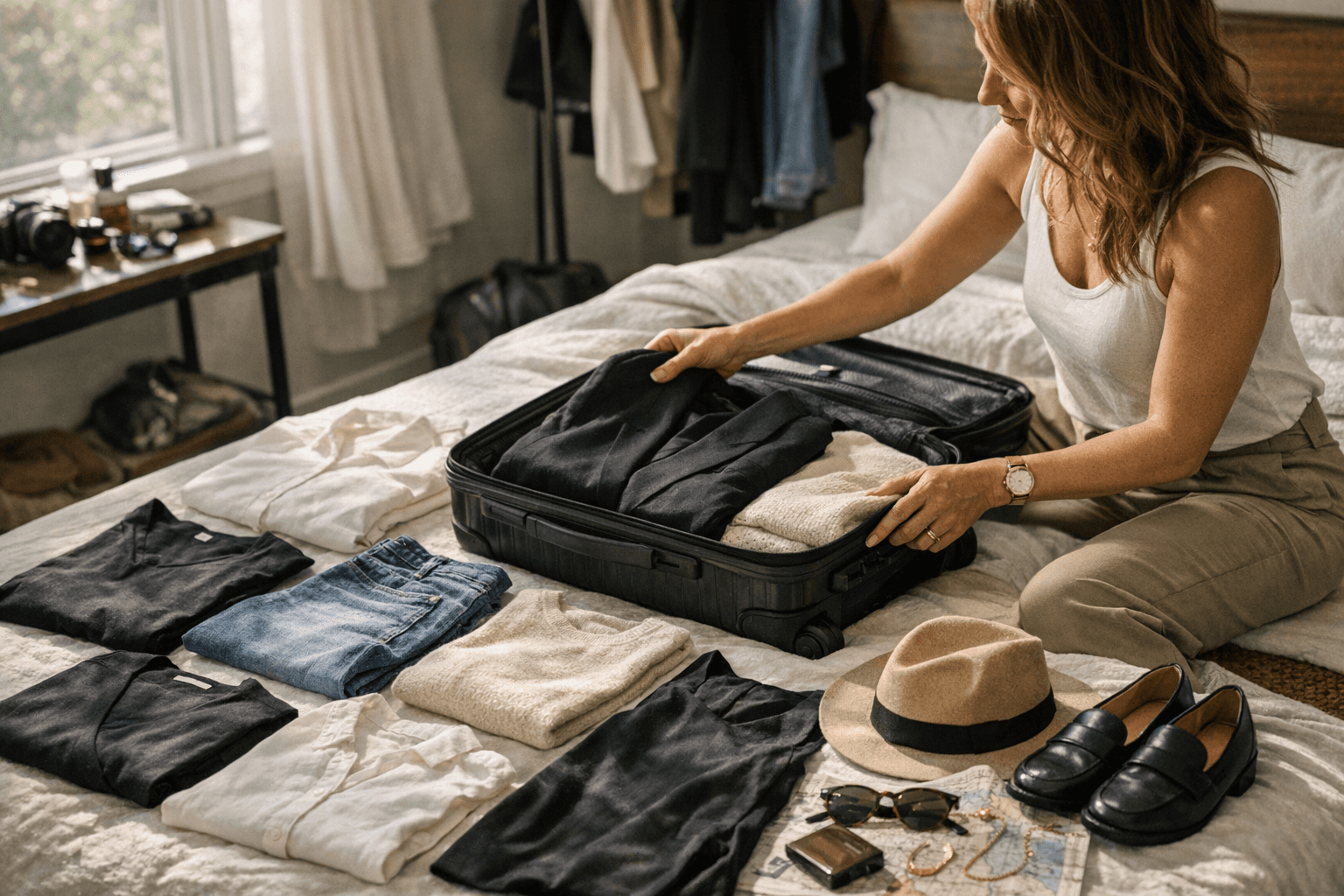
Nine pieces of clothing. That's it. Not a carefully negotiated 15-piece edit or a rolling rack of options squeezed into a checked bag and hoped for the best. Nine pieces, arranged in a clean 3x3 grid, capable of generating at least 27 distinct outfits before you've accounted for a single shoe or scarf. Celebrity fashion stylist Vanessa Powell has been working this way for years: "I have been Sudoku packing for over a decade — before I even knew there was a term for it." Now the method has a name, a mathematical backbone, and two experts to break down exactly how to build your own grid before your next departure.
The Grid Explained
Sudoku packing takes its name from the puzzle logic at its core: every piece must interact with every other piece. Expert organizer and founder of The Organized Mama, Jessica Litman, defines the structure precisely: a grid made up of three tops, three bottoms, and three layering pieces, like jackets or sweaters. All nine items should be wearable interchangeably, functioning in Powell's words like "a styling puzzle." Nothing exists in isolation, nothing serves only a single outfit, and nothing earns its place in your suitcase just because you love it. It earns its place because it connects.
The Math That Makes It Work
Three tops. Three bottoms. Three layers. The arithmetic is almost satisfying in its neatness: 3 x 3 x 3 = 27. If each top pairs with each bottom, and each layering piece can be worn over any of those nine base combinations, you have at least 27 wearable configurations before your shoes and accessories enter the equation. That "at least" is doing real work: shoes change the register of an identical outfit from casual to event-ready, and a scarf can shift the same look across three different moods. Powell calls the system "essentially the capsule wardrobe process, but for one suitcase," and that framing is precise. This is not a minimalism philosophy. It's a packing method with a formula and a result.
Your Three Tops
The tops row sets the palette and the energy of the entire grid. For the system to function, each top needs at least two clear pairing options across your bottoms, and at least one should sit cleanly under a jacket or layer without losing its proportions. Think of the three slots as covering three different registers: one foundational piece (a white or cream tee, a fitted ribbed knit, a silk shell), one that carries visual interest (a stripe, a subtle print, a color accent), and one transitional piece that can read as either a top or a light layer depending on how it's styled. The critical rule is shape variation: three tops of identical silhouette produce combinations that look nearly the same, which defeats the purpose of building 27 outfits.
Your Three Bottoms
The bottoms row demands the most versatility of any tier in the grid, because every bottom must work credibly with all three tops. That means looking for pieces that don't enforce a single mood or occasion. A dark straight-leg jean reads relaxed with a tee and pulled-together with a silk blouse. A pair of tailored trousers shifts from professional to weekend depending entirely on the shoe choice. A midi wrap skirt navigates from dinner reservations to a Saturday morning market without needing a costume change in mindset. The test for every candidate bottom is simple: hold it up against all three tops and confirm it works for at least two different occasions per pairing. If it only earns one use-case per combination, it's not carrying its weight.
Your Three Layering Pieces
The layering row is where Sudoku packing separates itself from a basic capsule edit. Litman gives jackets and sweaters as the defining examples, but the category is broader than outerwear. A layering piece is anything that completes an outfit rather than constituting one on its own. It absorbs temperature swings without requiring duplicate base outfits, which is precisely why the method is positioned as particularly well-suited to variable spring conditions. Each layering piece must sit over any of your nine base combinations without visually competing with them, which means texture and tonal weight matter as much as warmth or function.
Shoes and Accessories: The Multipliers
The 27-outfit count is the floor, not the ceiling. Powell is explicit about this: "every shoe, every accessory, should be able to mix and match and be worn across multiple outfits." Three shoes is a workable ceiling (one worn onto the plane, two packed), complemented by two bags and one scarf or statement accessory. A white sneaker makes a blazer-and-trouser combination look downtown-casual; a block-heeled sandal renders the same combination event-appropriate. A silk scarf worn at the neck differs entirely from the same scarf tied to a bag handle. "Every item earns its place by being versatile, re-wearable, and able to play well with everything else in your suitcase," Powell says, and that standard extends to every piece with a buckle, strap, or lace.
The Color Story
None of this logic functions without a cohesive color palette. Packing with a cohesive color story in mind is explicitly what enables effortless mixing and matching; without it, the grid collapses into a collection of items that simply don't connect. The most efficient approach is to anchor the palette in one or two neutrals (navy, white, cream, camel, stone, black) and introduce one accent color that recurs across at least two rows of the grid. This is not an argument for packing boring, monochromatic looks. A coral stripe top works with navy trousers and a cream blazer; a terracotta linen shirt bridges white wide-legs and a denim jacket. The palette is the permission structure that makes every combination viable before you even leave the house.
Sample Warm-Weather Grid
In high summer, the layering row adapts rather than disappears. Heavy outerwear is replaced by pieces that add visual dimension without adding temperature. A practical warm-weather Sudoku grid looks like this:
- Tops: a white linen shirt, a striped cotton tee, a sleeveless cami in a neutral or accent tone
- Bottoms: wide-leg linen trousers, a midi wrap skirt, tailored shorts
- Layers: a lightweight cotton shirt dress (worn open over a tank as a layer), a denim jacket for air-conditioned restaurants and museums, a fine-knit cardigan for evening
Every top pairs with every bottom. The shirt dress earns double duty as both a standalone outfit and a layer over the cami and shorts. The denim jacket handles the relentless chill of summer interiors and still looks intentional worn over a wrap skirt at lunch.
Sample Cold-Weather Grid
In cooler months, the layering row carries more thermal and visual weight, but the structural logic is identical:
- Tops: a silk blouse, a fitted ribbed turtleneck, a slim cream or white knit top
- Bottoms: dark straight-leg jeans, navy tailored trousers, a midi wrap skirt
- Layers: a classic trench coat, a fitted blazer in a warm neutral, a light cashmere or fine-wool cardigan
The trench and blazer each shift the register of the same trouser-and-blouse pairing from polished to downtown to dinner-ready. The cardigan softens every combination it touches. A single puffer vest can extend the grid toward colder temperatures without displacing any of the nine core pieces if the destination demands it.
Once the grid is mapped, execution is straightforward. Litman swears by packing cubes to store the Sudoku capsule, giving each row its own cube: one for tops, one for bottoms, one for layers. The result is a carry-on that unpacks with precision and re-packs with the same speed at checkout. The cube system also works as a built-in edit: if a garment doesn't slot logically into one of the three rows, it doesn't make the trip. Powell's framing holds from the first piece selected to the last: "When packing for a personal trip, it's truly the key to success." The grid scales to any destination and any season. What doesn't change is the discipline of building it before you open the suitcase.
Know something we missed? Have a correction or additional information?
Submit a Tip