Ten Pieces That Make Your Wardrobe Look Quietly Expensive
Ten pieces, a neutral palette, and the math that proves you don't need a designer budget to look like you have one.
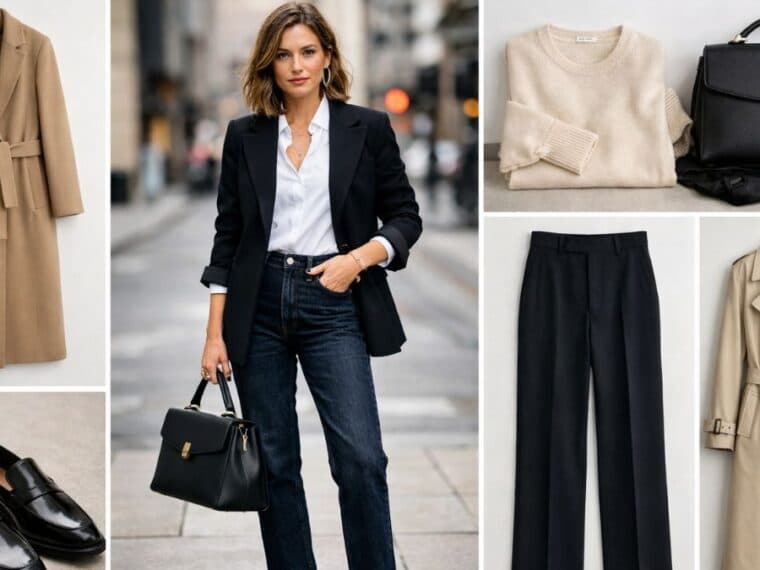
Opening a wardrobe that looks expensive is mostly a construction problem, not a budget one. The right ten pieces, chosen with attention to fabric weight, cut, and color coherence, do more visual work than thirty poorly chosen ones. What follows is a plug-and-play capsule built around a single neutral palette (cream, camel, stone, warm white, and black), sourced from the mid-market brands that have genuinely figured out the elevated basics problem: COS, Arket, & Other Stories, and Uniqlo. The total cost lands between $700 and $1,100. Averaged across five years of consistent wear, that's under $1 per outfit per day.
The Tailored Blazer
This is the piece that does the most work per square inch. A good blazer signals intention and transforms every other combination in this capsule. The shopping criteria is specific: look for a canvas or half-canvas construction rather than full fusible interlining (the fabric at the jacket's front should move slightly independently from the lining), clean welt pockets rather than flap pockets, and a back vent that lies flat when you stand still. COS delivers on all three for around $200, which calculates to roughly $2 per wear if you reach for it twice a week over two years. That math comfortably beats a $45 fast-fashion blazer worn eight times before the interlining bubbles.
Once you have it, alter it. A two-centimeter sleeve shortening costs around $25 at most tailors and immediately makes an off-the-rack jacket read as custom. Swap the standard plastic buttons for horn or corozo resin ones, around $15 for a full set, and the difference is visible up close. Styling reach: blazer over a cashmere knit for office days; blazer over a tee with straight-leg trousers for smart casual; blazer over the midi dress with ankle boots for evening. One piece anchoring three distinct registers.
The White Button-Down
The single most versatile piece in this capsule, and the one most people get wrong by choosing too thin a fabric. You need a poplin at a minimum weight of 100 to 120 gsm, or a cotton-linen blend that holds its shape without ironing. A shirt that collapses under its own weight looks cheap at any price. Arket's cotton-poplin shirts sit in the $90 to $110 range and consistently hit this specification.
Wear it fully tucked for a clean silhouette with high-waisted trousers. Half-tuck it (just the front hem, pulled through at one hip) with straight-leg trousers and loafers for that deliberately unconstructed look. Layer it open over a quality tee. Button it over the midi dress. Each variation reads as a distinct outfit; the white button-down alone accounts for six to eight combinations in this capsule, which makes it pound-for-pound the highest return piece here.
The Cashmere Knit
The share-worthy number on this piece: Uniqlo's 100% cashmere crew and V-neck sweaters are entirely hand-washable. The perceived high-maintenance of cashmere is, at this price point, a myth worth correcting. At roughly $80 to $100 for the same fiber content found in $400 designer versions, the cost-per-wear argument is almost embarrassingly strong. The construction is not identical to Loro Piana, but the fiber is, and from across a room, no one is distinguishing gauge from ten feet away.
What does distinguish quality is gauge: look for a closer-knit, slightly heavier weight (12-gauge and above) that drapes with gravity rather than floating open. This pills less, holds its shape through a full season, and reads as more refined than an airy open-knit. In camel, cream, or oatmeal, it layers under the blazer with a shirt collar visible at the neck, sits over the white button-down for a texture contrast that reads as intentional, or works alone with straight-leg trousers on a weekend.
The Perfect Straight-Leg Trouser
Straight-leg, specifically. Not wide, not tapered, not cropped: straight from hip to hem. It's the cut that works across the broadest range of body proportions and pairs with the most shoe silhouettes. Fabric criteria: a wool-blend crepe or technical twill with enough weight that the trouser leg holds its form as you move. A trouser that clings or balloons by mid-morning undermines every other elevated choice you've made. Lined trousers, even a half-lining to the knee, hold their structure through a full day. COS and Arket both offer lined straight-leg styles in neutral crepe from $90 to $130.
Hemming is non-negotiable, full stop. Fifteen to twenty dollars at a local tailor, and the difference between a trouser that grazes the ankle bone cleanly and one that puddles at the foot is, aesthetically, everything.
The Quality Tee
Not every piece in this capsule requires significant investment, and the quality tee is where you save, provided you apply one non-negotiable filter: fabric weight. A cotton tee under 160 gsm will be translucent under a blazer or knit, which eliminates its core function as an underlayer. Uniqlo's Supima cotton tees at $15 to $20 hit approximately 175 to 180 gsm, which is dense enough to wear solo or as a base. Stick to white, cream, and black with zero graphics and zero branding. This is not the piece that expresses personality; it's the piece that makes every other piece look better.
The Neutral Midi Dress
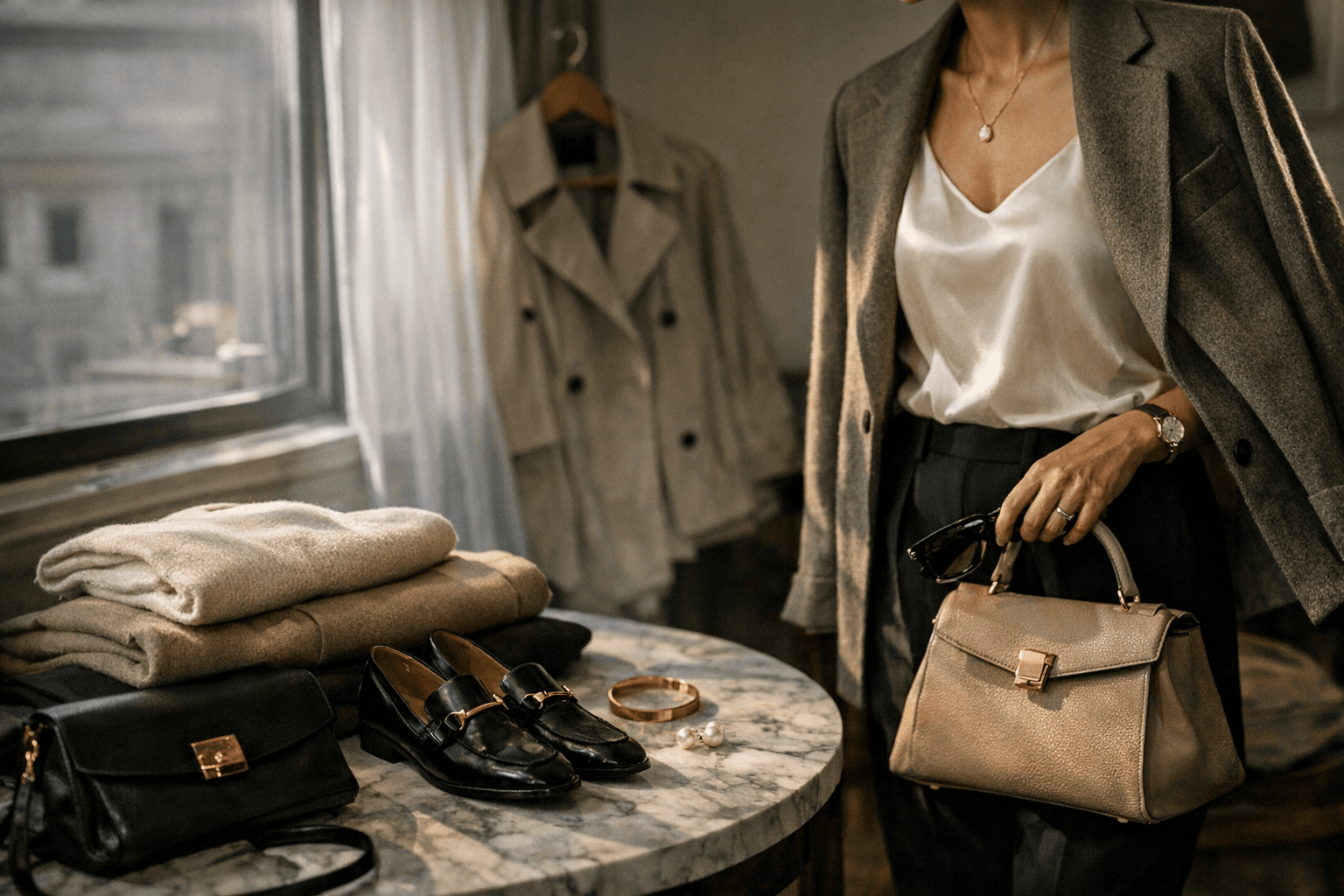
The midi dress is the capsule's quiet multiplier. Alone with loafers, it's a complete outfit. With the blazer draped over it and ankle boots, it shifts into evening territory. Belted at the waist with the trench coat open over it, it reads as a full spring look. Layer the cashmere knit over a fluid midi for an unexpected texture pairing that signals fashion awareness rather than playing it safe. & Other Stories produces a consistent range of neutral slip-style and structured midi dresses in the $100 to $150 range that carry all of these combinations.
Look for a neckline simple enough to layer: a V-neck or clean scoop works across every combination; a complicated collar fights with everything you put over it. Choose a length that sits at or below the knee rather than exactly at it, which can visually compress the leg.
The Versatile Trench
The trench belongs to no single era, no single occasion, and no particular dress code, which is precisely why it works here. A cotton-gabardine trench in camel or stone coordinates with every other piece in this capsule. The proportions matter: the hem should fall below the knee so it layers cleanly over the midi dress, and the sleeve length should fit as-bought without alteration. Arket and & Other Stories produce clean-lined options without the aggressive heritage branding of Burberry, at a fraction of the cost.
Belt it at the waist over a cashmere knit and trousers for a put-together weekend look that requires no further thought. Leave it unbelted over a midi dress with loafers for spring dressing at its most effortless.
Classic Loafers and Ankle Boots
These two shoes cover the full seasonal range of this capsule and represent the deliberate spend category. Construction quality shows immediately at the foot: cheap leather creases aggressively at the toe after a few wears and loses its profile, while a well-made leather sole develops a patina that looks intentional rather than worn out. Expect to spend $150 to $250 for a leather loafer with a genuine leather or Goodyear-welted sole rather than a cemented one. The cemented sole (where the upper is glued to the base rather than stitched) cannot be resoled, meaning a $60 loafer worn daily for a year costs more per wear than a $200 pair resoled twice over four years.
The loafer pairs with every bottom in this capsule. A low-block or Chelsea ankle boot in black or tan carries the midi dress and straight-leg trousers equally well from October through March.
The Refined Tote
One structured tote in leather or high-quality vegan leather replaces three handbags in a less coherent wardrobe. The key specification is interior structure: a firm base and sides that don't collapse when the bag is empty, because a shapeless tote signals cheap regardless of the material. In terms of color, tan and camel outperform black here; they add warmth to an all-neutral outfit rather than simply grounding it. & Other Stories and Arket both produce leather totes in the $120 to $200 range that hold their form across years of daily use, which is the real quality test.
Minimal Jewelry
Jewelry in this capsule functions as punctuation, not decoration. A thin gold chain over a white button-down, one fine ring alongside a cashmere knit, small gold hoops with the midi dress: each choice signals restraint, which in the context of a quiet, neutral wardrobe reads as confidence rather than absence. Gold-plated brass pieces from & Other Stories and Arket start at $20 and, with minimal contact with perfume and water, maintain their finish reliably. The rule is straightforward: one statement piece maximum per outfit, everything else kept quiet.
The total investment, shopped carefully from these four brands, comes in at under $1,100. Across twenty-five-plus outfit combinations and five years of wear, the cost-per-outfit-per-day figure is one most designer wardrobes can't touch. The expensive look was always a math problem in disguise.
This article was produced by Prism’s automated news system from verified source data, official records, and press releases, then run through automated quality and moderation checks before publishing. The system is built and supervised by the people who set the standards it runs under. Read our full AI policy.
Did this article answer your question?