Circular Fibers Scale Up as Traceability Systems Go Mainstream in 2026
Circ partnered with Xinxiang Bailu, the world's largest viscose filament producer, as OnceMore's traceability rollout hits supply chains ahead of EU Digital Product Passport rules.
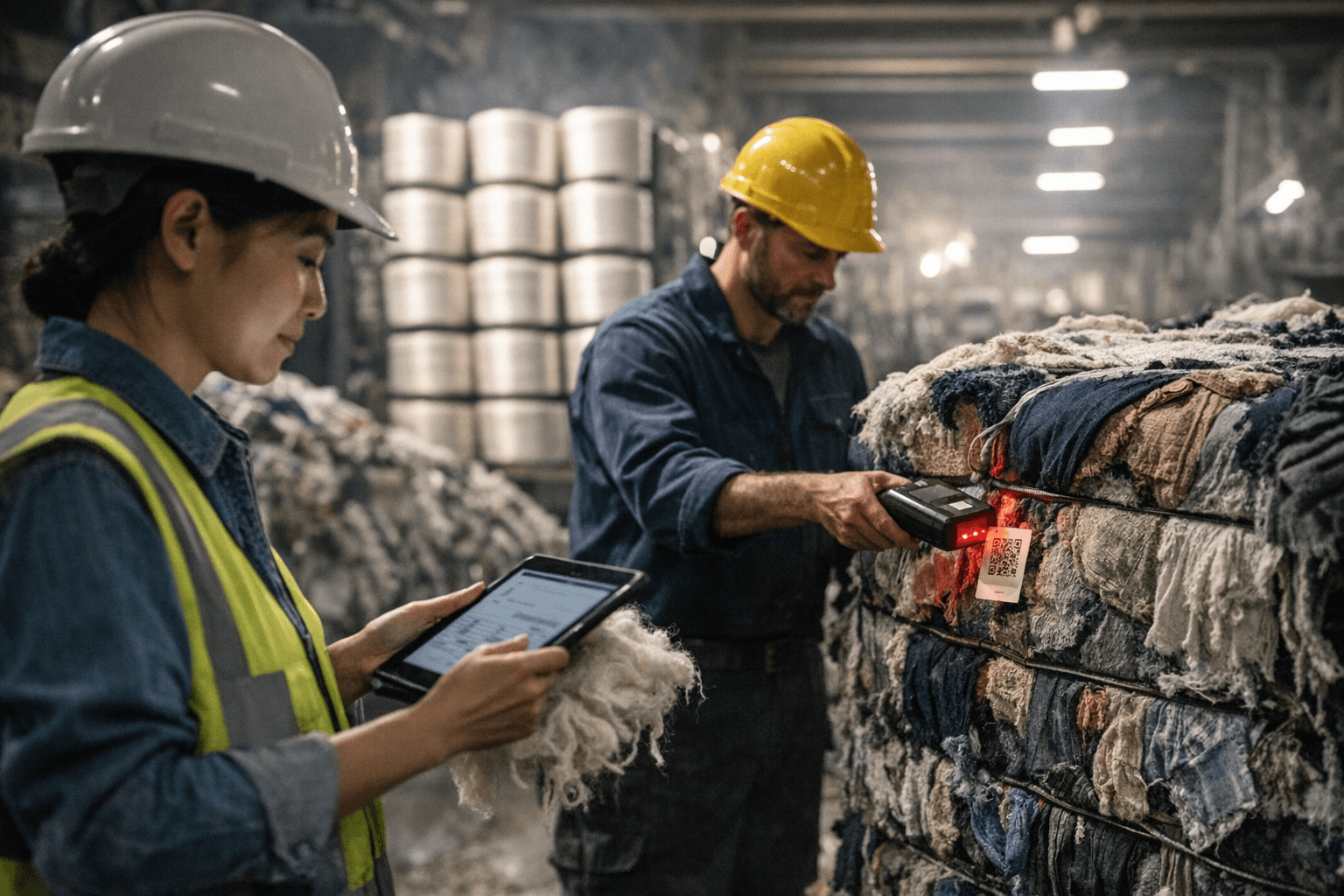
Three developments landed simultaneously this week that, taken together, signal the infrastructure for credible circular fashion is finally being built rather than merely promised.
Polycotton recycler Circ deepened its presence in Asia by announcing that Xinxiang Bailu Chemical Fiber, a Canopy-verified "dark green shirt" producer of viscose filament yarn, would be a commercial partner in China. Under the arrangement, Xinxiang Bailu Chemical Fiber will procure Circ's recycled pulp for use in its commercial-grade viscose filament production. The company holds the world's largest viscose filament production capacity, which makes the partnership less a symbolic handshake and more a genuine route to scale. The viscose filament produced will serve global fashion brands and mills in China, the world's largest textile manufacturing hub.
Circ CEO Peter Majeranowski and Bailu general manager Ji Yudong were photographed together at the partnership's signing ceremony. Majeranowski framed the deal in explicitly infrastructural terms: "By anchoring our technology within world's leading fibre manufacturers, we're accelerating the shift toward a truly circular textile economy and building the infrastructure required to scale it worldwide." Circ concluded a $25 million funding round last year with plans to scale its technology industrially, and the Xinxiang Bailu agreement positions that capital within one of China's most established fiber production networks. The company has already forged public partnerships with Zara, Mara Hoffman, United Arrows, and Christian Siriano.
On the data side, the week's equally significant news came from OnceMore's integration with TextileGenesis. OnceMore from Södra, the world's first large-scale process for recycling blended fabrics into high-quality dissolving pulp, will begin using TextileGenesis, a Lectra company, to strengthen traceability from raw material to retail across the value chain. The rollout is already underway. OnceMore's supply chain partners are currently being onboarded, using the platform's modules to capture consistent data and conduct transactions. TextileGenesis's Fibercoin token technology generates digital tokens linked to material volumes, creating a secure and verified digital footprint at each transformation stage.
Amit Gautam, founder and CEO of TextileGenesis, put the stakes plainly: "OnceMore is one of the strongest circular innovations in MMCF today, and this rollout shows what it looks like to operationalize traceability at scale. By embedding traceability directly into material transactions, this rollout creates the verified data infrastructure needed for regulatory compliance, brand accountability, and credible circularity claims." The regulatory pressure driving that urgency is real: the integration directly strengthens authenticated recycled-content claims and provides a stronger data foundation for product-level disclosures and upcoming regulatory requirements, particularly in preparation for the EU Digital Product Passport.
At the product end of the circular spectrum, Vivobarefoot announced the launch of the Gobi II Sneaker Leather, a step forward in regenerative design created in partnership with Natural Fiber Welding, featuring the innovative NFW Pliant outsole that blends timeless sneaker aesthetics with a radically natural construction. Crafted from 98 percent natural materials, it marks significant progress toward the brand's goal of producing 100 percent natural, regenerative barefoot wear. The NFW Pliant outsole is made from 100 percent natural rubber, offering durability and flexibility without reliance on synthetic plastics. The upper draws from chrome-free leather sourced from Buriram and Hyphalite with soft cow suede; the lining uses chrome-free Ayutthaya leather, laces are organic cotton, and the insole is cork. Customers are encouraged to return worn pairs through Vivobarefoot's Revivo program, extending the product lifecycle and reducing waste.
What unites these three moves is not aesthetics but architecture. Circular claims in fashion have long been easy to make and nearly impossible to verify. The Circ-Xinxiang Bailu deal routes recycled pulp into the world's highest-capacity viscose filament lines. The OnceMore-TextileGenesis rollout gives every gram of that kind of material a digital chain of custody before regulators demand one. The Gobi II demonstrates what the finished product looks like when both supply chain discipline and materials science arrive at the same last. The infrastructure is no longer theoretical.
This article was produced by Prism’s automated news system from verified source data, official records, and press releases, then run through automated quality and moderation checks before publishing. The system is built and supervised by the people who set the standards it runs under. Read our full AI policy.
Did this article answer your question?


