Digital Product Passports Let Shoppers Verify Fashion Claims Instantly
Scanning a label is about to mean something entirely different: the EU's Digital Product Passport turns every garment's QR code into verified proof of where it came from and where it can go next.

Fashion's sustainability promises have always been easy to make and nearly impossible to verify. That's the structural problem Digital Product Passports are designed to fix, not by adding another eco-label to a hangtag, but by turning the garment itself into a verifiable data record that travels with it for life.
The Digital Product Passport is a scannable ID revealing an item's full origin, composition and care history. Think of it less like a label and more like a file that never closes. A DPP essentially creates a digital twin of a physical product and securely records event, transactional and sustainability-based data from across the product's lifecycle. Bluecherry frames it plainly: "A Digital Product Passport is essentially a structured digital record that travels with a product throughout its lifecycle, containing detailed information about how that product was made, what it contains, and how it can be repaired, reused, or recycled." The analogy they offer is almost too apt: think of it as a permanent digital profile, not unlike a medical record.
Why this is happening now
In June 2024, the Digital Product Passport was officially approved by the EU as part of the Ecodesign for Sustainable Products Regulation (ESPR), a framework regulation that applies to any apparel and footwear company selling in the EU, no matter where they are based. The legislation passed in July 2024, and as of September 2025, designers and fashion houses are getting their first look into what they can expect for 2027: a new standard for transparency, circular revenue and, most importantly, consumer trust.
The timeline is tighter than it sounds. The delegated acts, the detailed rules for compliance, will be finalized in 2027, with enforcement expected 12 to 18 months later. That's just six fashion seasons for brands to embed passport data into every SKU. For brands selling in the EU, the message is clear: transparency, traceability, and structured product data will soon be legal requirements, not voluntary sustainability initiatives.
There are scope boundaries worth knowing. The requirement for Digital Product Passports comes from the EU Ecodesign for Sustainable Products Regulation (ESPR). Textiles and apparel are first in line, with an indicative adoption year of 2027. Footwear, however, is not included in the 2025 to 2030 Working Plan, and categories already regulated under the Energy Labelling Framework will not receive DPPs. Any brand placing textile products on the EU market, regardless of headquarters location, must comply with DPP requirements to maintain market access.
How to access a passport: the mechanics
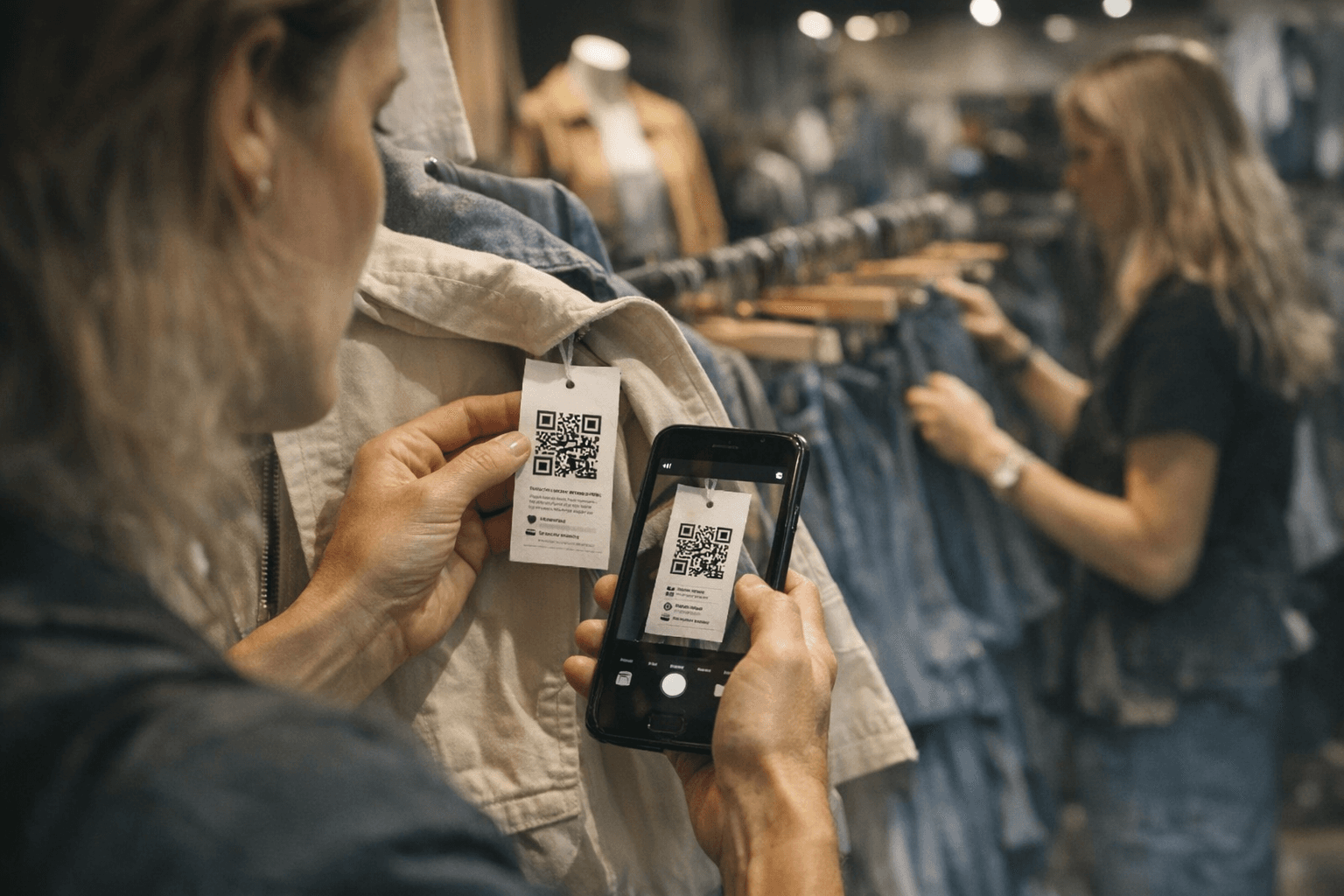
The physical-to-digital bridge is deliberately low-friction. Each product is assigned a unique digital identity, usually accessed through a QR code or NFC tag on the garment. When scanned, the Digital Product Passport displays structured information such as materials, care instructions, supply chain stages, and sustainability data.
By using a smartphone to scan a digital identifier, for instance a QR code printed on or attached to a product, a consumer will be directed to the product's associated DPP in the cloud, where they can view data such as the materials used, ownership history, and recycling instructions. Some brands are also exploring embedded widgets on garment labels and direct URLs as access points alongside QR and NFC options. The DPP chapter in the ESPR regulation is based on a decentralized approach for data storage, requiring a unique link to the product.
What you'll actually find inside
The passport is not a single standardized page, at least not yet, but across the industry there is strong consensus on what it will contain. Expect to see:
- Raw material origins and the countries where each stage of manufacturing occurred
- Full fiber composition and material percentages
- Supplier identifiers and production site details
- Certifications obtained and lifecycle analysis (LCA) data
- Environmental impact metrics, including real-world equivalences like carbon emissions reduced or water saved
- Repairability indicators and repair logs
- Care history and end-of-life guidance for recycling or resale
- Distribution and assembly data
For textiles specifically, DPPs are expected to demand comprehensive information on fibre composition, chemical treatments, water consumption metrics, worker welfare documentation, and detailed care instructions supporting long-term durability. Greenstory notes that brands can use this data layer to tell compelling sustainability stories, "displaying data points and real-world equivalences (like the number of trees saved or carbon emissions reduced)" to connect with consumers on a values level, not just a compliance one.
What it means for shoppers
This is where the DPP shifts from regulatory infrastructure to genuinely useful shopping tool. By making this information accessible, the DPP empowers consumers and other stakeholders to make informed buying decisions, promoting greater transparency and accountability in the production and consumption of goods.
In practical terms: scan the label before you buy. Check where the cotton was grown, which facility assembled the garment, and whether the brand holds the certifications it claims on its website. Amid a rise in dupes, Digital Product Passports will help consumers easily verify a product's authenticity. By simply scanning the label, consumers can access detailed information about the entire manufacturing process, which will help build trust in a brand.
The passport's value doesn't expire at checkout. As Digital Product Passports will need to include details of end-of-life options, brands can leverage this to engage with younger audiences and streamline the resale process. DPPs will also enable companies to maintain contact with customers and offer circular aftersales options such as repairs. Istitutomarangoni captures the longer arc well: "These passports extend well beyond the first purchase. By enabling product-level traceability, they underpin repair, resale and reuse ecosystems, allowing garments to be tracked over time, disassembled where necessary, and reintroduced into the market with verified data attached."
Younger consumers, particularly Gen Z, show much higher levels of interest in buying clothes with information on the label about end-of-life, compared to the average shopper. Growing numbers of Gen Zs contribute to circular fashion trends and sell clothes they no longer wear and are consciously purchasing items from brands that resell well, as they increasingly make value judgements on the long-term value of products.
The circular economy angle
The DPP's deepest purpose is structural. The requirement stems from the EU ESPR framework, introduced because the Circular Economy framework highlights that up to 80% of a product's environmental impact is determined at the design stage. A garment's data record, if maintained correctly, becomes the backbone of the circular economy: recyclers know exactly what fibers they're working with, resale platforms can verify authenticity instantly, and repair services can access a product's full history before touching a seam.
Bergans of Norway, for example, trialled Digital Product Passports by incorporating its end-of-life services into a QR code, making take-back and repair options immediately visible to the buyer. Womenswear brand Nobody's Child was one of the early adopters when it trialled DPPs on its denim collection, driving engagement by offering customers who scanned the QR code a gift including money to spend on a shopping spree. These pilots demonstrate that the passport is as much a commercial tool as a compliance one.
The implementation challenge brands face
Compliance looks straightforward from the outside. The reality is considerably more complex. Bluecherry puts it plainly: "Each of these systems holds part of the product story. But Digital Product Passports require brands to connect all of those pieces into a single lifecycle narrative. That means the product data created during design must remain connected to information generated during sourcing, production, distribution, and even resale. Which is easier said than done."
For brands, this data is managed in a central platform and can be updated over time, supporting compliance, reporting, and transparency as regulations evolve. The challenge is that most brands have never had to maintain a continuous, auditable data thread across every supplier tier. Supply chain data is frequently fragmented across tiers, which is why the NRF recommends brands start by mapping existing fiber mix, supplier identifiers, and repair logs against expected passport data fields before any technology decision is made.
The DPP's data longevity requirement adds another layer. As Bluecherry notes: "This information must remain accessible throughout the product lifecycle. Not just at the time of manufacture. So that jacket you bought in 2026 may still need to 'show its papers' in 2032."
What forward-thinking brands are doing now
The NRF's practical playbook for brands breaking into DPP compliance is direct:
1. Map your data first. Audit fiber mix, supplier identifiers, and repair logs against expected passport fields. Retailers should simultaneously assess supplier compliance and set requirements for data they'll need to display or store.
2. Test in market. Tag one hero product this season with a scannable passport, measure engagement, and refine the story before scaling across the full range.
3. Monetize transparency. Leverage passport data to authenticate resale, bundle repairs, and reduce counterfeits. These benefits work for both direct-to-consumer brands and retail marketplaces and can improve both top- and bottom-line performance.
4. Engage with innovators. The NRF Europe Innovators Showcase lands between the delegated-act draft and market enforcement, with demos of end-to-end traceability dashboards, fiber DNA scanners and zero-code consumer applications.
Even though EU-wide implementation is still pending, some fashion brands have already started implementing Digital Product Passports because climate responsibility is part of their DNA. Carbonfact's workwear customer Coverguard, for instance, is using DPP as a competitive advantage to win over customers through data transparency.
The enforcement reality
Brands that treat DPPs as optional storytelling tools are misreading the moment. Bluecherry is explicit: "Digital Product Passports are not just a marketing exercise. They are quickly becoming regulatory infrastructure." Authorities will use passport data to verify compliance around sustainability claims, material sourcing transparency, recycling obligations, and circular economy targets. Products sold in the European market without compliant digital product passports face market exclusion through CE marking denial.
Istitutomarangoni's framing of where fashion now stands is the clearest summary of what's at stake: "Transparency moves from branding to infrastructure, forcing fashion to confront what it produces, how it's made and what happens next." For decades, a brand's sustainability story lived in its marketing copy. The DPP moves that story to a place where it has to be true, provable, and permanently on record.
This article was produced by Prism’s automated news system from verified source data, official records, and press releases, then run through automated quality and moderation checks before publishing. The system is built and supervised by the people who set the standards it runs under. Read our full AI policy.
Did this article answer your question?


