H&M Targets Emissions Cuts and Circularity Amid High-Volume Growth Scrutiny
H&M's 2025 report reveals a 34.6% cut in supply-chain emissions since 2019, but a new Stella McCartney governance board signals the retailer knows numbers alone won't close the credibility gap.

The conversation around fast-fashion accountability has shifted decisively, and H&M is betting it can stay ahead of it. The H&M Group's Annual and Sustainability Report 2025, published in late March 2026, lands with a level of supply-chain specificity that most of its rivals haven't attempted, and that gap in disclosure quality is exactly where the story gets interesting.
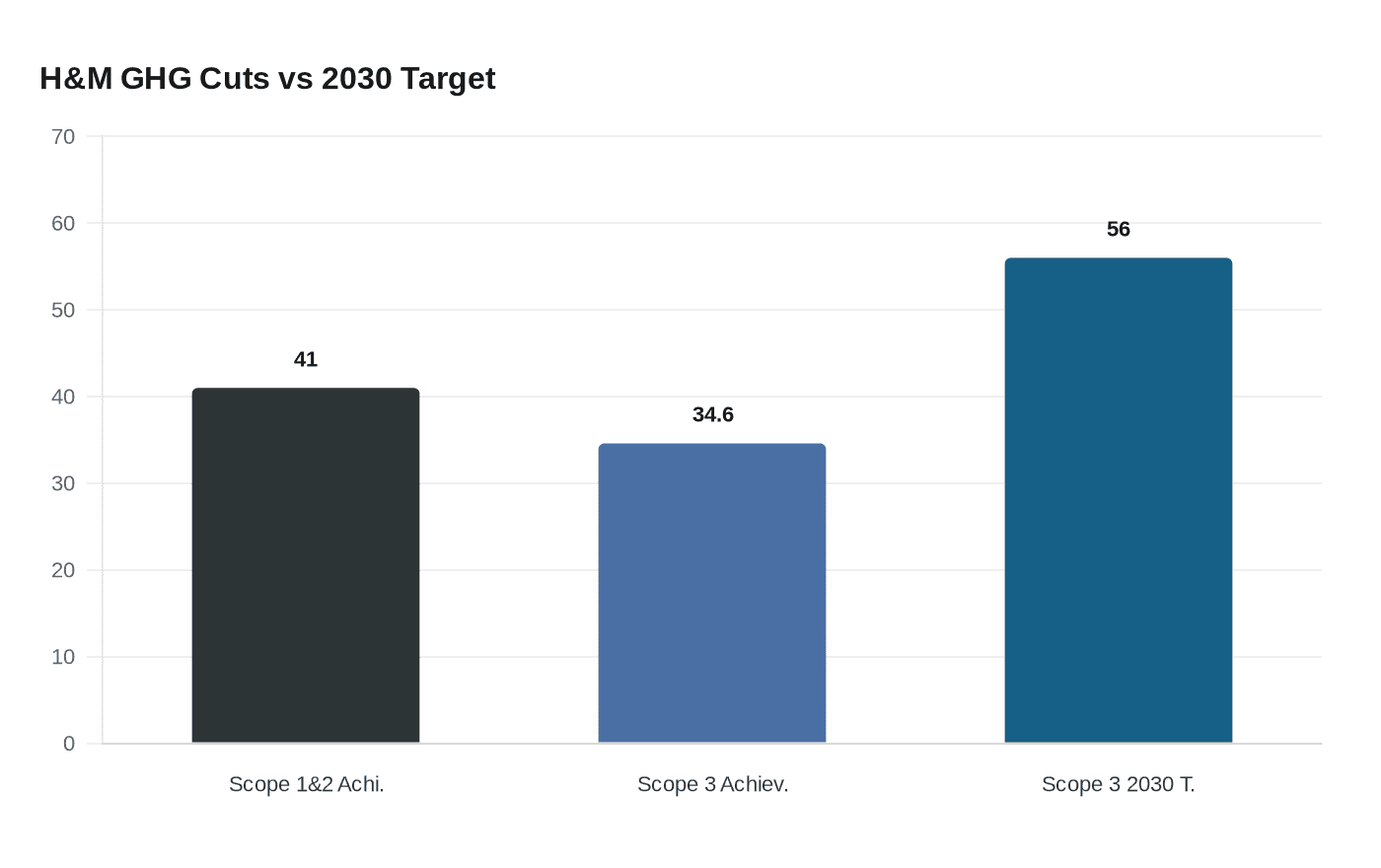
The headline figures are credible and concrete: a 34.6% reduction in Scope 3 greenhouse gas emissions against a 2019 baseline, meaning the emissions produced across H&M's entire supply chain, not just its own operations. On Scope 1 and 2, the company's own direct and energy-related emissions, the reduction reaches 41%. The group also disclosed SEK 2.8 billion invested in decarbonization and material innovation, and a science-based target of 56% supply-chain emissions reduction by 2030. None of those numbers are soft.
What makes the report structurally unusual is where H&M chose to go granular. The company tracked coal boiler use not just at Tier 1 garment manufacturers, its direct suppliers, but through Tiers 2 and 3, reaching fabric mills and raw material processors that most brands treat as a black box. The number of garment suppliers across those three tiers using on-site coal boilers dropped by 108 since 2022, with full phase-out targeted by 2026. Separately, H&M reported a 22.8% reduction in absolute freshwater use at wet-processing suppliers from a 2022 baseline, a metric that competitors including Zara parent Inditex do not publish at equivalent supplier-tier granularity. Shein, the ultra-fast-fashion platform facing intensifying European regulatory scrutiny, publishes no comparable supply-chain emissions baseline at all.
The 32% recycled materials figure, the third major metric H&M foregrounded, requires more careful reading. It is largely recycled polyester, which means plastic-bottle feedstock rather than closed-loop garment-to-garment recycling. That distinction matters for anyone assessing whether H&M's circularity claims are structural or cosmetic.
The governance move may be the most consequential disclosure of all. H&M launched a Sustainability Insights Board on March 25, in partnership with Stella McCartney, whose own label has spent two decades building credentials precisely on the issues H&M is now trying to address at mass-market scale. H&M chief executive Daniel Ervér said the board would give the business "a chance to hear a broader range of perspectives from across the fashion world." McCartney, for her part, said the initiative should help keep sustainability "front and centre" in a way that generates more meaningful dialogue. The two also released a Spring 2026 capsule collection using certified and recycled materials alongside the announcement, giving the governance initiative a commercial expression.
The accountability scorecard, then, looks like this: H&M has opened up its supply-chain tier structure, published a named investment figure, and attached an external governance mechanism with real reputational stakes. What remains opaque is the absolute emissions volume trajectory, because percentage reductions can coexist with growing total output in a business that still sells at enormous scale. That tension, between measurable progress and a model built on volume, is the one number H&M's report cannot resolve on its own.
Know something we missed? Have a correction or additional information?
Submit a Tip
