Iris van Herpen’s couture blends nature, science and architecture
Iris van Herpen turns couture into a laboratory for the body, proving that radical handwork still sets the pace for fashion. Brooklyn’s new survey shows why her work feels more necessary than ever.
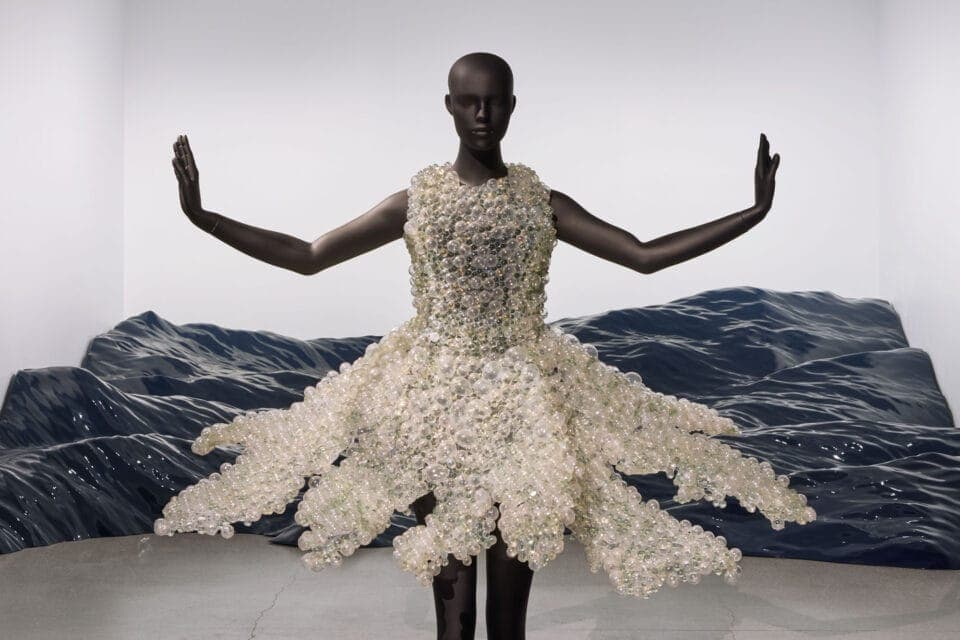
The couture mind at work
Iris van Herpen has built a fashion language that refuses to choose between artistry and invention. Her clothes do not simply sit on the body; they seem to test what the body can become, which is why her work feels less like seasonal dressing and more like a disciplined act of imagination. In an industry obsessed with novelty, that distinction matters. Van Herpen’s couture keeps proving that extreme craft is not a relic of old-world luxury, but one of fashion’s sharpest tools for staying culturally alive.
The Brooklyn Museum is making that case with unusual clarity. Iris van Herpen: Sculpting the Senses runs from May 16 to December 6, 2026, and the museum describes it as the first major New York presentation devoted to her work. More than 140 haute couture creations anchor the show, alongside contemporary art, design objects, scientific artifacts, and natural history specimens such as coral, fossils, and skeletons. That is not a decorative backdrop. It is the point: van Herpen’s work lives at the intersection of nature, science, and architecture, where fashion becomes a way to think about structure, fragility, and future form.
Why the museum setting suits her
Van Herpen founded her fashion house in 2007, and the pace of her career has always been remarkable, but what makes her singular is not speed. It is the rigor of her references and the ambition of her construction. Presented in a museum, her couture reads as research made visible. The show’s focus on the body’s place in space, its relationship to clothing and its environment, and its future in a rapidly changing world gives the collection the kind of intellectual frame that most runway seasons rarely earn.
That context matters because her clothes operate on multiple levels at once. A van Herpen piece can feel geological in one moment, architectural in the next, and eerily alive throughout. In mainstream luxury, craft is often deployed to signify polish. Here, craft is the language itself. The seams, transparency, curvature, and surface engineering are not there to soften the garment into wearable fantasy. They are there to make the viewer notice how much knowledge can be built into a single silhouette.
The Brooklyn Museum’s decision to honor her at its Brooklyn Artists Ball on May 11, 2026 reinforces that point. The institution is not just celebrating a designer with celebrity reach. It is acknowledging a practitioner whose work has become a cultural reference point for what fashion can do when it behaves like serious art.
3D printing changed the terms of couture
Van Herpen’s reputation as a forward thinker was cemented early, and her use of technology has always been more than a gimmick. In 2010, she became the first designer to show a 3D-printed dress on the runway with her Crystallization collection, a milestone that still feels significant because it shifted the conversation around what couture could be built from. The achievement was not about replacing handwork with machinery. It was about extending the vocabulary of handwork into forms that would have been impossible with fabric alone.
That is why her work remains competitive in a fashion landscape increasingly driven by spectacle. Many houses can stage a dramatic entrance. Fewer can make the mechanics of that drama meaningful. Van Herpen’s advantage is that she makes technology feel tactile. Her innovations do not flatten the romance of couture; they intensify it. The result is work that looks futuristic without losing the emotional charge that gives couture its power.

Art Basel has pointed to that breakthrough in describing her as the first designer to show a 3D-printed dress on the runway. More than a technical first, it helped establish a new model for luxury fashion, one where process, material science, and silhouette design are inseparable.
Sympoiesis and the urgency of interdependence
That same logic runs through Sympoiesis, her 2025 haute couture collection presented at Paris Haute Couture Week on July 7, 2025. Van Herpen has said the collection reflects urgency and the growing fragility of the interdependence between the organic and the technological. That idea sits at the heart of why her work keeps resonating: she does not treat nature and innovation as opposites. She treats them as entangled forces.
In practical terms, that means her clothes often feel alive to tension. They balance delicacy with structure, and softness with engineered precision. You see the architecture in the way forms are held together, but you also sense the natural world in the movement, texture, and fluidity. That duality gives the collection its charge. It is not nostalgia dressed up as futurism. It is a clear-eyed response to a world where biology, climate, and technology are constantly colliding.
This is also why her work carries more weight than standard luxury spectacle. In an era when branding can overwhelm making, van Herpen’s couture insists on the value of invention with substance. Her pieces reward close looking because they are constructed to reveal thought as much as beauty.
The cultural reach of a rare fashion language
Part of van Herpen’s relevance comes from the fact that her clothes are not confined to the runway or the museum. The Brooklyn Museum notes that her designs have been worn by Beyoncé, Björk, Cate Blanchett, Miley Cyrus, Lady Gaga, and Ariana Grande, a roster that says as much about her range as it does about her fame. These are women with very different public images, yet van Herpen’s work can meet each of them on common ground: theatrical, intelligent, and impossible to confuse with ordinary glamour.
That is the deeper reason her couture remains culturally relevant. It gives fashion a language for complexity at a time when the market often rewards simplification. Her garments are not trying to be easy, and that is precisely their value. They ask for attention, then repay it with technique, invention, and a sense of wonder that never feels empty.
Brooklyn’s survey makes the case in full. By placing more than 140 couture looks beside coral, fossils, skeletons, and scientific objects, the museum frames van Herpen not as a designer chasing fantasy, but as one redefining what modern luxury can mean. In her hands, couture is still a test of the human imagination, and that remains its most persuasive argument.
This article was produced by Prism’s automated news system from verified source data, official records, and press releases, then run through automated quality and moderation checks before publishing. The system is built and supervised by the people who set the standards it runs under. Read our full AI policy.
Did this article answer your question?


