Joyce Makitalo’s sculptural jewelry taps Metro Manila’s men’s style shift
Joyce Makitalo’s men’s pieces feel like sculpture you can wear, and that is exactly why they land now. Metro Manila’s style mood has moved past old-school bling into fluid, identity-driven jewelry.
The new masculine accessory is not subtle
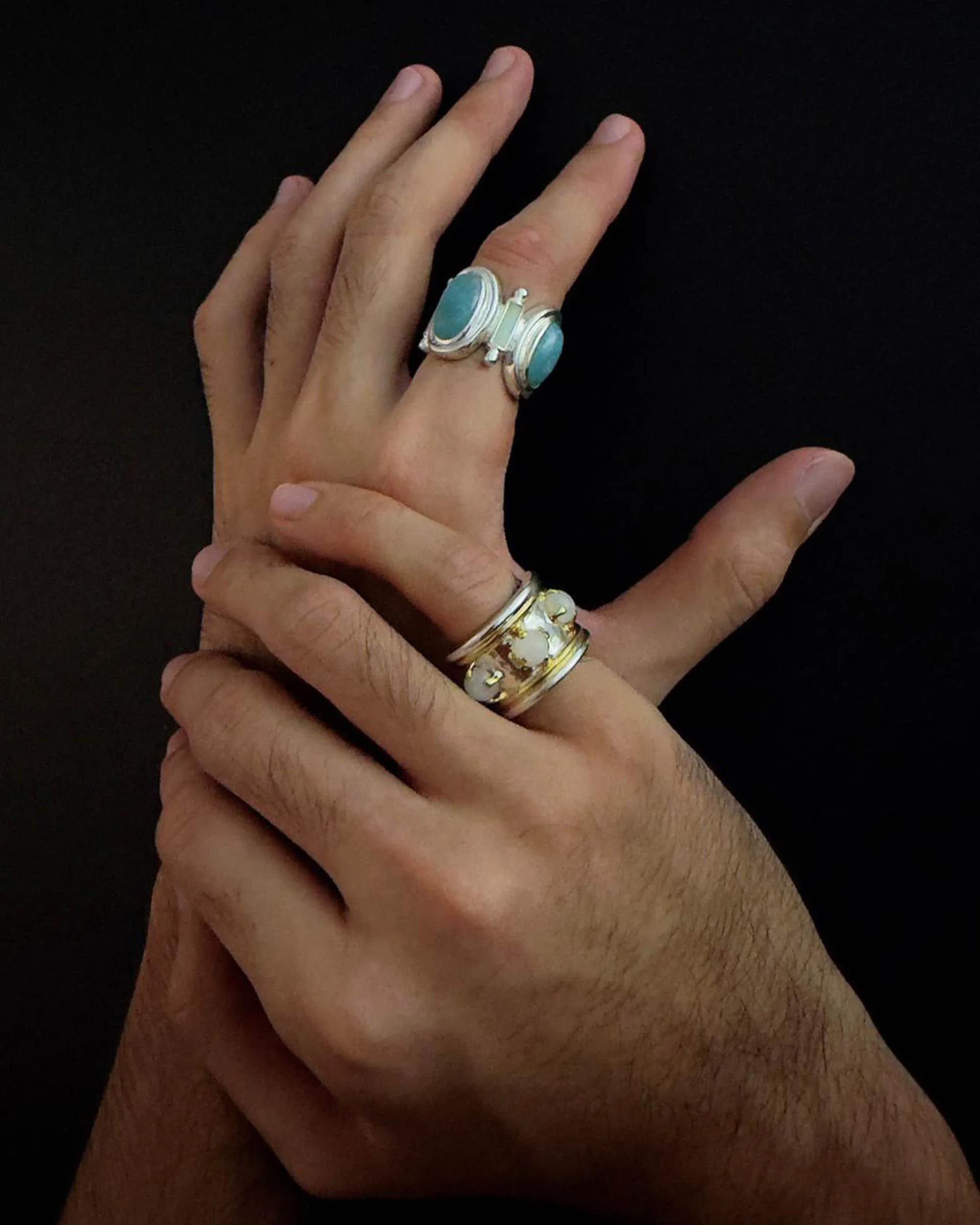
The sharpest men’s jewelry in Metro Manila right now does not read like decoration. It reads like intent. Joyce Makitalo’s latest collection, shown at a new Greenbelt 5 pop-up, leans into sculptural, talismanic forms that sit somewhere between jewelry and contemporary art, and that is the point. These pieces do not whisper for a man to notice them, they change the whole temperature of the look.
What makes the collection hit is how clearly it reflects the way men’s style has shifted in the city. The old rules, where jewelry had to stay small, safe, or aggressively masculine, are loosening fast. In their place is a more fluid, androgynous approach that leaves room for pendants, chains, brooches, pearls, and other nontraditional details to carry the outfit. Makitalo’s work fits that moment because it does not treat jewelry as an add-on. It treats it as identity.
Why Makitalo feels right for this moment
Makitalo has been building this language since 2008, when she established J Makitalo after winning the non-traditional category of a national jewelry design competition. That early win matters, because her work has never looked interested in following the tidy conventions of luxury jewelry. It has always had a slightly off-axis confidence, the kind that makes sense in a city where style is increasingly about mix, tension, and personality rather than a single polished code.
The new collection pushes that even further by focusing on the intersection of jewelry and contemporary sculpture. That is a smarter lane than simply chasing trend jewelry. In menswear, where the category has often been boxed into watches, wedding bands, and the occasional chain, sculpture gives the piece conceptual weight. It says the wearer is not borrowing from someone else’s language. He is building his own.
The craft story still matters, and Bulacan gives the pieces backbone
There is also serious craft under the shine. Makitalo works with third-generation goldsmiths in Bulacan, the country’s long-recognized jewelry hub, where the industry is built around cottage-type firms and heritage metalworking. That ecosystem matters because it keeps the collection from feeling like a purely gallery-minded exercise. The work has local depth, not just visual drama.
Bulacan’s role in Philippine jewelry is especially important here because gold remains the major product of the country’s jewelry industry. That gives Makitalo’s pieces a rootedness that many fashion-jewelry stories lack. You can see the sculptural ambition, but you can also sense the hands behind it, the inherited skill that keeps the forms sharp, balanced, and believable as actual objects to own and wear.
The result is a rare mix: pieces that look forward without severing themselves from where they come from. In a market full of novelty, that kind of continuity is part of the appeal.
Metro Manila’s men are ready for more than a chain and a watch
This collection lands because the market has already done some of the work for it. Men’s jewelry is being discussed less as a flourish and more as self-expression, and that shift is not theoretical anymore. Across 2024 to 2026 trend coverage, the strongest signals have been clear: statement pieces are winning, and so are pendants, chains, brooches, pearls, and other accessories that used to sit outside the standard male dress code.
That wider movement makes Makitalo’s approach commercially viable, not niche. The customer is already being trained to read jewelry as part of styling, not as a special occasion afterthought. A sculptural pendant can do the job of a logo tee in one look and the job of a conversation starter in the next. In a city like Metro Manila, where fashion is increasingly comfortable with fluidity, that flexibility is everything.
There is also a deeper shift happening in how men want to be seen. The point is no longer just to look expensive. It is to look specific. Jewelry is the fastest way to say something personal without having to explain yourself, and Makitalo’s pieces understand that instinct better than most brands playing in the category right now.
The proof is already in who has worn her work
Makitalo’s name is not arriving out of nowhere. Her pieces have already been worn by designers such as Rajo Laurel and Joseph Bagasao, which says a lot about the circle her work moves in. These are not men reaching for jewelry as a gimmick. They are people who understand silhouette, proportion, and the visual shorthand of strong accessories.
That earlier visibility also gives the new pop-up a sense of continuity. Makitalo was linked to talismanic jewelry in a 2022 Designers’ Holiday Bazaar at Greenbelt 5, where the setting turned The Gallery at Greenbelt 5 into something closer to an artful showcase than a standard retail event. The new presentation extends that idea, but the current collection feels more focused, more decisive, and more tuned to the moment men’s styling has reached now.
Why this story matters beyond one pop-up
The biggest takeaway is not just that Joyce Makitalo is launching a new collection in a prime retail location. It is that her work shows how men’s jewelry is being repositioned across the market. What used to be treated as a niche or a styling risk is becoming a legitimate identity category, especially when the design language is strong enough to stand on its own.
Makitalo has the right ingredients for that shift: a practice built since 2008, a foundation in competition-winning design, a working relationship with Bulacan’s goldsmiths, and a visual vocabulary that feels sculptural rather than decorative. Put that together with Metro Manila’s move toward fluid dressing, and the timing makes sense.
This is what men’s accessories look like when they stop behaving like accessories. They become the thing that finishes the outfit, but they also become the thing that tells you who is wearing it. In that sense, Makitalo’s latest work is not chasing a trend at all. It is helping define the new baseline.
Know something we missed? Have a correction or additional information?
Submit a Tip