Ladybug motifs charm Dior, Chanel and spring nails
Ladybugs have gone luxury, then viral. Dior, Chanel and Joey King’s nail art show why tiny charms are becoming fashion’s smartest spring signal.
The bug that suddenly looks expensive
Ladybugs are everywhere right now, and that is exactly why they matter. What started as a sweet little motif has landed in the rarest fashion territory: the overlap between house codes, nail art, and accessories that feel collectible without trying too hard. Dior, vintage Chanel, and even Joey King’s manicure have pushed the tiny insect into spring 2026’s most shareable microtrend, which is less about novelty for novelty’s sake and more about a new kind of luxury shorthand.
The appeal is immediate. A ladybug is small enough to feel playful, but familiar enough to read instantly on a bag, a shoe, a necklace, or a nail. That combination gives brands a low-friction way to signal personality, while giving shoppers a small, visible entry point into a bigger fashion idea. In a season where everything is competing for attention, the smartest accent is the one you notice in a glance and remember later.
Dior and Chanel are treating the motif like a house code, not a cute add-on
Dior is the clearest luxury proof point. Jonathan Anderson’s Spring-Summer 2026 collection looks back at the house archive with empathy and wit, reinterpreting old pieces for now while refreshing Dior’s codes. That matters because the ladybug does not appear as random decoration here. It behaves like part of a broader language, one that connects archive reference, craft, and a lighter mood without losing the discipline that makes Dior feel like Dior.
The Lady Dior angle sharpens that point even more. A Spring/Summer 2026 Lady Dior proposal reportedly folded a red ladybug motif into the Mini Lady Dior Clover, pairing the insect with clover embroidery. That is a smart move: clovers already carry luck, and the ladybug amplifies that symbolism while making the bag feel more playful and more visually legible from a distance. It is classic house embellishment with a wink, which is exactly the sort of thing people post, pin, and remember.
Chanel is in the same conversation, though in a different register. Matthieu Blazy’s spring 2026 ready-to-wear debut in Paris offered a layered, complex interpretation of the brand’s codes and set the French house on a new orbit. That orbit includes heritage references and accessories that can absorb small motifs without becoming gimmicky. Vintage Chanel pieces already live in that sweet spot, where a tiny charm or emblem can feel chic rather than childish. The ladybug fits because it behaves like a collectible detail, not a costume prop.
Why micro-charms are suddenly everywhere
The ladybug trend is not just about insects. It is about scale. Fashion keeps shrinking the point of entry because small objects are easier to wear, easier to gift, and much easier to photograph. A micro-charm, a mini motif, or a novelty accent can communicate taste without the cost or commitment of a major wardrobe overhaul.
That is why this trend makes such strong commercial sense. Luxury houses get a way to stretch their identity across categories, from runway to accessories to beauty, and consumers get something that feels special without demanding a full outfit-level investment. In other words, the math is perfect for the moment: low cost, high shareability, instant recognition. It is the same logic that made logo pins, tiny hearts, cherry details, and other petite signals move so fast when fashion wants the mood to feel optimistic.
There is also a practical emotional layer. WWD framed the ladybug as whimsical and tied it to the idea of healing everyone’s inner child, which is exactly right. People are responding to details that feel soft, lucky, and not too serious. The ladybug does not ask to be decoded. It simply gives pleasure, and that is a stronger sell than abstract cool right now.

The manicure is where the trend turns from runway to real life
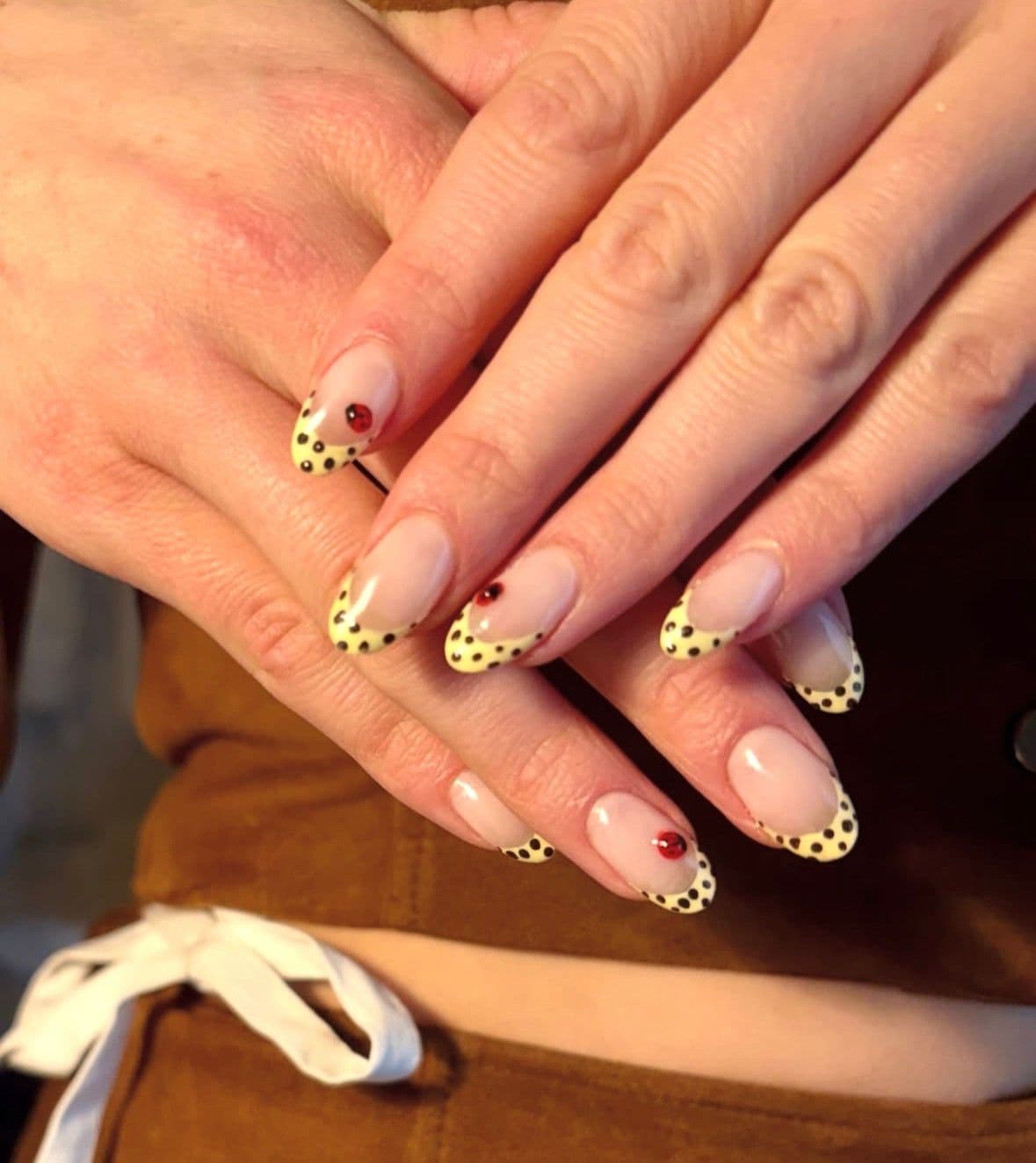
Joey King’s look made the nail version impossible to ignore. At a Miu Miu event in New York City, she wore a butter-yellow French manicure with polka dots and 3D ladybug designs, a combination that turned an already strong spring nail shade into something much more specific. The butter-yellow base kept it fresh, while the dots and raised ladybugs gave it a slightly toy-like finish that felt deliberate rather than saccharine.
That is the beauty of the manicure interpretation: it moves the trend off the runway and into the kind of detail people can actually copy. You do not need a full outfit or a rare runway piece to participate. You need a polish color, a little nail art, and the confidence to wear something that looks charming on purpose. It is the fastest route from luxury inspiration to mass adoption, which is exactly how a motif leaves the fashion bubble and enters daily style.
The spring 2026 nail angle also matters because beauty is now one of the quickest trend transmission systems in fashion. A bag motif can take a while to circulate. A manicure can hit social feeds in hours. Once the ladybug shows up on nails, it stops being just a house embellishment and starts behaving like a seasonal styling idea.
Why the symbol feels lucky instead of childish
Ladybugs have a long symbolic life, and that history gives the trend more depth than a simple cute-girl moment. Britannica traces the name back to the Middle Ages, when the insect was dedicated to the Virgin Mary and called the beetle of Our Lady. That devotional root explains why the motif still reads as protective and talismanic. It carries luck, softness, and a little bit of old-world tenderness.
The scale helps too. Britannica says there are about 5,000 ladybug species worldwide, which is a reminder that the insect is common in nature even when it appears rare in fashion. That tension is useful. It lets luxury houses turn something familiar into something elevated, and it lets everyday shoppers feel like they are wearing a symbol rather than a gimmick. The result is a motif that lands somewhere between charm jewelry and superstition, which is a very current place for fashion to be.
What this changes for spring styling
The ladybug moment is not a one-off. It points to a broader shift toward small, emotionally readable details that can travel across categories. Luxury brands are leaning into motifs that are easy to spot and easy to repeat because those details build identity without requiring a full design overhaul. Consumers, meanwhile, are gravitating toward accents that feel personal, optimistic, and simple to integrate into the clothes and accessories already in rotation.
That is why the ladybug works so well across Dior, Chanel, nails, and accessories. It is tiny, but it carries enough meaning to matter. In a season obsessed with quick recognition and easy charm, the smartest fashion signal may be the smallest one on the page.
This article was produced by Prism’s automated news system from verified source data, official records, and press releases, then run through automated quality and moderation checks before publishing. The system is built and supervised by the people who set the standards it runs under. Read our full AI policy.
Did this article answer your question?


