Mexican Designers Chart Sustainable Growth While Honoring Cultural Craft Traditions
Mexico City's most compelling independent labels are proving that craft-rooted, women-led fashion can scale without selling out.
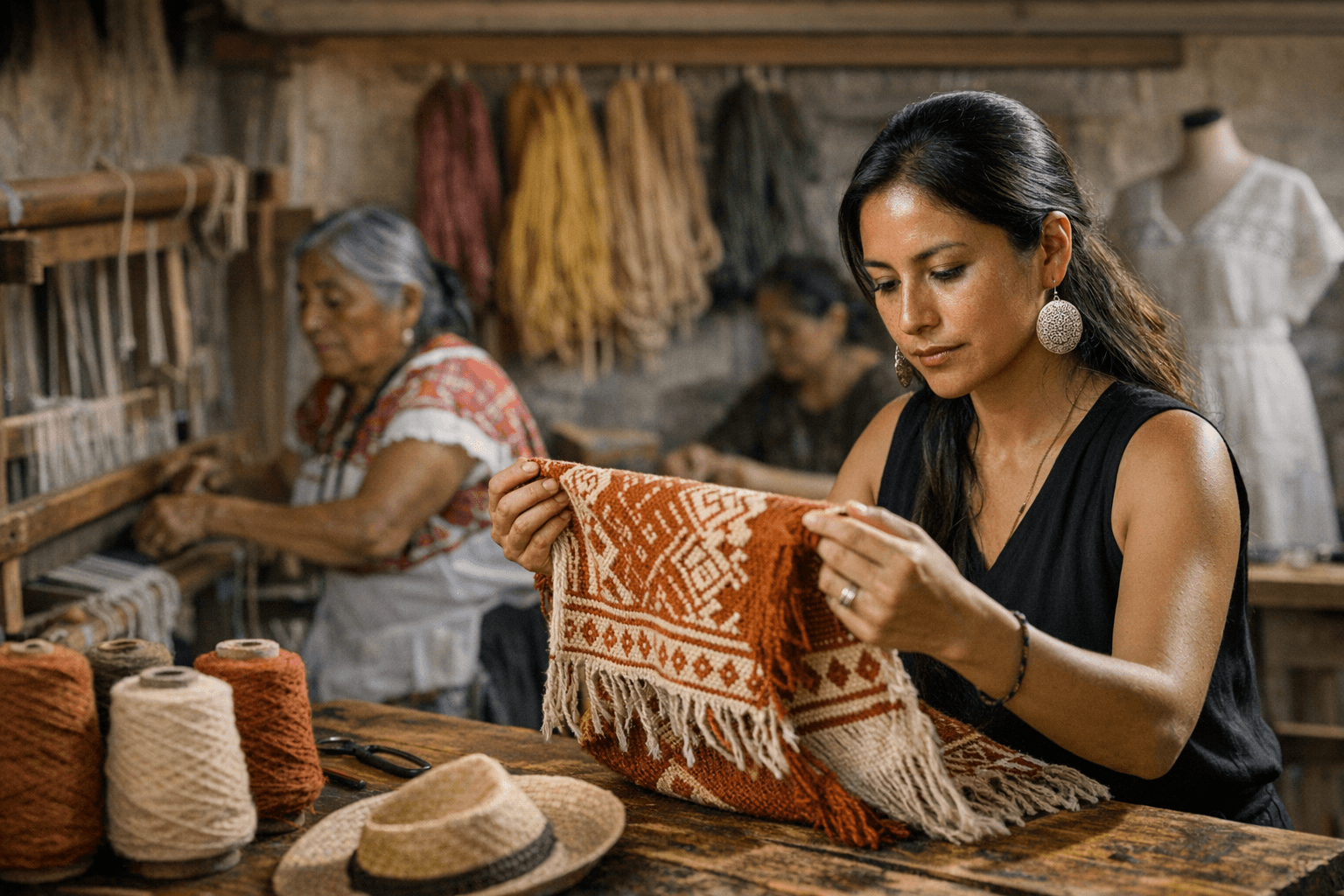
Mexico's fashion scene has never needed a co-sign from Paris or Milan to validate what's happening on its own terms. But the international attention landing on a tight cluster of women-led independent labels right now signals something more significant than a trend cycle: it's a structural shift in how the global fashion industry understands cultural authenticity, craft production, and what sustainable growth actually looks like in practice.
Earlier this month, Business of Fashion brought together three of the country's most compelling independent designers, Carla Fernández, Bárbara Sánchez-Kane, and Camila Banzo, at Soho House Mexico City for a frank conversation about building fashion businesses that don't compromise the cultural and material foundations they were built on. The event was part of both Women's History Month and Soho House's ongoing Women Shaping the Future initiative, moderated by BoF's Yasmine Dahlberg. What emerged wasn't a panel of designers talking abstractly about values. It was a working blueprint.
Carla Fernández: 25 Years of Proving the Model
Fernández has collaborated with 200 artisans across 16 Mexican states, helping to document and preserve the rich textile heritage of Mexico's indigenous communities through her brand. That infrastructure, built over more than two decades, is the backbone of an approach that treats craft not as aesthetic inspiration but as economic and intellectual partnership.
The Carla Fernández team travels throughout Mexico visiting communities of artisans who specialize in handmade textiles and centuries-old indigenous techniques, with the brand's approach contributing to sustaining ancient indigenous techniques and the people who collaborate with it. Crucially, the model goes further than sourcing: the brand pays artisans not only for hand labour but also for the intellectual property of their designs, a distinction that separates Fernández's operation from the cultural extraction that has long plagued fashion's relationship with indigenous communities.
Traditional patterning in Mexico is an incredibly elaborate system of pleats, folds, and seams that construct a vast array of garments using squares and rectangles only, due to the woven nature of the textiles. The Carla Fernández collections rely on this untapped inventory of techniques. The result is clothing with structural integrity rooted in pre-colonial geometry, not approximations of it. Her mobile studio, Taller Flora, operates as a traveling design laboratory, meeting artisan cooperatives throughout the country on their own ground.
One of her three stores in Mexico, the Calle Marsella location in Mexico City, doubles as a home for folk art, promoting the work of indigenous, mestizo and Afro-Mexican communities. The retail space functions as an extension of the brand's wider purpose: to reframe what luxury means when it originates from communities rather than ateliers.
Bárbara Sánchez-Kane: Emotional Chaos as Design Logic
Bárbara Sánchez-Kane is a Mexican menswear fashion designer known for her experimental and political statements mixed with her fashion designs, from Mérida, Yucatán. She describes her eponymous brand, founded in 2016, as "a Mexican clothing brand curated by emotional chaos," and the garments deliver on that framing: deconstructed Catholic school uniforms, conceptualized cowboy gear, and silhouettes that interrogate machismo and gender norms with the precision of a trained conceptualist.
Sánchez-Kane studied fashion design at Polimoda in Florence, with her graduate collection catching the attention of Vogue Italia, who labelled her a designer to watch. She has dressed Björk and Future and shown during New York Fashion Week, but her practice remains grounded in her Mexico City atelier, where the physical experience of the garment, the fit, the construction, the provocation, is inseparable from the brand's meaning.
Her work straddles the art and fashion worlds, and that dual positioning has made her label genuinely difficult to categorize in conventional market terms. It's a feature, not a bug. For Sánchez-Kane, operating outside the standard collection cadence and distribution channels isn't a limitation of scale; it's a deliberate refusal to dilute the work's specificity for the sake of volume.
Camila Banzo: Upcycling as Cultural Memory
The youngest of the three in terms of brand history, Camila Banzo founded her label in 2021, and the origin story is entirely characteristic of her aesthetic. Banzo is a sustainable fashion brand that breathes new life into pre-existing garments through a thoughtful transformation process, founded by Camila Banzo in 2021, born from a profound need to channel emotion into something both tangible and beautiful, while exploring the intimate connection between memories and clothing.
The designer started deconstructing and upcycling pre-existing garments from her vintage shop, La Vintaje, located in Roma, Mexico City. The artisanal approach to each piece that is re-crafted makes every one of them one-of-a-kind. The brand's signature Apron Blazer, a structural reinterpretation of the apron worn by women across Mexico, assembled with cutouts and ribbon detailing, exemplifies how Banzo transforms the everyday and the domestic into something quietly radical. Each piece carries its own material history.
The Banzo model is deliberately restrained in scale. Operating largely online and producing in small quantities, the label treats limitation as a design principle: because each piece is unique, the brand cannot and does not operate on a conventional delivery schedule. That cadence, slower and more considered, was central to the conversation at Soho House, where all three designers addressed the tension between growing international demand and maintaining the integrity of craft-led production.
The Business of Slowing Down
The sharpest takeaway from the BoF event isn't about aesthetics at all. It's about strategy. These three labels represent three distinct production philosophies but share a resistance to the conventional growth playbook: more collections, faster drops, broader distribution. Instead, the conversation at Soho House Mexico City centered on the specific mechanics of sustainable expansion: selective partnerships that respect production realities, market-specific distribution that doesn't require scaling up volume, and collection cadences slow enough to honor the time that craft-led work actually demands.
For Fernández, that means a community-first supply chain that can't be rushed without breaking the relationships it's built on. For Sánchez-Kane, it means treating each collection as an artistic statement that requires its own conceptual development timeline. For Banzo, it means working only with what already exists, a constraint that makes overproduction structurally impossible.
This convergence of cultural rootedness and operational pragmatism is what makes Mexico City's independent fashion scene worth watching on its own terms, not as a satellite of international trend cycles but as a genuinely distinct ecosystem producing work that is rigorous, specific, and built to last. The designers at Soho House weren't describing where they hope to go. They were describing systems that already function, and the clarity of that distinction is exactly what the broader industry is still trying to figure out.
This article was produced by Prism’s automated news system from verified source data, official records, and press releases, then run through automated quality and moderation checks before publishing. The system is built and supervised by the people who set the standards it runs under. Read our full AI policy.
Did this article answer your question?


