Middle East Conflict Rattles Fashion Supply Chains, Costs, and Sourcing Strategies
Freight costs up 400% in some regions, spring collections stranded at airports: here's what the Middle East conflict means for what you'll pay and when you'll shop.
The Disruption Nobody Budgeted For
Geopolitics doesn't usually make its way onto a brand's mood board, but right now it is dictating lead times, landing costs, and the retail prices consumers will see by mid-year. The escalating conflict in the Middle East has sent shockwaves through global apparel supply chains, touching everything from the cost of a polyester blend to the question of whether a spring collection will arrive in time to sell at full price. Business of Fashion has been tracking the ripple effects closely, and the picture that emerges is one of compounding pressure: freight disruption layered onto raw-material inflation, layered onto regulatory scrutiny, layered onto an industry that was already operating on razor-thin margins.
Which Textile Hubs Are Most Exposed
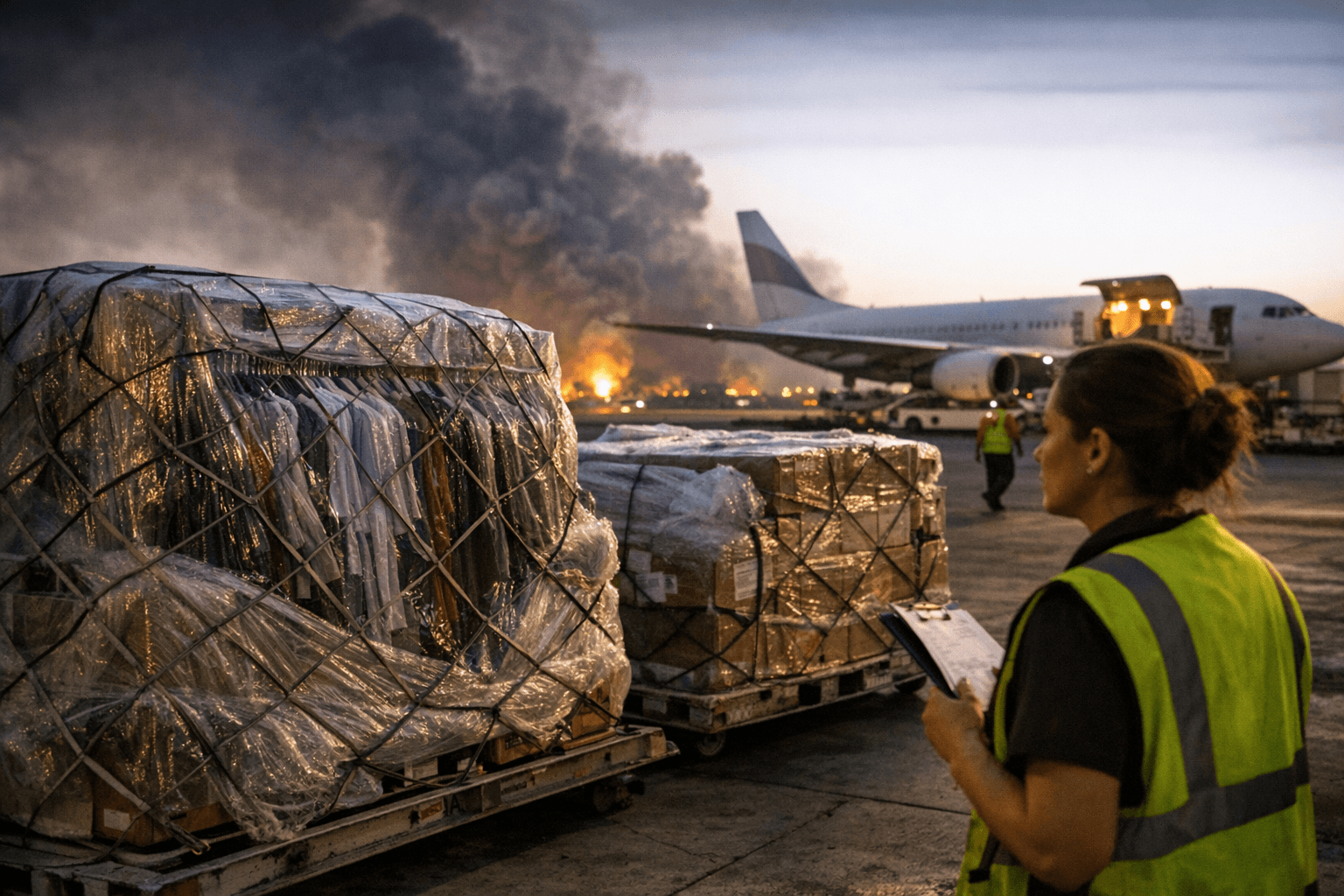
The supply chain geography here matters enormously. The closure of vital airspace and the suspension of operations at major transit hubs like Dubai have created a major problem for brands and retailers. For the fashion industry, that hits hardest in South Asia. While maritime routes have long been under pressure due to Red Sea diversions, the sudden paralysis of air freight corridors has left high-value seasonal consignments stranded, forcing industry giants to choose between exorbitant costs and empty shelves. For fast-fashion giants like Inditex (Zara) and Primark, the crisis has manifested as a literal pile-up of inventory, with manufacturers in Bangladesh and India reporting that thousands of garments intended for spring/summer collections are currently languishing at airports.
The logistics paralysis has a paper trail. Denmark's shipping and logistics company Maersk confirmed it suspended all new bookings between the Indian subcontinent, including Bangladesh, and the Upper Gulf markets with immediate effect, citing the "evolving situation" in the Middle East. The suspension covers the UAE, Bahrain, Qatar, Iraq, Kuwait, and Saudi Arabia.
The Middle East's role in synthetic-fibre production compounds the problem further. The region acts as a supplier of petrochemical intermediates, including MEG/EG, benzene, and p-xylene, for the production of polyester, polyamide, and elastane, while final processing is concentrated in China, accounting for roughly 60-65% of global production, as well as India, Vietnam, and Bangladesh. Any sustained disruption to those feedstocks flows directly into the yarn and fabric costs that sit at the foundation of every garment.
Freight and Synthetic-Fibre Costs
The numbers are stark. Freight costs have surged sharply for exporters, with some regions experiencing increases of up to 400% compared with pre-crisis levels, putting pressure on working capital and transport budgets. Rising crude oil and energy costs add further pressure on petrochemical feedstocks, which feed directly into fibres such as polyester, inflating raw material costs and compressing margins.
For chemical fibers specifically, rising crude oil prices have pushed up the cost of chemical fibers like polyester and acrylic by more than 10%. British retailer Next, one of the first major fashion groups to quantify the damage publicly, warned that instability in the Middle East region will not only restrain growth in the region but is also likely to have a knock-on effect on costs, selling prices, and consumer demand. The company has accounted for £15 million ($20 million) of additional costs likely to arise from the conflict, covering fuel and air freight.
Energy markets are feeding the volatility directly. Brent crude oil rose from around $70 to $80-$85 per barrel within days after the conflict escalated, a 10-13% increase during the initial shock. That swing in oil prices is not an abstraction for fashion: it reprices the synthetic fibres, the dye chemicals, the fuel for container ships, and the jet fuel for air freight simultaneously.
The Just-in-Time Model Under Pressure
Fast fashion's entire operating logic, built around frequent small-batch deliveries, minimal warehousing, and tight sell-through windows, is structurally exposed to exactly this kind of disruption. These pressures are challenging the fast-sourcing model that has dominated textile supply chains for decades. Delays are forcing brands and retailers to rely on costly air freight or accept markdowns when seasonal products arrive late, both of which undermine already fragile margins.
With few alternatives, companies must either accept skyrocketing air cargo costs, assuming they can even secure a spot with the few airlines still operating, or wait and hope for a lull in the conflict. The upheaval will be most keenly felt by fast-fashion brands like H&M, Inditex, and Primark that depend on garment manufacturers in Bangladesh, India, and Pakistan for much of their inventory. Given that their businesses rely on timely shipments, any extended wait could result in lost sales or excess leftover inventory.
The macro context amplifies the strain. The WTO has forecast that global merchandise trade growth will slow to 1.9% in 2026, down from 4.6% in 2025, with WTO economists warning that the ongoing Middle East conflict could further reduce trade growth if energy prices remain elevated.
Regulatory Scrutiny: Forced Labour and Tariff Reviews
Supply chain disruption has a habit of exposing practices that were hidden inside efficient logistics, and regulators are paying attention. Regulatory complexity is also rising, with trade controls and stricter origin checks on exports from key manufacturing regions intensifying compliance demands. Business of Fashion's analysis highlights that forced-labour probes and tariff reviews are being renewed specifically in the context of this conflict, as governments scrutinize both the rerouting of goods and the labour conditions inside factories under financial pressure.
The broader tariff environment is already in flux. Ongoing and frequently changing U.S. tariff policies are creating persistent uncertainty for manufacturers, driving up costs and disrupting supply chains. Companies are facing longer lead times, fluctuating pricing, and difficulty planning investments due to constant policy shifts. For brands already absorbing freight surcharges and fibre-cost inflation, a tariff review on top of that is not a peripheral concern; it is a threat to the entire sourcing equation.
The Decarbonisation Dilemma
Perhaps the most uncomfortable tension in this moment is the one between sustainability commitments and survival economics. Fashion's push toward factory-level energy standards and decarbonisation targets was already a heavy lift before freight costs quadrupled. Now brands face a genuine strategic conflict: the very crisis that makes the case for cleaner, more resilient energy infrastructure at the factory level also makes it harder to fund that transition.
Europe faced its most severe energy shock following Russia's invasion of Ukraine in 2022, and policymakers responded by redoubling efforts to accelerate renewables deployment. The conflict with Iran raises fresh concerns, with political leaders already signposting the need for further renewable investment. That playbook, applied at the factory level, suggests the crisis could ultimately accelerate sustainability retrofits in major manufacturing hubs, but only for brands and suppliers with enough financial runway to invest through the disruption.
Onshoring, Nearshoring, and the Diversification Push
The strategic response being discussed across the industry is supplier diversification, with nearshoring and onshoring as longer-term hedges against precisely this kind of single-corridor dependency. In response to compounding disruptions, many manufacturers are rethinking their strategies: stockpiling inventory, shifting sourcing, and accelerating trends like onshoring and AI adoption to improve agility. However, these adjustments come with trade-offs, including financial strain and inconsistent material availability.
The events of the past six years, including the pandemic, tariffs, and now an expanding war in the Middle East, have made it clear that flexibility is no longer a competitive advantage; it is a baseline requirement. The brands that entered this crisis with diversified supplier networks and regional redundancy are managing. Those that built their model around a single low-cost corridor through the Gulf are learning that lesson at great expense.
The Middle East conflict is, in this sense, an accelerant: it is forcing conversations about supply chain architecture that the industry has been deferring since the pandemic. Whether those conversations translate into structural change, or simply another round of short-term workarounds, will shape what fashion's cost base, its sourcing map, and its sustainability credibility look like for years to come.
This article was produced by Prism’s automated news system from verified source data, official records, and press releases, then run through automated quality and moderation checks before publishing. The system is built and supervised by the people who set the standards it runs under. Read our full AI policy.
Did this article answer your question?


