Nike Air Liquid Max Brings Poison-Dart-Frog Colors and Bold New Air Geometry
Nike's most technically ambitious Air Max in years takes its color story from one of nature's most toxic creatures, and point-loaded sole geometry unlike anything in the archive.
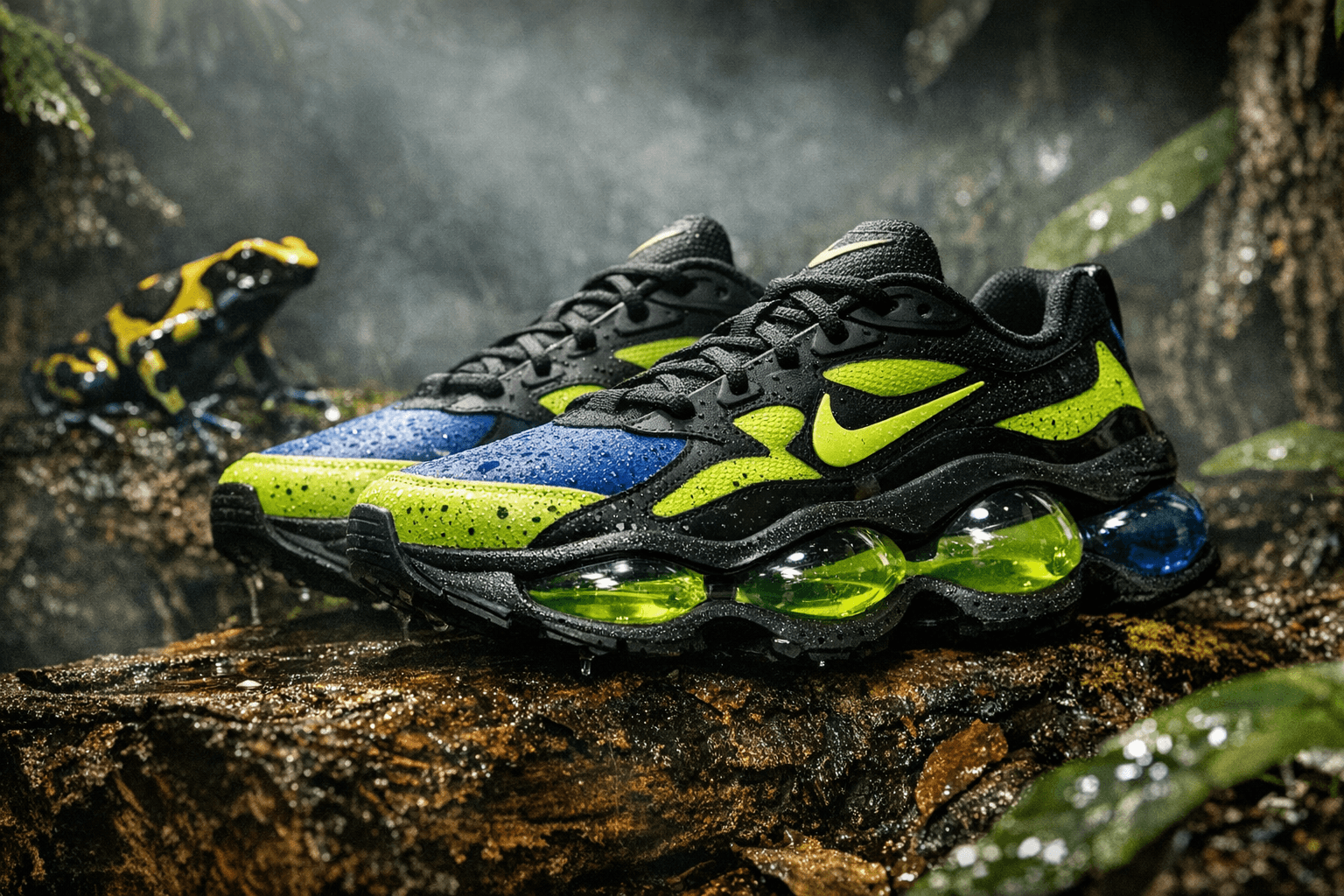
Nature's most garish amphibian just became Nike's most compelling design brief. The Air Liquid Max, which dropped on Air Max Day, March 26, for $230, is the brand's headliner silhouette for 2026 and its most structurally unconventional Air Max in years. It does not ease you in. The debut colorway hits in Black/Green Apple-Volt-Chrome, a palette that practically hisses, and the sole unit beneath it looks more like something sketched in a biomechanics lab than anything sitting in your current rotation. Whether you find it arresting or overwhelming will say a lot about where your head is in sneaker culture right now.
The Color Story: Danger as a Design Language
The poison dart frog is one of nature's most effective communicators: its vivid coloration is not decoration but a warning system, a biological signal that reads "stay back." Nike lead color designer Mike McCoy leaned directly into that logic. "For the poison dart frog, color is confidence and boldness is protection," McCoy said, and the launch colorway is exactly that: a layered, multi-tone cascade of electric greens against a black mesh base, finished with a chrome Swoosh that throws light at the right angles and a tinted, translucent rubber outsole that reinforces the overall sense of something slightly alien.
What elevates the design past novelty is the surface treatment. Lead material designer Marya Chan, Nike Sportswear's director of NSW LAB Expression, developed a three-layer textured nanoprint applied directly onto the mesh upper. The effect is technically sophisticated: the shoe reads as nearly seamless from across a room, one unified surface. But pull it close, and three print layers sitting at different heights reveal themselves, adding tactility that is genuinely unexpected. "From far away, the upper looks very unified," Chan said. "But as you get closer, you see the three layers of printing at various heights, adding a lot of tactility that's surprising to the touch." That duality, deceptively clean at a distance and richly textured up close, is one of the more considered decisions in recent Air Max history.
Point-Loaded Air: What Is Actually New Underfoot
The cushioning story is where Nike makes its boldest claim. The Air Liquid Max introduces what the brand calls point-loaded Air, a system that abandons the continuous Air unit architecture seen on most prior models in favor of targeted zones placed only at the foot's actual pressure points. Sole images reveal roughly two dozen discrete Air zones. Between them, the midsole is cored out, creating areas of deliberate negative space that reduce weight by eliminating material where no structural purpose exists.
The visual result is striking from above: the sole looks skeletal, almost porous, and the geometry traces the shape of a frog's toe pads, continuing the amphibian reference through every layer of the shoe. Functionally, Nike positions the system as its closest approximation yet to the sensation of walking on air, a low-profile, flexible ride that stays grounded rather than stacking height the way earlier Air Max silhouettes often did. Nike VP and Creative Director of Sportswear Andy Caine framed the shift in generational terms: "The Air Liquid Max is a testament to Nike design excellence and tenacity, and a reminder that when we enhance and improve the Air experience, we also get to inspire Nike designers to deliver something entirely new."
For context, the two preceding Air Max Day flagship launches, the Air Max Dn and Air Max DN8, both explored Dynamic Air technology, which used tension and pressure to create a more responsive feel. Point-loaded Air moves in a different direction: rather than amplifying responsiveness across the whole foot, it asks where cushioning is actually needed and removes everything else. It is a leaner, more surgical philosophy.
Who This Is For, and Who Should Think Twice
The Air Liquid Max is a sportswear shoe, not a running or training model, and that distinction matters for how you evaluate the $230 price point. At that number, you are paying for a statement silhouette built around a genuinely novel sole architecture and a surface treatment that has no real equivalent in the current market. If you buy sneakers because the technology signals something about where the category is heading, this is one of the more interesting purchases of the year. If you want a comfortable everyday sneaker without the visual intensity, the Air Max 95 or Air Max 1 options also in the Air Max Day 2026 lineup will serve you better at lower price points.
The styling proposition is specific. The colorway does not negotiate: it is electric green and it commands the outfit. It pairs best with the kind of neutral, pared-back dressing that gives the shoe room to operate. Washed-out denim, black technical trousers, a solid-color oversized tee. Adding competing prints or loud outerwear will fight with the upper rather than amplify it. The chrome Swoosh is small enough to read as a refined detail rather than a logo statement, which gives the shoe a slightly more considered edge than its coloring might suggest.
The Fragment Design Collab and the Broader 2026 Moment
The poison-dart-frog colorway may be the headline, but the story around the Air Liquid Max extends further. Hiroshi Fujiwara, Fragment Design's founder and one of the architects of modern sneaker culture's collaborative playbook, was among the first to be seen in the silhouette, having previewed it alongside rising rapper Yeat before the official reveal. Fujiwara's own Fragment Concept Testing version of the shoe, style code IQ8601-001 at $225, takes the opposite approach to the launch colorway: a near-total blackout with Fragment's lightning bolt branding rendered in the same dark tone and industrial product text running around the ankle collar. It is restraint as a statement, the Liquid Max stripped of its amphibian vibrancy and rerouted toward something more like a lab prototype. That collab dropped at Fragment retail locations on March 31 with a global release via Nike SNKRS on April 3.
The two versions together illustrate why the Air Liquid Max matters for 2026's sneaker conversation. Since 2014, Nike has used Air Max Day as its proving ground for the next chapter of Air technology. The Air Liquid Max is the clearest argument the brand has made in several years that there is genuinely new territory to explore in a cushioning system that is now four decades old. The poisonous colors are provocative by design, but the point-loaded geometry underfoot is the bet that will actually age.
Materials and Accountability: What Nike Has (and Has Not) Said
Nike has not published specific material composition data or end-of-life guidance for the Air Liquid Max at launch. The brand's broader Move to Zero sustainability program, which targets net-zero carbon and zero waste across its supply chain, covers new product lines in principle, but the Air Liquid Max launch materials do not detail what percentage of the upper mesh uses recycled content, nor whether the point-loaded Air unit is separable for recycling at end of life. The translucent rubber outsole and multi-layer nanoprint upper represent a construction that is technically complex to disassemble, which is a real consideration for buyers thinking beyond the first wear. Nike's Reuse-a-Shoe program accepts worn athletic footwear, but the Air Liquid Max's mixed-material construction places it in the same category as most modern complex sneakers: not easily recyclable through standard channels. For a shoe whose design language borrows so heavily from the natural world, a clearer account of its materials impact would be the more honest complement to the frog metaphor.
The Air Liquid Max arrives as the most structurally adventurous Air Max in years, and it knows it. Whether the point-loaded geometry proves as durable over 18 months of wear as its geometry is visually impressive will be the test Nike's innovation story ultimately depends on.
This article was produced by Prism’s automated news system from verified source data, official records, and press releases, then run through automated quality and moderation checks before publishing. The system is built and supervised by the people who set the standards it runs under. Read our full AI policy.
Did this article answer your question?


