Paul Smith softens tailoring with playful 1990s archive cues
Paul Smith turned Milan tailoring into something looser and more personal, using 1990s archive cues, dusty colors and crossbody styling to recast the suit for off-duty men.

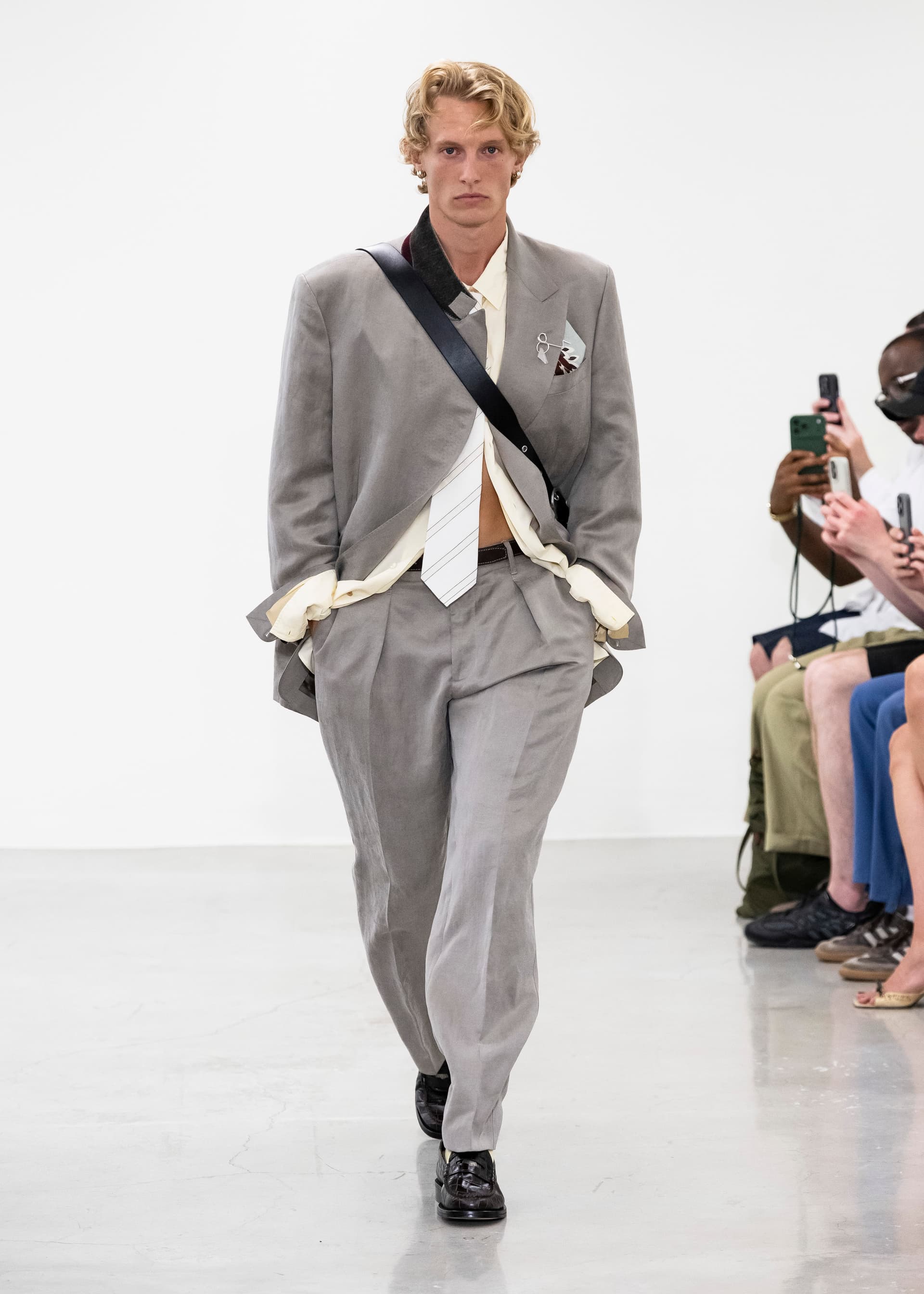
Paul Smith’s latest move in Milan was not to abandon the suit, but to make it feel alive again. For Spring/Summer 2027, the British designer titled his intimate salon show “Suits in Unsuitable Situations,” then filled it with boxy jackets, dusty shades, fluid fabrics, roomy vests and crossbody bag styling that stripped tailoring of its corporate polish. The effect was less boardroom, more off-duty swagger: a reminder that the suit still has a place, as long as it stops behaving like office uniform.
A suit loosened for real life
The collection’s strength was its refusal to treat tailoring as stiff ceremony. Paul Smith leaned into silhouettes that felt built for movement, not posture: relaxed shoulders, looser trousers and fabrics with a silky finish that softened the architecture of the jacket. Even the styling pushed against formality, with crossbody bags slicing across the chest and fishing lures used as boutonnières, a sly detail that made classic menswear feel human and a little mischievous.
That is exactly where the broader menswear conversation is now. Tailoring is being rescued from corporate sameness and recast as something modular, personal and lightly subversive, and Smith understands that shift instinctively. His version of the suit does not ask men to dress like executives. It offers them a way to look considered without looking trapped by the old rules of nine-to-five dressing.
Why the 1990s archive matters now
Smith’s return to his 1990s archive gave the collection its edge. Those references appeared not as costume nostalgia, but as a practical toolkit for rethinking proportions and attitude: boxier jackets, easier volume, and that slightly irreverent sense of dressing that defined the decade’s best tailoring. FashionNetwork also noted 1990s-inflected elements stemming from collaborations with young talents in his studio, which helped the collection feel current rather than self-archived.
What made the reference point work was that it aligned with the way younger men actually dress now. They want tailoring, but not rigidity; they want versatility, but not blandness. Smith answered that need by pulling the suit away from formal category language and toward something that can be worn with ease, layered casually, and styled with enough personality to register outside the office.
From Tuscan memory to modern swagger
Smith’s approach was also deeply personal. FashionNetwork reported that he drew on a summer memory in Tuscany, where a white linen suit was stained with red grapes. That detail matters because it captures the designer’s instinct to find elegance in imperfection. A suit, in Smith’s world, is not precious fabric sealed off from real life. It is a garment that earns character from being lived in.
Backstage recollections of his grandfather in a full suit, tie and hat added another layer to that thinking. The image connects this collection to the social history of dressing up, when tailoring carried ceremony, identity and respectability all at once. Smith has spent years teasing apart those codes, and here he seemed to ask a simple question: what if the power of suiting came not from authority, but from personality?
The commercial logic behind the looseness
There is a clear business reason this softer tailoring pitch makes sense. Smith has said that suit and necktie sales have recently risen, which suggests that menswear buyers are not rejecting tailoring so much as rewriting how they want to wear it. The collection reads as a response to that appetite: not a retreat from the suit, but a recalibration of what counts as desirable.
That recalibration also fits Paul Smith’s broader brand identity. Founded in 1970, the label is still sold in more than 70 countries and across 3,000 retail doors, and tailoring remains one of its core commercial pillars. The current tailoring offer is notably broad, spanning wedding suits, evening suits, business suits, statement suits and a Modern Working Wardrobe edit. In other words, Smith is not treating tailoring as a side story. He is treating it as a living business category that can be nudged, softened and refreshed without losing its centrality.
An archive strategy with momentum
The Spring/Summer 2027 show did not emerge in isolation. Smith’s Fall 2026 menswear presentation had already looked back to his 1980s archive, which suggests a deliberate seasonal strategy: use the brand’s own history as a lens for renewing tailoring rather than repeating it. The move gives each collection a built-in sense of continuity, but it also allows Smith to keep shifting the silhouette and mood without severing the brand from its roots.
That ongoing archive pull feels especially smart at a moment when many menswear labels are trying to prove that tailoring can still matter outside the old office cycle. Smith’s answer is not a revolution in the strict sense. It is subtler, and perhaps more persuasive: make the jacket boxier, the trousers easier, the fabrics lighter, the styling more personal, and let the suit behave like something a man chooses because it feels right, not because he has to wear one.
What this collection says about tailoring now
Paul Smith’s Milan show landed because it understood that the suit’s future depends on emotional flexibility as much as technical cut. The collection kept the language of tailoring intact, but it removed the pressure to perform it in a conventional way. Dusty colors, fluid cloth and playful accessories turned the suit into a wardrobe proposition rather than a dress code.
That is the real shift here. Smith is not asking men to dress up for corporate life. He is showing them how to dress with wit, memory and ease, using tailoring as a personal signature rather than a uniform. In a season crowded with menswear reinventions, that may be the most useful idea of all.
This article was produced by Prism’s automated news system from verified source data, official records, and press releases, then run through automated quality and moderation checks before publishing. The system is built and supervised by the people who set the standards it runs under. Read our full AI policy.
Did this article answer your question?


