Prabal Gurung blends party girl ease with CEO polish for resort 2027
Prabal Gurung’s resort 2027 asks if party-girl looseness and CEO polish can really share one closet. The answer may depend on whether women buy the styling, or the clothes.
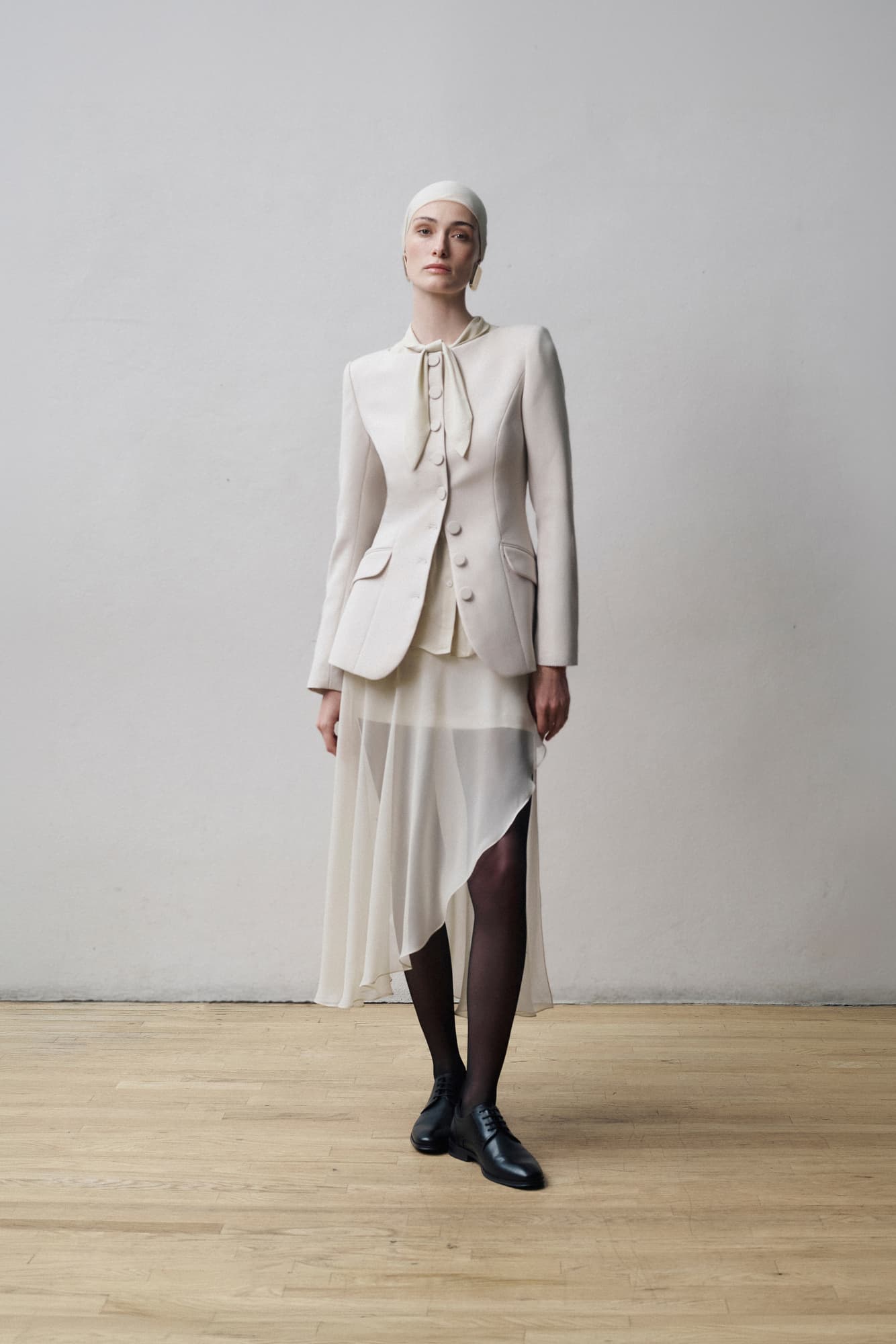
A champagne silk-jacquard trench worn loose enough to feel like a robe, then pulled together with a cardigan, tells you everything about Prabal Gurung’s resort 2027 mood. Titled “The First Light,” the collection turns that liminal hour before New York wakes up into a wardrobe thesis. Gurung is betting that the woman leaving a party and the woman heading into a boardroom may, in the end, be the same customer.
Two New York archetypes, one luxury proposition
The sharpest idea in the collection is also its most marketable: Prabal Gurung has collapsed two familiar Manhattan characters into one polished but slightly undone silhouette. WWD cast the poles as the disheveled party girl and the suited-up CEO, which is exactly the kind of duality fashion loves to sell because it sounds contradictory until you see it on the body.
That tension is the whole point of “The First Light.” Gurung drew on early New York mornings and pre-dawn stillness, plus the atmospheric street photography of Saul Leiter, so the clothes feel as if they belong to the hour when last night’s glitter has not quite disappeared and this morning’s discipline has not yet fully arrived. It is a compelling read on how women actually dress now, at least in cities where daywear has become more relaxed and eveningwear more tactical. The question is whether that idea translates beyond the runway into real closets, where outfits usually have to choose a side.
What the clothes get right
The collection’s strongest pieces work because they make softness look intentional rather than careless. Collarless jackets, sheer skirts, shoulder-tied cardigans, silk-jacquard trenches and beaded organza floral accents all push against the stiffness that can make “polished” feel corporate in the worst way. Instead of a hard morning-after silhouette, Gurung offers something lighter and more sensual, with texture doing the talking.
The clothes also lean into contrast without turning into costume. A cardigan knotted around the shoulders can make a silk-jacquard trench feel less precious, more lived-in. A sheer skirt can signal evening, but when it is cut with enough clean structure elsewhere, it reads as city-smart instead of theatrical. That balance is what gives the collection its appeal: it is trying to look expensive, but not uptight.
Gurung’s own description of the feel matters here. He said one piece should “hug” and “caress” the body, and that language makes sense across the lineup. This is not a collection built on armor; it is built on movement, touch and the kind of quiet confidence that lets luxury feel intimate.
The party girl and the executive are not the same shopper by default
Still, there is a difference between a strong styling concept and a convincing retail proposition. Resort collections often live or die on that gap, because they have to sell vacation, work, event dressing and the in-between moments all at once. Gurung’s pitch is elegant, but it also depends on whether the customer who likes a glittery after-hours look is willing to buy a trench with executive polish, and whether the executive buyer wants enough rebellion to keep it interesting.
That is why the collection’s hybrid language feels so current. Women are already mixing formal and casual, desk and dinner, in ways that make old dress codes look brittle. But the market still tends to buy in categories, not in mood. Gurung’s challenge is that his woman may be real, but she is not necessarily one person shopping one rack.
The holiday-season retail test will be revealing. If these clothes move, it will suggest that the modern luxury customer wants one wardrobe to cover multiple versions of herself. If they stall, the collection may be remembered as a brilliant runway idea that asked too much of the hanger.
Why Nepal is part of the story, not just the backstory
Gurung’s best collections often work because they carry biography without turning into autobiography. He launched his eponymous label in February 2009, was born in Singapore and raised in Kathmandu, Nepal, and has long described himself as a global citizen. That perspective matters here, because “The First Light” is about New York, but it is also about an outsider’s eye on the city’s rituals, glamour and social codes.
His connection to Nepal runs deeper than inspiration. In 2011, he was named goodwill ambassador for Maiti Nepal, and after the April 2015 earthquake he launched a Nepal earthquake relief fund. By June 2015, he had raised nearly $1 million for Nepal relief efforts, a reminder that his public platform has repeatedly extended beyond clothes. Recent coverage also points to his knitwear production in Nepal as a meaningful part of the business, which gives the cardigans and sweater elements in this collection a commercial and personal weight.
That connection makes the softer layers in “The First Light” feel more grounded. The cardigan is not just a styling device here; it also nods to a real production story and to the designer’s larger identity as someone who moves between places, communities and registers with unusual ease.
A busy year, and a useful test
The collection arrives in the middle of a packed 2026 for Gurung. He followed his Fall 2026 ready-to-wear show in New York on February 14, 2026, and then had a high-profile Met Gala season that put Atelier Prabal Gurung on Angela Bassett, Princess Gauravi Kumari and Maharaja Sawai Padmanabh Singh of Jaipur. That kind of visibility matters, but resort is where brand image meets actual buying behavior.
And that is why “The First Light” is more than a pretty mood board. It is a smart, slightly slippery attempt to sell a woman who can move from late-night sparkle to morning authority without changing her personality, only her layers. If Gurung can make that idea feel as wearable as it does aspirational, he will have found a real luxury language for the way women already live.
This article was produced by Prism’s automated news system from verified source data, official records, and press releases, then run through automated quality and moderation checks before publishing. The system is built and supervised by the people who set the standards it runs under. Read our full AI policy.
Did this article answer your question?


