Short Videos Carry Neo-Chinese Guochao Style Into Western Women's Wardrobes
Analyst Samo Burja says short videos are driving Neo-Chinese Guochao into Western wardrobes as a market now valued at 1-billion yuan in 2023.
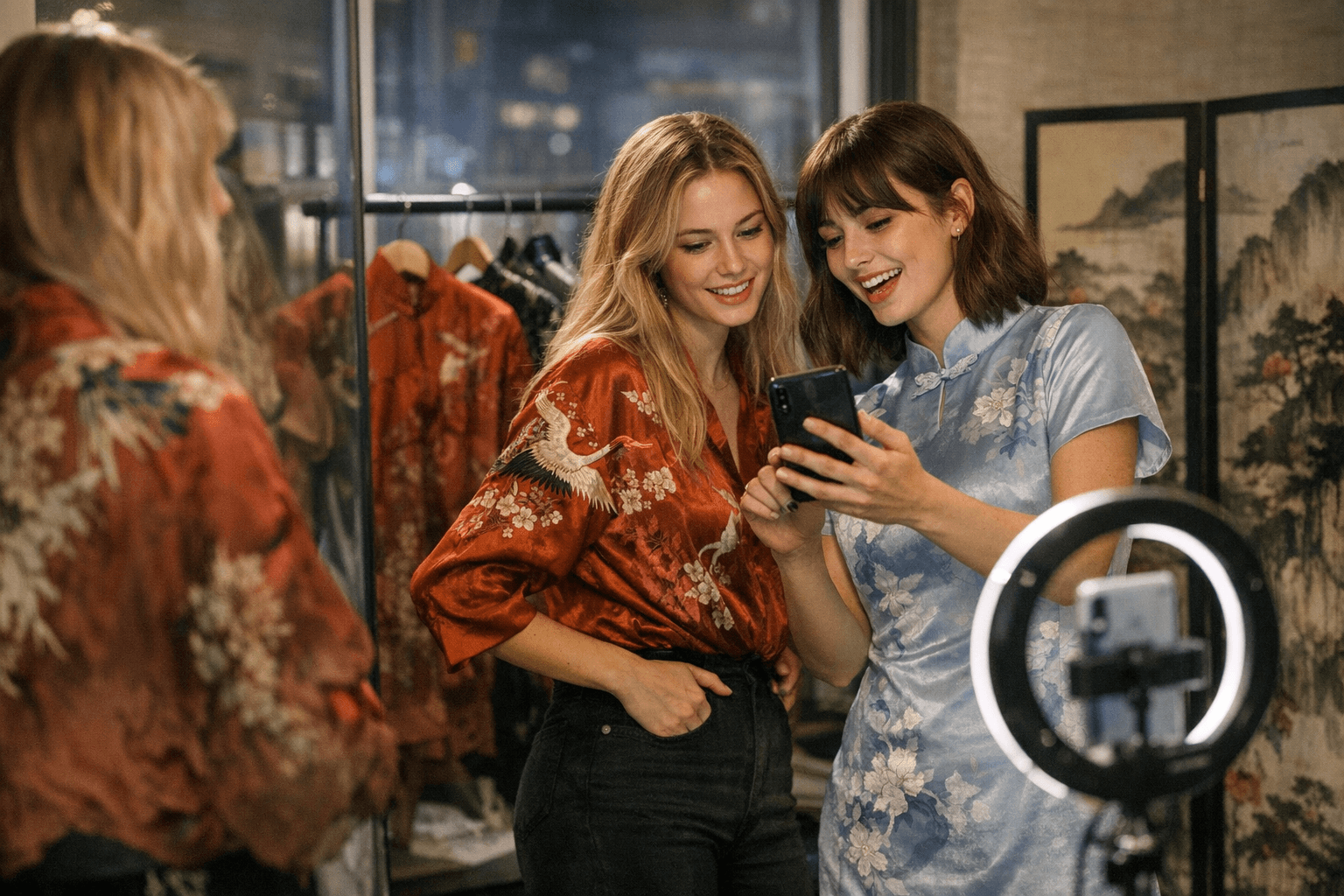
Analyst Samo Burja says “Chinese fashion trends are now routinely jumping to the West via short videos, influencing general women's fashion. This fulfills his earlier prediction of China becoming a major cultural force like Japan. The shift was unthinkable a decade ago.” Estimates from the China Textile and Apparel Council put the new-Chinese style market at 1-billion yuan, roughly $197-million, in 2023, and designers such as Li-Ning and Feng Chen Wang have turned that momentum into visible runway statements and online and retail traction.
The historical record shows this is not an entirely new influx. A content analysis of 704 issues of American Vogue covering 1960–2009 found Chinese influence in visual representations throughout the period, with written references and visual representations peaking most often in the 1970s and 1990s. The study identified the Qipao as the garment type with the greatest influence, and collars as the construction element most affected; across the five decades visual counts outnumbered written references. The academic dataset stops at 2009, leaving contemporary diffusion to be traced by other industry measures.
Contemporary framing calls the movement Neo-Chinese Style or 新中式 and links it to the Guochao national-tide phenomenon. Foxylabny summarizes the design approach: “Neo-Chinese Style (新中式) unites traditional Mandarin collar elements with Pankou frog closures and luxurious Chinese fabrics into modern Western clothing designs including blazers, trenches and sophisticated dresses,” a synthesis echoed by designers Uma Wang and Ms MIN. Heuritech situates the shift as identity work, noting that fashion rooted in classical aesthetics - like Hanfu and motifs from the Tang, Song and Ming dynasties - has become a symbol of cultural identity and authenticity, “turning 'Made in China' into a mark of pride rather than mass production.”
Theglobeandmail and industry reporting place names and retail proof behind the trend. Feng Chen Wang and Li-Ning are credited with driving visibility; Li-Ning in particular has staged runway shows that foregrounded traditional motifs. Designer Ma of bridal couturier OUMA, who moved to New York in 2010 and now operates boutiques across Canada, the U.S., Shanghai, Singapore, Japan and Korea, reflects the shift personally: “I feel like it’s become the opposite now.” Canadian retail examples include Vancouver boutique InFashion Canada’s neo-Chinese silk collection, Toronto-based House of Tytan’s made-to-order bowties with Chinese motifs, and Toronto designer Wanze Song’s Dumpling Bag, released in 2022, which became her brand’s hero product.
Mechanisms and audiences are explicit. Samo Burja points to short videos as the transmission channel. Osmud Rahman of the School of Fashion at Toronto Metropolitan University says global demand for Chinese-inspired clothing has steadily grown over the past two decades and expects the trend to continue as China cements its position as a global powerhouse and national pride deepens among Gen Z consumers. Heuritech highlights designers AO Yes, Samuel Gui Yang, Ms MIN and Vivienne Tam as hybrid voices that resonate with bicultural identities and lists Neo Chinese Style among top aesthetics shaping fashion into 2026.
Craft and styling are the tangible payoff for consumers and designers alike. Artchinesedesign spotlights Su Xiu (Suzhou embroidery) and velvet flowers, and forecasts a 2026 “Relaxed Power Dressing” where loose blazers and oversized coats are softened by craft accents like Su Xiu scarves. Theglobeandmail describes Ma’s use of shui-mo inspiration translated into lace, tulle and pleated satin to mimic ink-wash movement.
From the 704-issue Vogue archive through Li-Ning’s runway moments, OUMA’s boutiques and a 1-billion yuan market in 2023, the pattern is clear: short videos accelerate diffusion, Gen Z and diaspora designers supply the aesthetics, and Mandarin collars, Qipao cues and Suzhou embroidery are now moving from snippets into Western wardrobes as hybrid staples through 2026.
Know something we missed? Have a correction or additional information?
Submit a Tip
