Spring 2027 Bridal Trends Embrace Victorian Romance and Sculptural Drama
Victorian drama is back, but the smartest bridal dresses are the ones you can actually wear. Think sculpted waists, softer minimalism, and details that work beyond the aisle.

The most useful thing about Spring 2027 bridal is that it is not really about one mood, it is about range. The Knot’s editors spent four days moving between private appointments and front-row seats, seeing hundreds, if not thousands, of gowns, and the picture that emerged was less a single trend story than a market split between Carolyn Bessette-Kennedy ease and full-on Brontë romance.
The season’s split is real, but it is not a choice between opposites
WWD framed the collections as a collision of “Wuthering Heights” and “Love Story,” and that tension showed up everywhere in the official New York Bridal Fashion Week calendar for Spring/Summer 2027. The season ran April 7 to 10, 2026, with in-person collection showcases from anchors like Monique Lhuillier, Naeem Khan and Tanner Fletcher, plus Batsheva’s bridal debut and a new wave that included Alyssa Kristin, FERRAH, Netta BenShabu Elite Couture, OUMA Bridal, Poeza, Priscilla Couture and RENHUE. That breadth matters to brides because it tells you these ideas are not trapped in one corner of the market. They are moving from runway mood to actual inventory.
The week also marked real milestones for the business of bridal, with Mark Ingram Bride celebrating 25 years and Verdin Bridal marking five. That kind of longevity is part of the story, too: the market is mature enough to support heritage names, but restless enough to keep welcoming designers who want to rewrite what a wedding dress can be. L’Officiel USA captured that shift neatly by describing the week as a meeting point between the city’s most celebrated bridal houses and a new wave of designers.
The silhouettes that have staying power are the ones that shape the body
If there is one thread running through the season, it is structure. Strapless gowns came back, but not as simple tubes of satin. They were reworked with long-line corsetry, basque and dropped waists, and draped waists that create shape without looking stiff. This is the most commercially durable part of the story because it flatters across body types and translates well from runway to fitting room.
For real brides, this is the trend to buy into if you want the most mileage. A well-built strapless gown with internal support will still look current in 12 to 24 months, especially if the waist is sculpted rather than flat. If you already own a dress or are working with a tailor, this is also the easiest place to modify: bring the waist down slightly, add visible boning, or ask for a cleaner, more architectural bust line. The look is contemporary, but it is also practical, which is why it has legs.
Victorian romance is strongest when it is edited, not literal
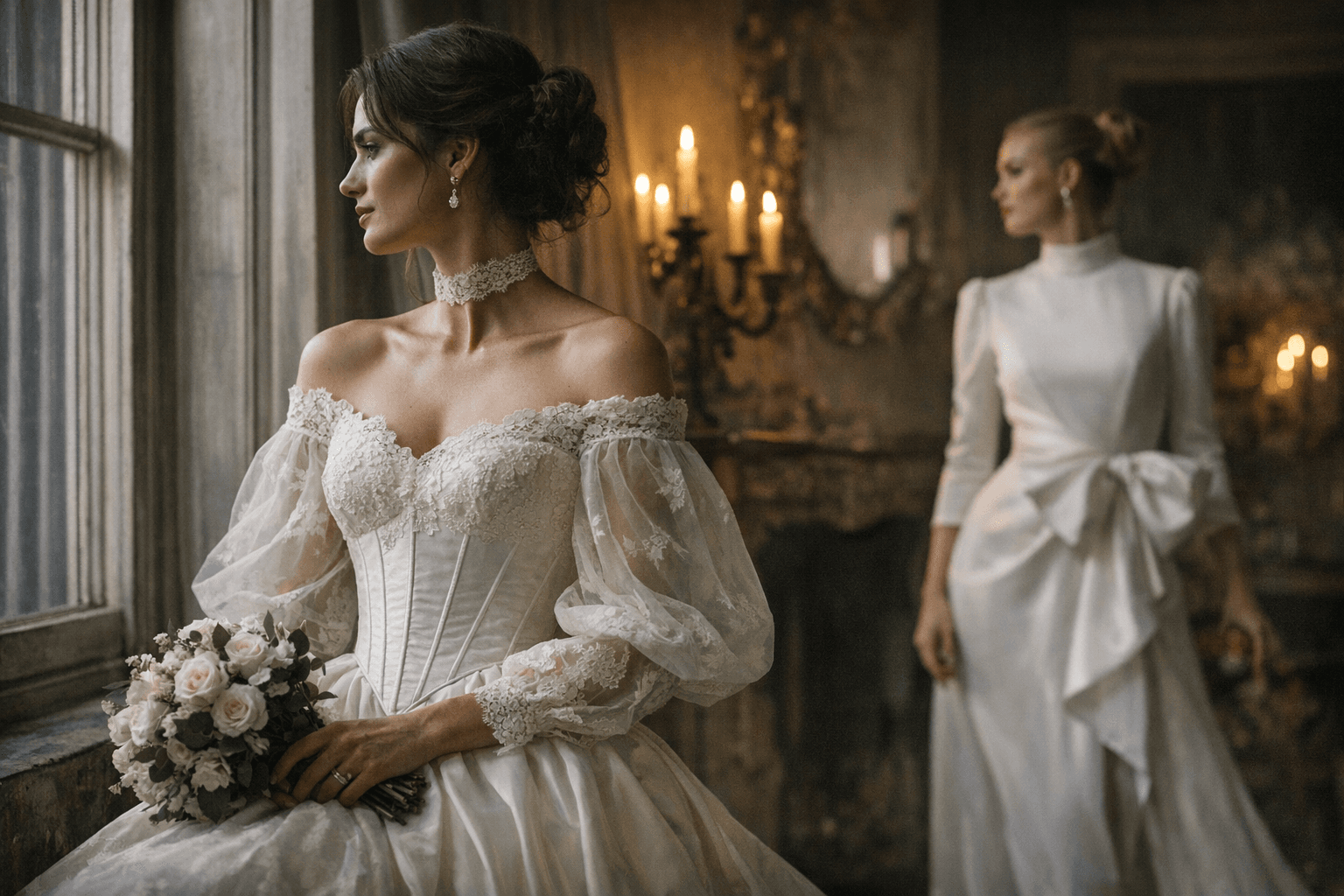
The more dramatic end of the spectrum leaned into Victorian necklines, pickup skirts and a generally more historical silhouette. These looks are the ones that photograph like a dream, especially in motion, but they are also the most likely to read as fashion-forward rather than broadly wearable. That does not make them irrelevant. It just means they are better suited to a bride who wants a ceremony moment and is happy to lean all the way in.
The smartest way to wear this trend is to borrow the feeling rather than the whole costume. A mantilla veil can deliver enough drama to change the entire line of a simpler gown. A Victorian-inspired neckline can work if it is softened by modern fabric or a clean skirt. What is less likely to endure is the most literal version of the trend, especially when the volume starts to feel decorative for decoration’s sake. Gorgeous? Absolutely. Easy to live with? Not always.
Texture is where the romance becomes personal
The other major story of the season was surface detail. Designers layered in maximal fabrics and appliqués, three-dimensional florals and micro bows, giving the collection a richer, more tactile finish. This is the easiest place for brides to make the trend their own because it scales beautifully. A single bow at the back, a floral cluster at the hip, or a hand-worked appliqué hem can feel fresh without overwhelming the silhouette.
That said, this is also where judgment matters most. The bridal market is clearly rewarding dresses that feel personal, confident and shape-conscious rather than generic, but personal does not have to mean maximal from every angle. If your dress already has a strong waist or a dramatic neckline, keep the embellishment disciplined. If the gown is pared back, let one sculptural flourish do the talking. The more targeted the detail, the longer it will feel relevant after the wedding album is closed.
The cleanest counterpoint is still ’90s minimalism
On the opposite side of the mood board, the week kept circling back to Carolyn Bessette-Kennedy and a renewed appetite for stripped-down ’90s cool. The Knot’s Spring-Summer 2027 read on the market included continued ’90s minimalism, muted color, asymmetry and the bridal midi, and that combination is the most likely to survive beyond the trend cycle. It is sharp, wearable and easy to style without looking overworked.
This is the lane for brides who want a dress that can move from ceremony to dinner to after-party without feeling like costume change number one. A muted ivory, pearl or even subtly off-white gown with an asymmetrical hem or midi length feels modern in a way that still reads elegant in person. It is also the best option if you want to spend on tailoring rather than novelty. A clean dress becomes expensive when the cut is precise, the hem is exact and the finish is immaculate.
How to translate the look at different budgets
If you are working with a tighter budget, borrow the drama instead of buying it whole. A veil, headpiece or detachable accessory can deliver the season’s romantic punctuation without committing you to a fully embellished gown. If you have more room to spend, put the money into silhouette first: basque waists, corsetry and well-engineered strapless shapes are the details most likely to hold value in the fitting room and in photographs.
For higher budgets, the strongest splurge is craftsmanship you can feel up close. Hand-appliqué, precise draping and custom structure are what separate a dress that looks trendy from one that looks considered. That distinction is why this season feels bigger than a mood swing between romance and minimalism. Spring 2027 bridal is not asking brides to choose a costume. It is asking them to choose a shape, then decide how much drama belongs on top of it.
This article was produced by Prism’s automated news system from verified source data, official records, and press releases, then run through automated quality and moderation checks before publishing. The system is built and supervised by the people who set the standards it runs under. Read our full AI policy.
Did this article answer your question?


