Statement engagement rings reshape bridal jewelry, wedding bands follow suit
Statement rings are changing bridal taste from matching sets to personal stacks, and wedding bands are becoming design pieces in their own right.
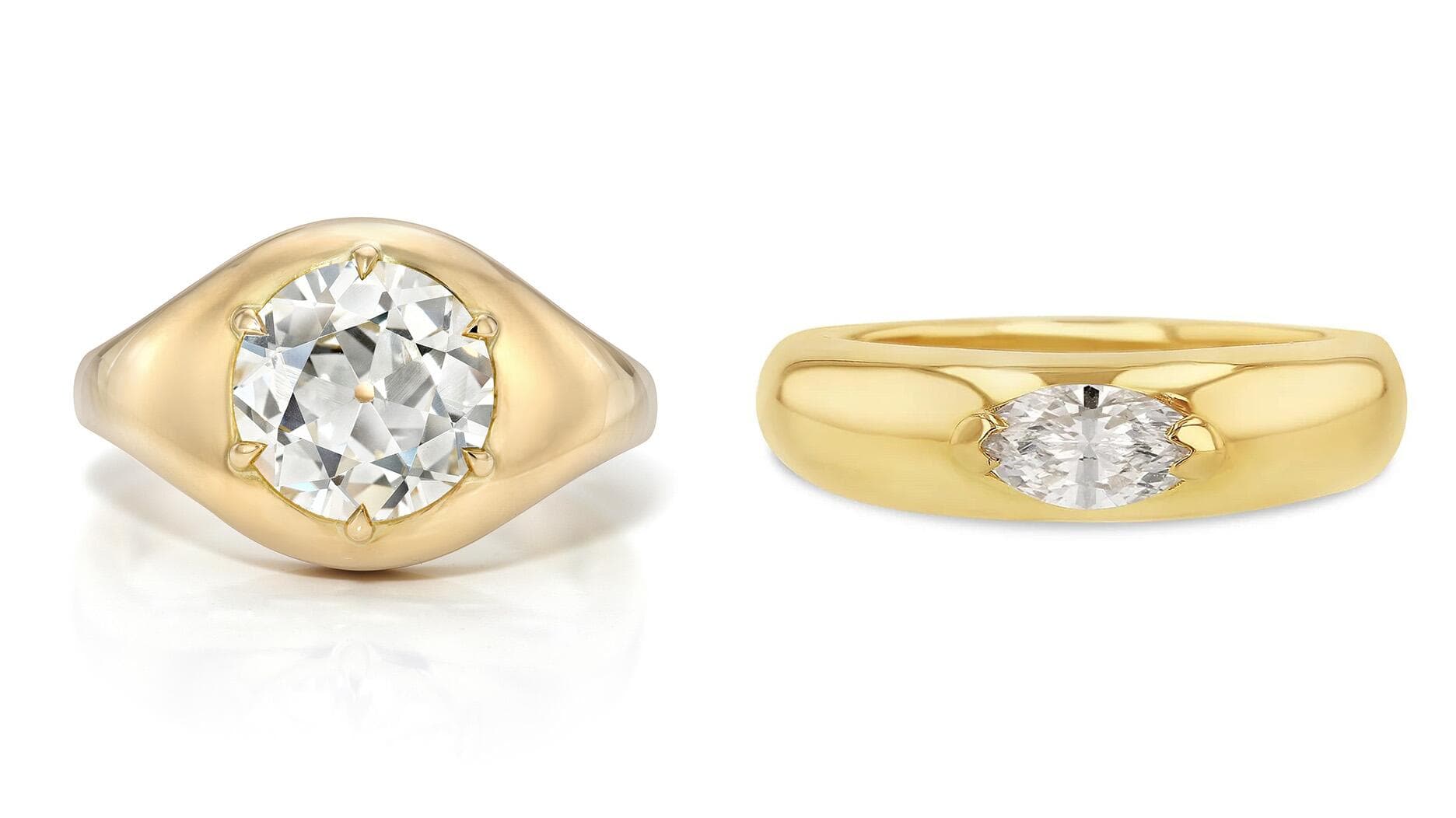
The bridal mood has turned decisively away from polite symmetry. Dua Lipa’s chunky gold engagement ring, with its round diamond set in a semi-bezel, helped push cigar bands and heftier settings into the conversation, and Miley Cyrus later reinforced the shift with a thick yellow-gold band carrying an east-west cushion-cut diamond in a semi-bezel setting.
The new bridal code is personal, not prescribed
What makes this moment feel different is not simply that rings are bigger or bolder. It is that the center stone is now expected to express taste, not just status, and the surrounding metal is doing more of the talking. Chunky domes, east-west settings, floating stones and mixed-metal pairings are all pulling bridal jewelry away from the old solitaire hierarchy and toward something more editorial, more fashion-led, more visibly individual.
That change reflects the way couples are dressing more intentionally overall. A ring no longer has to read as a universal symbol of permanence; it can read as a choice, and a highly specific one. The result is a bridal look that feels less like inherited tradition and more like personal styling, with the engagement ring acting almost like the first piece of a wardrobe.
Why the wedding band no longer has to match
The wedding band used to function as the quiet companion piece, selected to mirror the engagement ring and disappear into the set. That rule is loosening fast. As stones grow larger and settings become more unconventional, the band often no longer complements the engagement ring in any obvious way, which is why some buyers are skipping a separate band altogether or building a stack gradually over time.
Jillian Sassone, founder of Marrow Fine Jewelry, says couples are thinking more carefully about contrast, shape and texture so the two pieces feel cohesive and personal. That matters because the new bridal conversation is not about perfect sameness. It is about balance, and balance can mean a slim pavé band beside a heavy gold mount, or a textured companion piece that echoes the ring’s profile without copying it.
For many modern buyers, the wedding band is becoming less of a one-day decision and more of an evolving styling problem. One ring can stand alone. Two rings can be mismatched on purpose. A stack can build over years. Bridal jewelry is moving toward the same logic that drives good fashion: composition matters more than convention.
The aesthetics behind the ring shift
The strongest emerging ring directions are all deeply fashion-coded.
Chunky domes and cigar-band silhouettes carry the same visual authority as strong shoulders in tailoring. They look deliberate, architectural and a little subversive. East-west settings, where the stone sits horizontally, have a similar effect: they make even a classic shape feel new, directional and relaxed. Floating stones and semi-bezel settings create a lighter, more contemporary read, as if the gem has been suspended inside the metal rather than trapped by it. Mixed metals bring in the layered, eclectic instinct that has made jewelry styling feel more personal across fashion at large.
The other important shift is that bridal details once reserved for special occasions are now being treated as everyday jewelry language. Sassone points to enamel bands, mixed metals and design-driven pieces gaining traction beyond ceremony. That is a meaningful change. It suggests buyers want their rings to work with denim and silk, with a watch and with a tennis bracelet, not only with a wedding dress.
The market is backing up the shift
This is not just an aesthetic swing, it is a market one. The Knot Worldwide’s 2026 Real Weddings Study, based on more than 10,000 U.S. couples married in 2025, places the U.S. wedding industry at roughly $100 billion. It also pegs average wedding spend at $34,000 and average guest count at 117, which underscores how much intention is going into every visible detail, including jewelry.
The study also shows how quickly bridal norms are changing. Gen Z now represents 41% of the wedding market, nearly 9 in 10 proposers now present a ring at the proposal, and lab-grown center stones account for 61% of all engagement ring purchases, up 239% since 2020. Taken together, those numbers point to a market that is more value-conscious, more design-aware and more open to personal customization than the old bridal script ever allowed.
National Jeweler adds another useful signal: yellow gold is gaining ground even though white metal remains the most common engagement-ring metal overall. That matters because the metal choice changes the whole feeling of the ring. Yellow gold reads warmer and more jewelry-like; white metal still leans closer to the classic bridal code. The fact that yellow gold is gaining ground tells you how far taste has moved from the old default.
The old rules are giving way to new ones
Jewelry historian Marion Fasel has described how, around 2001, there was effectively an unwritten rule that engagement rings should be white metal, with platinum dominant and white gold as the backup. That assumption has broken open. Consumers are now embracing yellow gold, fancy-shape diamonds and more substantial settings where the metal matters as much as the center stone.
That evolution changes the wedding-band question in a fundamental way. It is no longer just whether the band matches. It is whether it should match at all, whether it should contrast, and whether the engagement ring is strong enough to carry the look on its own. In that sense, the band has moved from accessory to argument: should it echo, offset, stack or step aside?
Brands are building for the new bridal wardrobe
Jewelry houses and suppliers are already adapting assortments to this more editorial, less formulaic market. Stuller’s Bridal 2025-2026 catalog, released on April 28, 2025, includes more than 700 new styles, expanded customization options, a dedicated section for quick pricing references on lab-grown diamond bridal jewelry, and bridal stack styling tips. That is not the language of a rigid category. It is the language of retailers trying to support mix-and-match decision-making and more individualized selling.
Brilliant Earth is making a similar point in its 2026 wedding-ring trend guide, where it describes wedding bands as entering a design renaissance. Its focus on statement diamond bands, sculptural bands, emerald and baguette bands, vintage-inspired bands, substantial bands and textured bands shows how far the category has moved from plain polish. The wedding band is being treated as a piece with its own silhouette, not just a partner piece.
What this means for how bridal jewelry will be worn
The clearest takeaway is that bridal jewelry is becoming less literal and more styled. A dramatic engagement ring can now set the tone for the whole hand, making the band an opportunity for contrast, texture or restraint rather than automatic coordination. That opens the door to single-ring solutions, asymmetrical stacks and mixed-metal combinations that would once have looked like rule-breaking and now look considered.
For anyone choosing bridal jewelry now, the message is simple: start with the ring’s shape, metal and profile, then think like a stylist. Let the materials speak to each other. Let the stack develop with time if that feels right. Above all, stop assuming the wedding band has to behave like a duplicate. In 2026, the most modern bridal jewelry looks less like a matching set and more like a personal composition.
This article was produced by Prism’s automated news system from verified source data, official records, and press releases, then run through automated quality and moderation checks before publishing. The system is built and supervised by the people who set the standards it runs under. Read our full AI policy.
Did this article answer your question?


