Stella McCartney's Decades of Ethical Design Keep Reshaping Luxury Fashion Standards
McCartney's 25-year label hit 93% sustainable materials for its Winter 2026 Paris show, and the ripple effect on luxury's supply-chain standards is impossible to ignore.
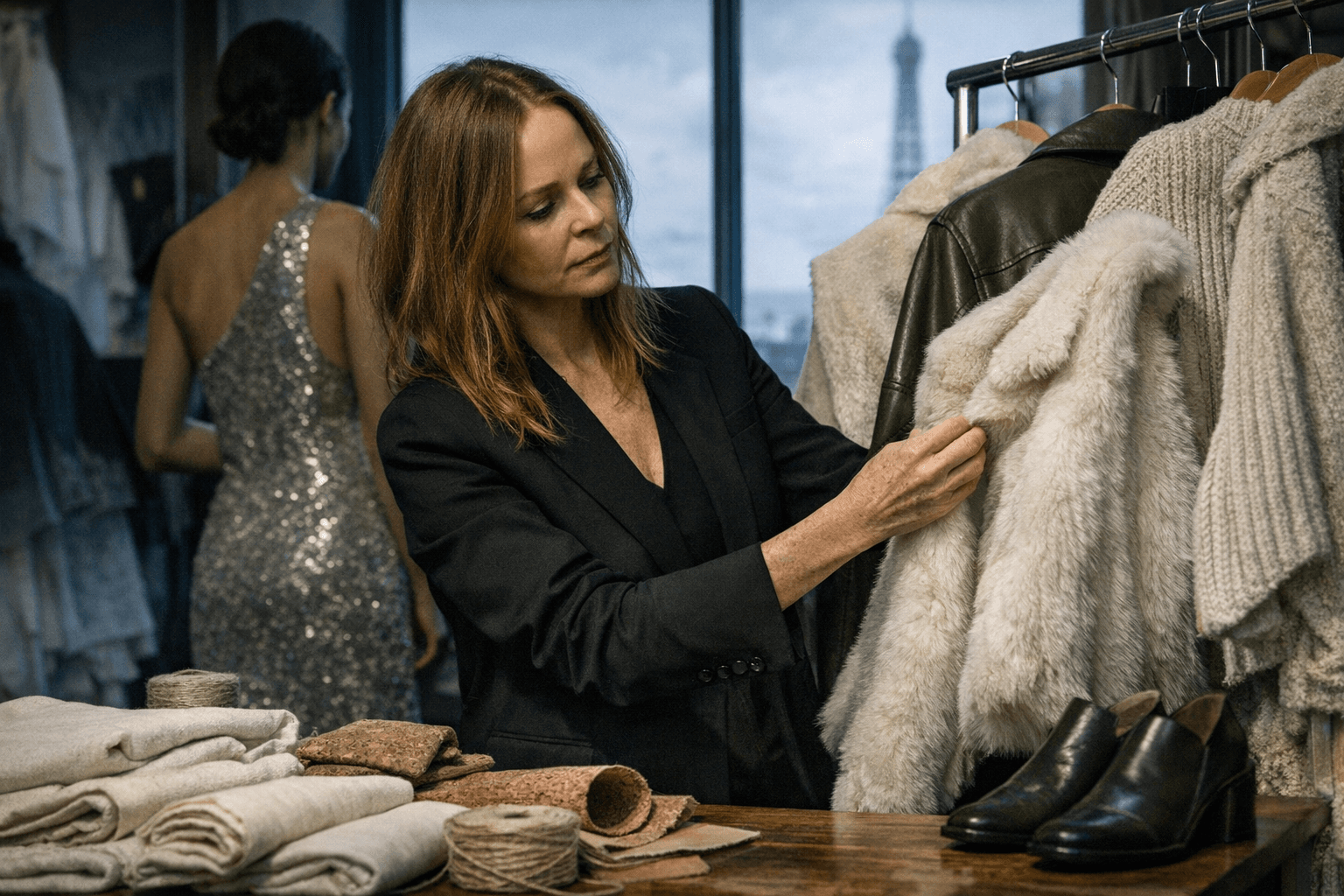
The luxury fashion industry spent decades treating sustainability as a PR footnote. Stella McCartney turned it into the entire sentence. Now 54 and celebrating her brand's 25th anniversary, McCartney has spent a quarter century inside the most rarefied levels of fashion, pushing responsible materials and animal-free alternatives not as a niche position but as a creative mandate that the rest of the industry is slowly, sometimes reluctantly, being forced to follow.
A Childhood That Built the Blueprint
The ethical architecture of the Stella McCartney brand was laid before she ever touched a sewing machine. Born and raised in London and England's countryside, McCartney graduated from Central Saint Martins, but her real education happened earlier. There were the culottes and cowboy boots her late mother, photographer, musician, and animal-rights activist Linda McCartney, wore while riding her Appaloosa horse, and the costumes her parents wore onstage while touring with their band Wings, with Stella and her siblings in tow. The wardrobe fluidity she witnessed, that blending of masculine and feminine across her parents' shared closet, shaped her design instincts permanently. More critically, she listened to conversations at the kitchen table about the requirements and challenges of getting organic certification from Britain's Soil Association, imbibing what it involves to be a pioneering environmentalist. That kitchen table education, she has said, is what sowed the seeds of everything that followed.
From Chloé to a House of Her Own
By 1997, McCartney had become creative director of French fashion house Chloé, where she met designer Tom Ford. Ford was building what would become the luxury-brand conglomerate Kering, and McCartney was an obvious candidate. Ford has said he "was incredibly impressed with her as a designer," noting that "she was also ahead of the rest of the fashion industry by at least a decade with her commitment to sustainability and cruelty-free fashion." In 2001 she launched her eponymous fashion house in a partnership with Kering as a 50/50 joint venture, showing her first collection that year. From that debut, the label's core rules were fixed: no fur, no leather, no feathers sourced from animals. Those were not trend statements. They were foundational constraints that forced constant material innovation, turning restriction into a research-and-development engine that most luxury houses still haven't matched.
The Winter 2026 Paris Show: 93% and a Riding Hall
For her Winter 2026 show at Paris Fashion Week in early March, McCartney chose a riding hall in the Bois de Boulogne, where 13 pure Spanish horses, seven white and six brown, moved in choreographed patterns throughout the show, as models walked an oval catwalk around the perimeter to a playlist featuring the haunting music of Icelandic singer Björk. The choice was pointed: the animals were present not as spectacle but as argument. In the spirit of the Chinese zodiac this year, McCartney is "leaning into the fiery horse," she has said. Her case for animal-free luxury was made flesh: "Billions and billions [of animals] are killed every year for handbags and shoes and jackets. It's kind of ridiculous," she says. "And I'm showing there is an alternative."
The collection itself delivered that alternative with measurable specificity. As the fashion house celebrates its 25th anniversary, the Winter 2026 collection, which the brand says is made from 93% sustainable materials, is a journey through McCartney's own life, featuring fisherman rib knits and silhouettes that draw from the same personal archive she has always returned to. That 93% figure is the kind of granular, publicly reported percentage that the broader luxury industry rarely volunteers, and it raises the bar for what accountability in materials sourcing actually looks like when it's presented as fact rather than aspiration.
Spring 2026: Painted Greenery and the Power of "Come Together"
McCartney's Spring/Summer 2026 show at Centre Pompidou celebrates humanity's connection with nature and features innovative textiles. Before the first look walked, Helen Mirren stepped onto the runway and recited the lyrics to "Come Together," McCartney's mission statement for spring. The season's organizing idea, borrowed from the Beatles song, called for humans to live in harmony with nature, and the clothes translated that philosophy into texture and silhouette. The designer worked her innovative sustainable fabrics into a collection filled with wide-shouldered silhouettes and feathery surfaces made of painted greenery. What looked like plumage on a long lavender dress and a candy pink bodysuit was, on closer inspection, painted fragments of plant matter, enveloping models in a cloud of constructed botanical detail.
McCartney's message of togetherness extended to the audience: Helen Mirren, Robin Wright, Eva Mendes, Ice Spice, and Woody Harrelson gathered under the Pompidou's steel skeleton, with the front row uniting icons of fashion, film, activism, and music around McCartney's vision of ethical beauty, including Anna Wintour, Johnny Depp, Paris Jackson, Jeff Koons, Cara Delevingne, and Dylan Penn. It was a deliberate casting of culture, not just celebrity, around a creative position that McCartney has held for 25 years.
Material Innovation as Industry Infrastructure
What separates McCartney's sustainability practice from marketing is the concrete impact her platform has on emerging material startups. When she became the first designer to use Fevvers, the plant-based, naturally dyed alternatives that look and behave like ostrich feathers, in her summer 2026 runway show, it was a proof of concept rather than a commercial endeavor. The Fevvers plant-feather alternative subsequently appeared across her Spring 2026 collection, closing the show on a striking lilac evening dress. The effect on the startup was transformative. Fevvers co-founder James West said the exposure "put us on the map in a way that we couldn't have ever imagined," adding that "nearly every leading name in fashion brands has been in touch."
PURE.TECH, a new fabric that McCartney herself says literally cleans the air by neutralizing CO₂ and NOx, was woven into denim across the Spring 2026 collection. This carbon-zapping denim is precisely the kind of material claim that reframes what luxury product development can mean: not simply elevated craft, but functional environmental intervention built into the garment itself. When McCartney used Radiant Matter's plant-derived, biodegradable iridescent BioSequin to embroider a jumpsuit modeled by Cara Delevingne in Vogue in 2023, it helped the startup show its value proposition to investors and potential partners. Each placement is, in effect, a funded proof of concept with a global audience.
Setting the Standard for Accountability
Ingrid Newkirk, president of PETA, which named McCartney its Person of the Year in 2024, has described her as compassionate and someone who was going to "make that shine through, sink or swim." McCartney has been clear about the mechanics of change: "I think I've changed a lot of minds and opened a lot of doors for other people that want to work that way," she has said. That influence operates at the industry infrastructure level. Her public percentages, her startup collaborations, her willingness to absorb the higher cost of pioneering materials rather than waiting for price parity, all of it applies pressure to larger retailers who can no longer claim ignorance of alternatives.
Supply-chain transparency and circular thinking are not abstract concepts at Stella McCartney. They're operational requirements that have been refined over two and a half decades. She admits that making garments using sustainable materials can be costly, and frames early adoptions of new materials as sacrifices worth making to draw attention from investors and buyers to innovations that could make or break a startup. That investment logic, treating the runway as a proving ground for next-generation textiles, is what distinguishes a genuine accountability framework from a sustainability report written for investor relations.
Twenty-five years in, Stella McCartney's relevance isn't nostalgic. It's structural. The luxury industry is still catching up to the standards she set in 2001, and her Spring and Winter 2026 collections suggest she has no intention of slowing that chase down.
This article was produced by Prism’s automated news system from verified source data, official records, and press releases, then run through automated quality and moderation checks before publishing. The system is built and supervised by the people who set the standards it runs under. Read our full AI policy.
Did this article answer your question?


