Student designers turn patriotic motifs into sustainable runway statements
Patriotic graphics, 3D-built looks, and sustainability gave Miami Dade College's student runway the kind of polish that gets stylists paying attention fast.

Student fashion in Miami is no longer warming up for the real industry. It is the real industry pipeline, and the annual Miami Fashion Institute show made that obvious with star-spangled boots, reworked stripes, and red-white-and-blue styling that felt sharpened for the red carpet, not softened for a classroom.
Held Thursday, June 4, 2026, at the Freedom Tower in downtown Miami and presented with Miami Fashion Week, the show doubled as a 10th anniversary celebration for Miami Fashion Institute. Miami Dade College opened the night with a video look back at a decade of growth, community support, and collaborators, then sent out a finale built to make a point: student design can be ambitious, technical, and market-ready all at once.
Patriotism, stripped of the cliché
The strongest move in this collection was not the flag motif itself. It was the decision to treat patriotism as a design language instead of a costume. Star-spangled boots, altered stripes, and a red-white-and-blue palette gave the work a familiar visual code, but the execution pushed it away from pageant and toward fashion.
That matters because stylists are always hunting for something they can translate quickly from runway to event dressing. Sculptural silhouettes, graphic color blocking, and a little patriotic tension can move fast when they are clean enough for a celebrity fitting and bold enough for a camera flash. This is the lane where student work stops looking like student work and starts looking like the next aesthetic package brands will borrow from.
The 10-look finale was the pitch
The final statement came through a 10-look capsule collection created in honor of the United States' 250th anniversary. Miami Dade College also described the special finale as 10 innovative looks made using CLO 3D, which tells you exactly where fashion training is headed: less draping in theory, more digital fluency, more speed, more precision, and more room for experimentation before fabric is ever cut.
That is the kind of production logic the industry is leaning into right now. CLO 3D does not just make student presentations look modern, it changes how design is developed, reviewed, and approved, which is why these kinds of collections feel so relevant to stylists and buyers. When a look can be built digitally, then translated into a physical runway moment, it already speaks the language of commercial fashion.
Why stylists are betting on sculptural silhouettes
The silhouettes here point to a broader shift: stylists are chasing shape, not just surface. Futuristic lines, structured volume, and pieces that hold their own in photographs are exactly what gets traction when red carpet dressing has to compete with social media speed and nonstop visual noise.
Patriotic motifs are working because they are being treated as pattern, shape, and attitude rather than literal symbolism. Reworked stripes can read athletic, graphic, or tailored depending on the cut. Red-white-and-blue can look juvenile in the wrong hands, but in a disciplined collection it becomes a strong brand signal, especially when paired with sustainable construction and a clear point of view.
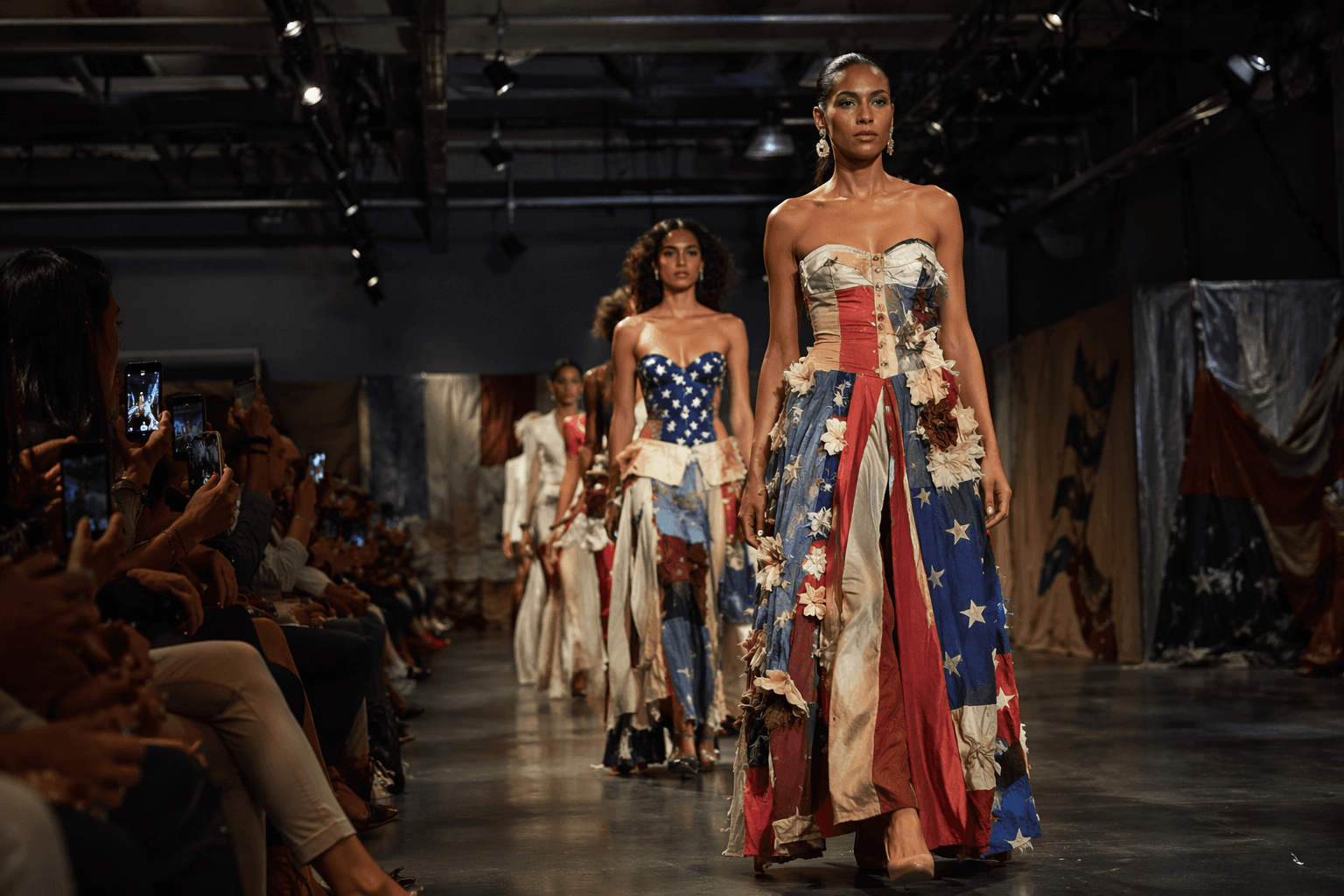
That is why this kind of student runway can influence occasionwear so quickly. A polished shoulder, a crisp boot, a hard-edged stripe placement, or a digitally engineered silhouette can migrate into eveningwear, influencer styling, and even brand campaigns before the season is over.
MFI's training model is the real engine
Miami Fashion Institute is not a side project. Miami Dade College describes it as South Florida’s only two-year fashion program at a public institution, with associate degrees in fashion design and fashion merchandising. The program blends creativity, technical training, and hands-on experience, and Oscar Lopez, who serves as chair of fashion programs, has made it clear that the goal is to push students toward the global fashion industry, not just graduation.
That structure explains why the show feels so plugged in. Miami Fashion Institute has been tied to Miami Fashion Week for years, and MDC has pointed out that the first graduating class showed collections at Miami Fashion Week in January 2019. In other words, this is not a one-off showcase built for applause. It is a recurring launchpad with enough history behind it to give student work real industry gravity.
The awards reinforced what the room valued
After the runway, the event moved into awards presented by industry partners, and the list itself says a lot about what fashion wants from the next generation. Miami Dade College announced the Ruben and Isabel Toledo Award, the Retail Concept Award presented by Saks Fifth Avenue, the Collaboration Award presented by Faith Connexion, the Editorial Award presented by Brickell Magazine, the Miami Made Award presented by Miami Fashion Week, and the Sustainability Award presented by Upcycle Project.
Winners included Teresa Chumpitaz, Amanda Rodriguez, Mauro Blanc, Laura Prada, Milagros García, and Maryna Gorbachova. The mix of categories is telling: retail viability, collaboration, editorial impact, local identity, and sustainability all sat in the same room, which is exactly how emerging designers are judged now. It is not enough to be imaginative. You have to be legible to a stylist, interesting to an editor, and credible to a brand.
Why this runway already feels bigger than a campus show
The Freedom Tower setting gave the whole evening an extra layer of significance. In downtown Miami, with Miami Fashion Week attached and the institution marking a decade, the show read less like a student presentation and more like a proof-of-concept for how fashion schools can feed the industry with speed and style.
The sharpest takeaway is simple: the next wave of occasionwear will not come from safe, repetitive glamour. It will come from designers who can turn identity, technology, and sustainability into silhouettes people want to wear in public. Miami’s student runway just showed how fast that pipeline is moving.
This article was produced by Prism’s automated news system from verified source data, official records, and press releases, then run through automated quality and moderation checks before publishing. The system is built and supervised by the people who set the standards it runs under. Read our full AI policy.
Did this article answer your question?


