Veja and Baserange Unite to Reinvent the Ballet Sneaker With Eco-Friendly Materials
Veja and Baserange's new ballet sneaker is built from Mesclat, a rare blend of Lacaune wool and French hemp grown entirely in the South of France.
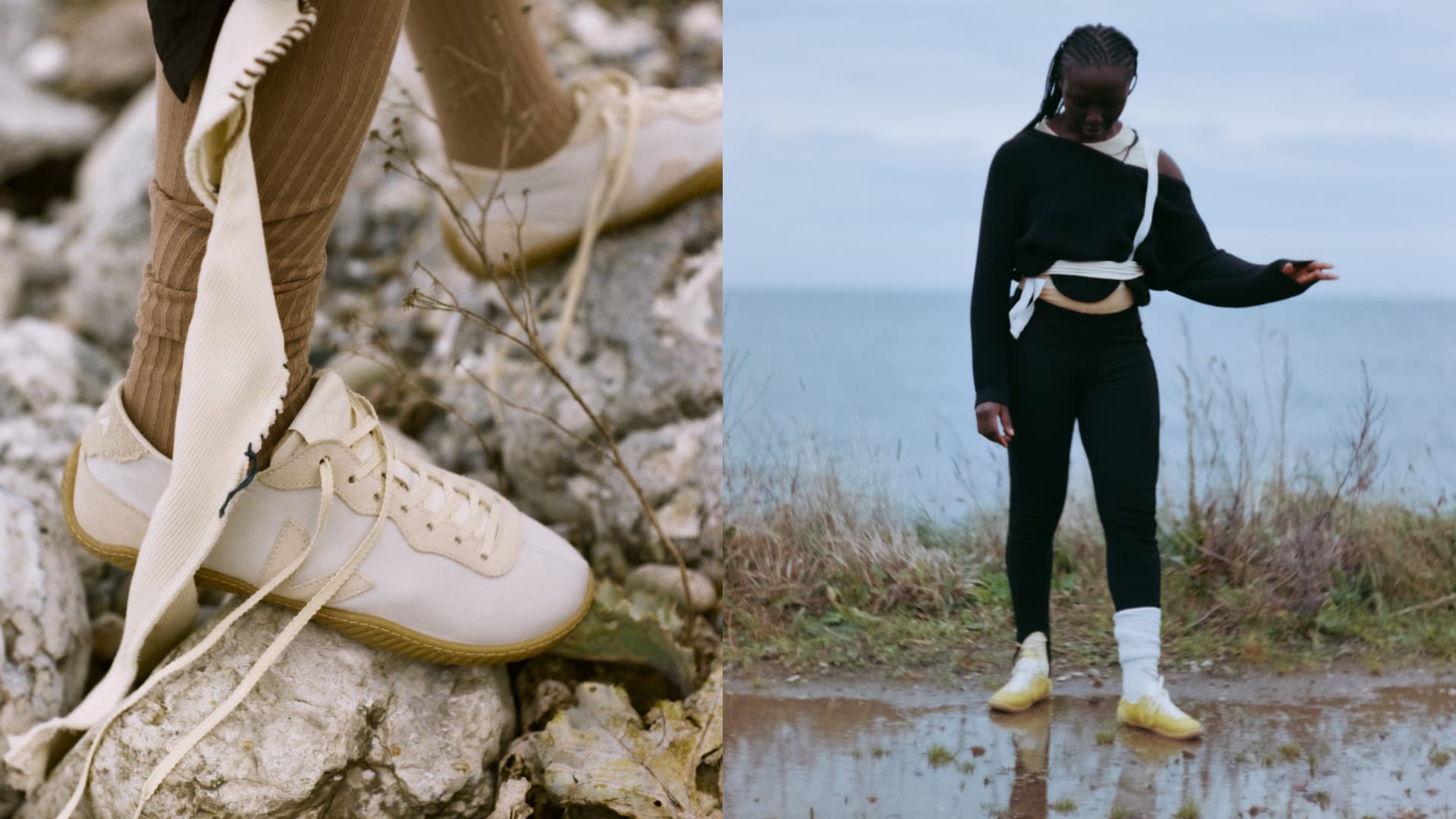
Walk any block in New York, Paris, Milan, or Copenhagen right now and the ballet sneaker is inescapable. From Puma and Nike to Miu Miu and Celine, the slim, low-to-the-ground silhouette has been reissued, repositioned, and runway-tested at spring 2026 shows for Stella McCartney, Loewe, Prada, Ferragamo, and Staud, and confirmed again for winter 2026 at Brandon Maxwell, Valentino, Khaite, Tory Burch, and Ganni Resort. The question now is not whether the ballet sneaker has cultural momentum. It is whether anyone can make it with a conscience.
Veja and Baserange answered that question last week with a slim, ballet-sneaker collaboration built around materials that have no equivalent at a conventional sneaker retailer. Veja, known for responsibly sourced leather and rubber, brought its Nolyn, a sustainable nylon, to the construction. Baserange, the French-Danish label specializing in organic knits for intimates and dresses, contributed something rarer still: Mesclat, a hybrid fabric combining Lacaune wool and organic French hemp, developed by VirgoCoop, a textile cooperative in the South of France. Baserange co-founder Blandine Legait describes it plainly: "It's one of the rarest, one-hundred percent locally grown and produced fabrics."
Recycled materials run throughout the rest of the shoe, from the low-to-the-ground soles to the substitute-nylon uppers, resulting in what the brands describe as a less energy-intensive, more eco-friendly construction than the conventional ballet sneakers flooding the market.
Veja co-founder Sébastian Kopp was clear-eyed about both the appeal and the risk of entering a trend this saturated. "The no-sole trend is a super interesting one, and very Veja, old school, and vintage," he said. "But the challenge was to modernize it, to launch this trend into the future." That framing distinguishes the collaboration from the retro revivals at mass sportswear labels, where nostalgia is largely the point. Here, the silhouette is a starting position, not a destination.

The result has been described as a "prima sneakerina," and the styling language around it suggests a shoe that sits at the precise intersection where dancewear references meet street-ready minimalism. Whether the Mesclat upper, with its Lacaune wool softness and hemp structure, translates that lightness into a wearable everyday shoe remains the most interesting open question. No retail pricing or distribution details have been confirmed, and no quantified sustainability metrics, such as recycled content percentage or emissions comparisons, have been published alongside the launch. What exists is a material story genuinely worth scrutinizing: a textile cooperative in the South of France producing fabric from locally grown wool and hemp is not marketing language, it is supply chain specificity of a kind the broader ballet-sneaker trend has not prioritized.
In a category where every major brand now claims a slimmed silhouette, Veja and Baserange staked their entry on what is inside the shoe rather than how it looks from across the street.
This article was produced by Prism’s automated news system from verified source data, official records, and press releases, then run through automated quality and moderation checks before publishing. The system is built and supervised by the people who set the standards it runs under. Read our full AI policy.
Did this article answer your question?


