Waste-Based Textiles Could Unlock a $78 Billion Fashion Supply Chain Opportunity
The clothes you're throwing away this spring could fund a $78 billion supply chain revolution, and brands like GANNI and Reformation are already wearing the proof.

Fashion has a forest problem that most consumers never see on a hangtag. Conventional wood-based fabrics log 300 million trees annually, creating volatile, high-risk supply chains for fashion brands. The viscose in your blouse, the rayon in that slip dress, the modal in your basics drawer: all of it flows through supply chains that are increasingly exposed to climate-driven shocks, tightening regulations, and a certified wood supply that simply cannot keep pace with global demand. Conventional forest-based supply chains, like viscose and paper, are increasingly a relic of the last century. Once steady, these value chains are now exposed to regular climate-driven supply shocks, and tightening regulations are converging to create a riskier and more volatile outlook for fashion companies using conventional wood-based inputs in textiles and packaging. These pressures are expected to drive cost increases, supply disruptions and higher spending on compliance for companies that rely heavily on virgin wood.
The answer to this structural crisis is sitting in your wardrobe, in your neighbour's recycling bin, and in agricultural fields around the world. The question is whether the industry is willing to fund the infrastructure to capture it.
The $78 Billion Case for Rebuilding Fashion's Supply Chain
Canopy has calculated that it will take about $78 billion in investments by 2033 to build the mills that can turn inputs like waste textiles and agricultural residues that would otherwise be burned or landfilled into high-quality paper, packaging and fashion fabrics. That figure, calculated by the forest conservation nonprofit Canopy, is less a fundraising target than a structural blueprint: the precise industrial investment required to redirect the fashion industry away from ancient forests and toward the waste streams it is already generating.
The initial infusion of $2 billion will enable the first 1.5 million tonnes of next-gen paper, packaging, and textile production capacity in India and is part of a broader global initiative to mobilize $78 billion into the global next-gen infrastructure transition by 2033. At Davos in January 2026, Canopy and partners including the NO.17 Foundation and Tsao Pao Chee Group unveiled a blended finance blueprint specifically designed to de-risk early investments and attract institutional capital at the scale the transition demands. The model is based on blended finance structures, with the aim of reducing the risk of initial investments and attracting institutional capital to alternative materials with a lower environmental impact. India will host the first deployment, and the program is designed for global replication from there.
The funding gap remains stark. Funding the production shift requires $78 billion in investment by 2033, compared to the $1.5 to $1.8 billion invested so far. Canopy's Nicole Rycroft, the nonprofit's founder and executive director, has framed the goal plainly: "We plan to mainstream next-gen [materials] to a critical tipping point, and to help galvanize the $78 billion needed to build and retrofit next-gen mills globally."
What Next-Gen Textiles Actually Are
The term "next-gen textiles" sounds like runway-season marketing language, but the mechanics are straightforward and the inputs are decidedly unglamorous. Proven next-gen alternatives, made from recycled textiles, industrial food waste and agricultural residues, are ready to scale. These low-carbon, circular alternatives offer the industry a pathway to build supply resiliency while meeting business, performance and design demands.
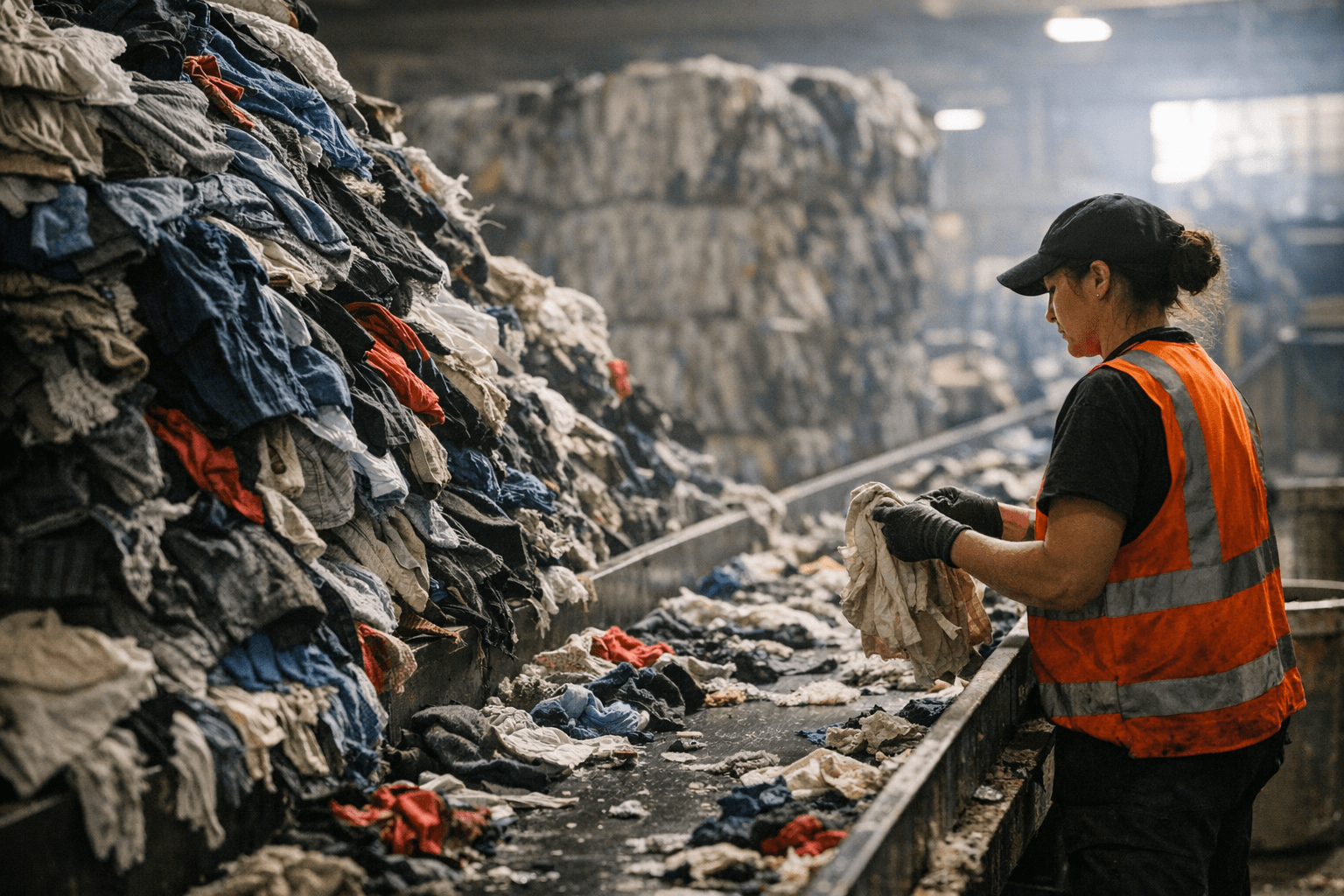
The environmental performance case is compelling. Each tonne of next-gen fibre delivers compelling environmental and social returns compared to its virgin wood counterparts, including up to 4 tonnes of CO₂ emissions avoided per tonne, improved air quality especially in rural areas, new income pathways for farmers and waste collectors, and significantly lower impacts on biodiversity, land use, water and energy.
The scale of waste being left on the table is equally striking. Most discarded clothing and other waste textiles are currently destined for landfills and a slow decomposition into climate-damaging methane. Agricultural residues face a similar fate: "Many agricultural residues are still being burned on the fields, when we know they can be used more sustainably, cutting air pollution and scaling a sustainable supply chain for paper, packaging, and textiles." In India, air pollution from crop residue burning contributes to an average of 150 premature deaths daily.
The Brands Already Wearing Next-Gen
These next-gen alternatives aren't future fiction; they're already on the market and ready to scale. Designers and brands such as GANNI, H&M, ZARA and Reformation are already integrating next-gen textiles into their clothing lines. This is not limited to capsule experiments. More than 950 brands, including Inditex, Hugo Boss and Etam, with a combined turnover in excess of US$2.1 trillion, already collaborate with Canopy, which reinforces expectations of future demand.
The technology companies enabling this shift are moving quickly. In the past 12 months, fashion tech company Circ announced it will build the world's first commercial-scale mill capable of transforming blended polyester-cotton textiles into advanced recycled materials. Sweden's Circulose is reopening its textile-to-textile pulp mill in late 2026, and numerous conventional Chinese viscose producers have leaned into next-gen production for fashion clients that represent billions of dollars in annual revenues.
Circulose operates the world's first commercial-scale textile-to-textile recycling plant, transforming cellulosic textiles into dissolving pulp for new fibres. With 60,000 metric tonnes annual capacity, the company has a network of over 100 suppliers and partnerships worldwide and sees its fabric being used by a growing number of fashion brands including GANNI, H&M, Levi's, and others. Meanwhile, Circ's technology for separating and recovering both polyester and cotton from blended textiles to create high-quality lyocell and polyester fibres has attracted significant investment from Breakthrough Energy, Inditex, and Patagonia. The company plans to open a facility with the capacity to recycle 60,000 metric tonnes of textile waste annually, scaling to 300,000 metric tonnes by 2030.
Why Supply Chain Resilience Is the Real Sell
For fashion brands weighing the business case, the environmental argument is secondary to what next-gen materials actually fix at an operational level. Scaling the production of these low-carbon next-gen materials is an opportunity for companies to reduce sourcing risk and build resiliency into their supply chains and for high-carbon forests to be kept standing.
The regulatory pressure reinforcing that logic is intensifying. The upcoming European Union Deforestation Regulation, entering into force in late 2026, is expected to reshape sourcing expectations for forest-derived inputs by restricting market access for non-compliant commodities and increasing competition for certified volumes. In parallel, investors are setting stricter conditions toward deforestation-free portfolios and are beginning to withdraw capital from companies considered high risk on environmental or supply chain metrics. Growing alignment with climate-related disclosure regimes means the cost of capital could rise for companies that fail to adapt.
In this context, next-gen textiles are not an ethics upgrade; they are a hedge.
Circular Manufacturing: Fashion's Most Significant Trend for 2027
Last season's clothing can be more than just a trip to the local second-hand store or pollution; it can be next season's styles thanks to circular manufacturing being one of the hottest fashion trends for 2027. That framing matters: it positions the shift not as sacrifice but as design opportunity, the kind of language that has historically moved fashion faster than policy mandates.
Less than 1 percent of textiles are currently recycled into new clothing, which means the scale of what remains uncaptured is almost architectural. The industrial infrastructure to close that gap does not yet exist at the required scale, which is precisely why the $78 billion figure carries the weight it does.
With proven technologies, committed brand partners, and abundant waste streams ready to be transformed, next-gen textiles are no longer a niche experiment. If we invest at the scale this transition demands, we can keep ancient and endangered forests standing, reduce waste and emissions, and redefine what the future of fashion is made of, not from the world's last forests, but from yesterday's waste. The fabric of fashion's future is already in the landfill. The only question left is whether the industry will fund the mills to pull it back out.
This article was produced by Prism’s automated news system from verified source data, official records, and press releases, then run through automated quality and moderation checks before publishing. The system is built and supervised by the people who set the standards it runs under. Read our full AI policy.
Did this article answer your question?


