Brunello Cucinelli Sets a New Standard for Thoughtful AI Development
Brunello Cucinelli's in-house AI platform, Callimacus, is rewriting how luxury brands build digital experiences — one ancient Greek philosopher at a time.
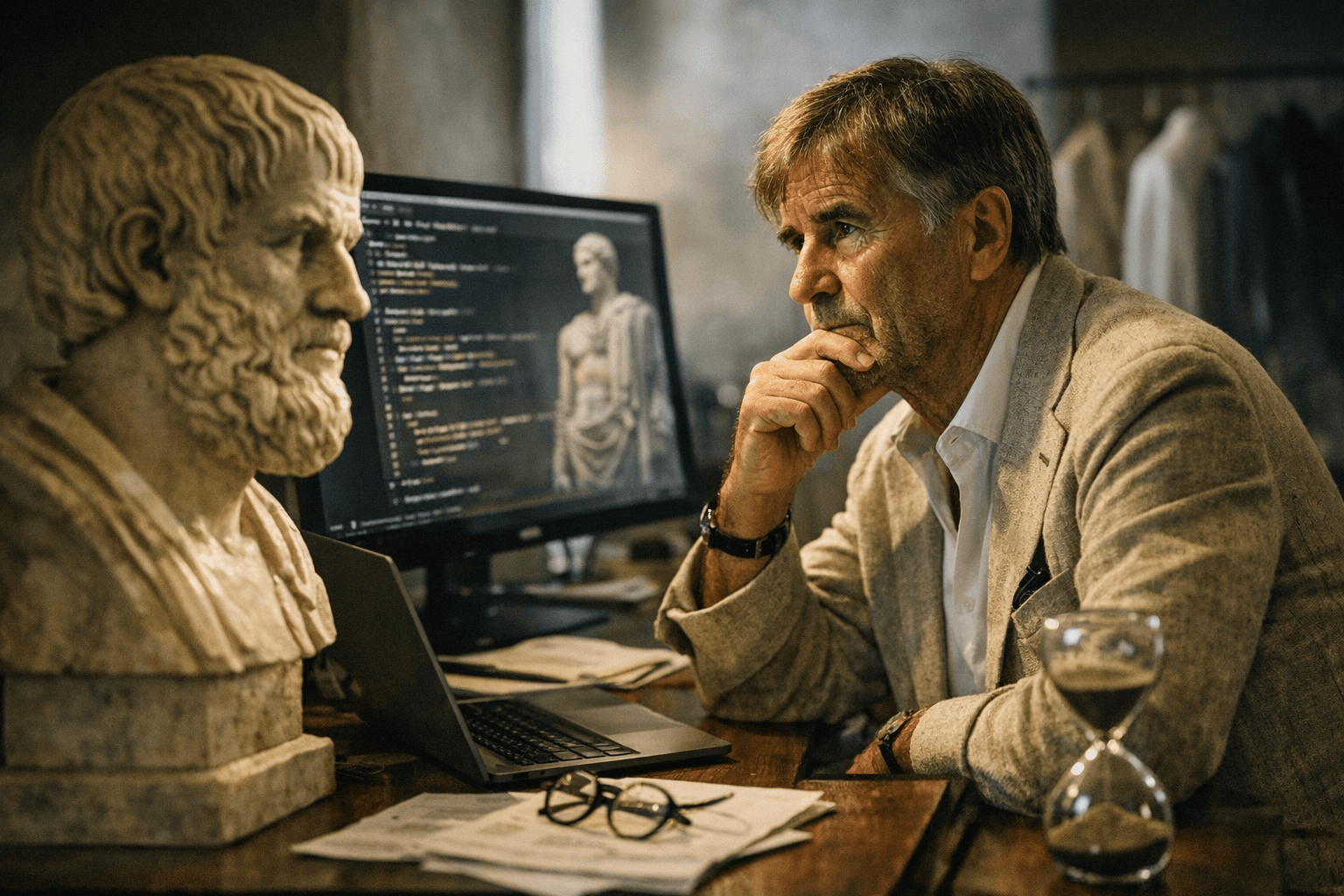
Brunello Cucinelli has never been a brand in a hurry. Its cashmere moves slowly, its philosophy runs deep, and its Umbrian hamlet of Solomeo operates on a timescale more Renaissance than Silicon Valley. So when the house announced it had spent three years quietly building its own AI platform from scratch, with a team of five people drawn from mathematics, engineering, philosophy, and art, the fashion industry paid attention. Almost as famous for its humanist philosophy as its luxury products, Brunello Cucinelli has emerged as a lighthouse for AI: not by rushing recklessly forwards, but by undertaking in-house platform work that venerates the human touch at the same time as building composable experiences in real-time. That positioning is not merely brand language. It describes a concrete, multi-year technical program that is now producing results in market.
The Interline Podcast's March 17 episode, titled "A Case Study In Deeply-Considered AI Development At Brunello Cucinelli," put those results under rigorous editorial scrutiny. Host and Editor-in-Chief Ben Hanson described the episode as covering "not just unique practical applications of AI in creating a new generation of websites," but also "philosophical considerations that need to be weighed when evaluating the roles that we actually want AI to play versus the areas that we think should stay ineffably eternally human." His guest was the executive best placed to explain both dimensions: Francesco Bottigliero, who holds a dual role as Chief of Humanistic Technology at Brunello Cucinelli and Chief Executive Officer at Solomei AI, which is part of the same overarching Foro delle Arti.
The Architecture of Restraint
Most luxury brands reach for AI as a conversion tool: faster checkout, tighter targeting, optimized product feeds. Brunello Cucinelli began from the opposite end of the problem. At the end of summer 2021, Cucinelli created a team of researchers from mathematics, engineering, philosophy, and art to explore possible ways of adopting artificial intelligence into the company's activities, while respecting the values that have always guided it. The mandate was not efficiency. It was alignment: could technology be made to serve the same humanistic principles that govern every cashmere coat and every stone-laid courtyard in Solomeo?
Towards the end of 2022 came the idea of trying to use AI to innovate the way websites are designed and built, trying to combine human creativity and the potential offered by technology. That idea became Solomei AI, named after the small town of Solomeo in Umbria, where Brunello Cucinelli is based. The project's intellectual framework drew heavily from antiquity: inspiration from ancient Greece plays an important role in the philosophy behind the project, with Cucinelli referencing the teachings of thinkers such as Xenophanes, who emphasized the importance of the constant search for truth and improvement.
Callimacus: What a Luxury Website Becomes
The first product to emerge from Solomei AI is Callimacus, a proprietary software development kit that now powers Brunello Cucinelli's live e-commerce experience. Callimacus is an AI-native software development kit that uses custom AI agents to dynamically generate the user experience based on user intent, named after the ancient Greek poet and curator of the Great Library of Alexandria.
The architecture represents a wholesale rejection of conventional web design logic. "We wanted to create a new generation of website that leverages human intelligence with the help of AI," Bottigliero explained, noting that the team "looked at the way in which traditional sites were constructed, with pages, indexes, menus, instructions for use, etc., which we removed in order to design something totally different and innovative, with a site that allows content to be freed up." The result is a pageless structure: the platform eliminates the concept of pages and menus and is able to generate and organize content in real time based on visitors' navigation and to respond to formulated questions.
Bottigliero is emphatic that this is not a chatbot rebranded for luxury. "It's not a chatbot," he says. "We've designed a system that understands the visitor's intentions and adapts to them. It answers questions and then offers content, such as images and text, for visitors to browse. During tests, we noticed that a new type of interaction was being established, as if the exchange were infinite, because the site adapts directly to the user."
The internal architecture is populated by agents drawn from Greek antiquity: Socrates engages in dialogue with visitors and learns through interaction; Demosthenes ensures effective communication in multiple languages; the Dioscuri monitor conversations to maintain accuracy and respect; Callimachus assists in website creation by verifying and improving content through interactive dialogue; and Thamyris captures visitors' intent and guides their exploration. Together, these components form the Solomei AI platform, creating dynamic, user-centric websites.
The Commercial Case
Brunello Cucinelli launched a new e-commerce site, conceived and delivered using Callimacus, the proprietary platform that Solomeo AI developed. Solomei AI is the retailer's in-house e-commerce project, named after the Italian city where it is headquartered. The e-commerce expansion built on earlier proof of concept: in July 2024, the brand had published BrunelloCucinelli.ai, a standalone AI-powered site focused on philosophy and history, before extending the platform to the transactional business.
Initial reactions to the new experience were positive, with the metrics reflecting this: increases in engagement rate, time spent on the website, and items added to the cart. Bottigliero has articulated an ambitious five-year vision: in five years, the experience should feel more like shopping in a physical boutique, with voice-based interaction that understands what the customer is looking for, while respecting privacy and personalizing the experience without relying on third-party data.
The commercial rationale is clear even to outside observers. Justin Baer, founder and CEO of upscale menswear brand Collars & Co., noted that "for a brand like Cucinelli, ecommerce is not just a sales channel — it is an extension of the brand's philosophy and how they want people to feel," adding that an AI-driven experience that adapts to customer intent is "much closer to how luxury sells in real life." Not everyone is ready to declare revolution: Giovanne Bordone, senior lecturer in Fashion Marketing at London Metropolitan University, assessed the Callimacus launch as "a new way of showcasing ecommerce products in harmony with a demanding clientele — so an innovation but certainly not a disruption." The tension between those two readings is precisely what makes this case study instructive.
Philosophy as Infrastructure
What distinguishes Brunello Cucinelli's approach is not the technology itself but the governance model around it. Cucinelli describes his AI as "Humanistic Artificial Intelligence," one that takes into account humans and ethical issues. The development process was accompanied by constant reflection on the moral implications, with the goal being a balanced symbiosis between human genius and the power of AI: uniting human creativity and intuition with the potential of technology, without one side dominating.
That ethos traces back further than the 2021 research team. The brand was approached by Silicon Valley players back in 2015 who wanted to exchange views on subjects such as humanism, technology, and humanist capitalism, including Marc Benioff, founder and CEO of Salesforce. Reid Hoffman, founder of LinkedIn, was later brought to Umbria, where the University of Perugia awarded him an honorary doctorate in Human Sciences. The conversations that most fashion brands hold privately in boardrooms, Brunello Cucinelli turned into symposia in a medieval Umbrian village.
Solomei AI has also begun to move beyond the house that built it. When the corporate website was first published in July 2024, the team received inquiries from other brands and other industries. A separate company was created, and the team developed the first SDK for the market, released in July 2025, after which interest from system integrators and creative agencies followed. The platform Brunello Cucinelli built for itself is now a product that others can adopt.
What the Debate Actually Covers
The Interline episode positions itself as more than a technology briefing. The podcast frames Brunello Cucinelli as having emerged as a lighthouse for AI and sets out "to debate the frontier between the artificial and the human, and to get into the weeds about a future of composable websites and software." That framing matters because it refuses to separate the practical from the philosophical. The question of which parts of a luxury brand's digital presence should remain human is not decorative hand-wringing. It is a design constraint that shapes architecture decisions, agent behaviors, and editorial guardrails.
Brunello Cucinelli chooses technologies that align with its values, ensuring they don't compromise the craftsmanship and brand positioning built over more than 40 years. In its boutiques, the aim is to make technology invisible, so there is no barrier between sales associates and customers. The Callimacus platform attempts to carry exactly that philosophy into the digital channel: a system that serves the person in front of it without asserting itself. Whether that is achievable at scale, and whether luxury's most considered AI experiment can become a transferable model for the industry, is the question the Interline episode sets out to probe. Francesco Bottigliero, who has spent the better part of five years working on nothing else, is currently the most qualified person alive to answer it.
Know something we missed? Have a correction or additional information?
Submit a Tip