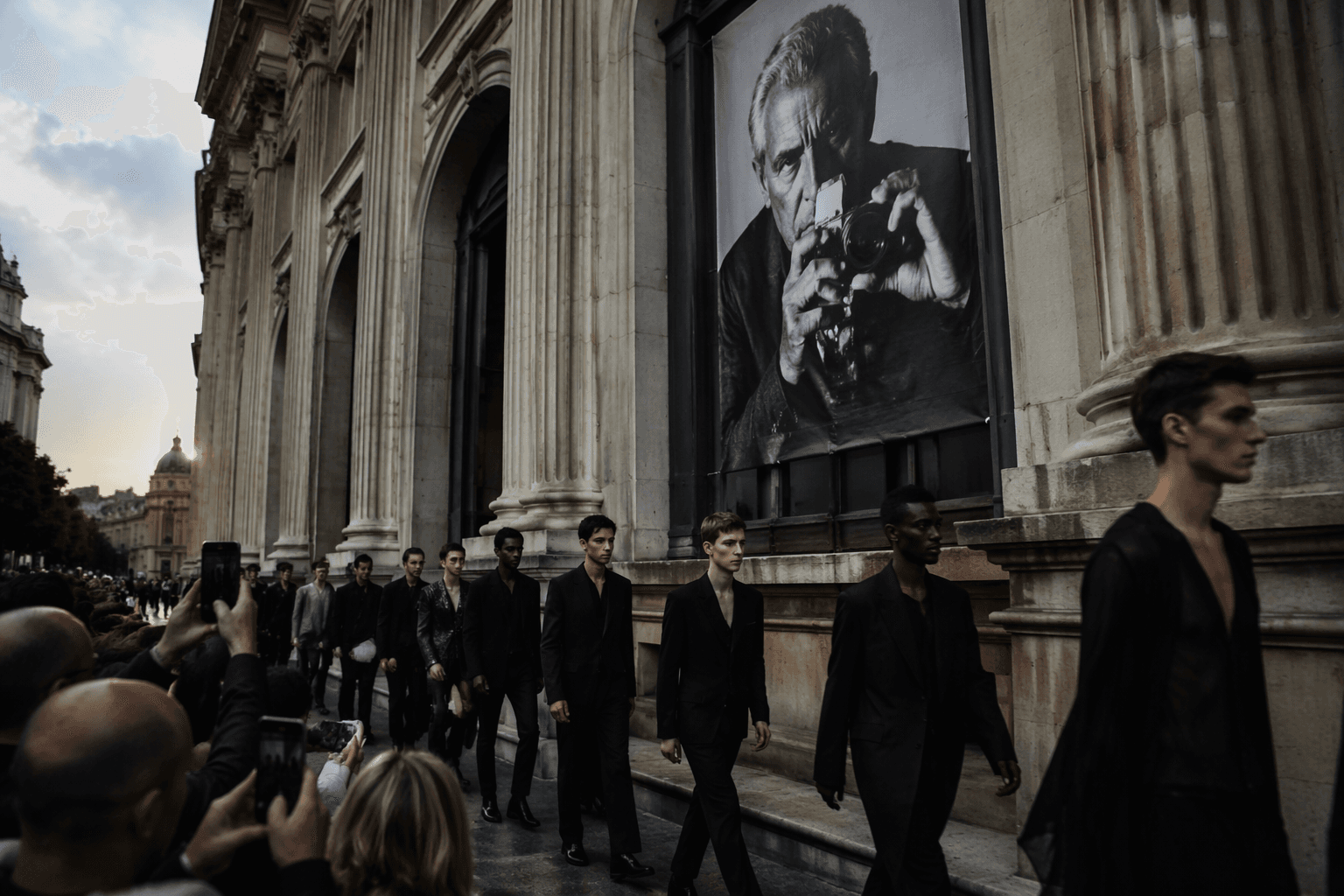
Etro turns old-money dressing into heritage-rich travel maximalism
Etro made old-money dressing look stamped, packed, and boarded: paisley, madras, and silk dusters turned aristocratic style into a travel fantasy.
At Milan Fashion Week on June 22, 2026, Etro turned its men’s show into a retro train-station scene, complete with a train on the track, stacks of luggage, and archive-heavy travel imagery. The clothes did the rest: saturated color, paisley, and ornament pushed the usual beige-and-navy code into something far richer and far louder. Etro was testing how far old-money menswear can stretch before it stops reading as old money, and the answer landed somewhere between aristocratic and theatrical.
A train platform instead of a clubhouse
Instead of a hushed salon or a country-house fantasy, Etro gave the audience departure boards in spirit, if not literally, and framed the collection as a journey rather than a wardrobe edit. The mood was “all aboard,” built around movement rather than stillness.
The classic aristocratic wardrobe leans on restraint, but Etro used vibrant color, layered prints, and decorative texture to argue that inheritance can be lush, not beige.
Why Etro can pull this off
Etro has the backstory to make maximalism feel like continuity instead of costume. The house was founded in 1968 by a family of collectors, and its fabric archive has always been part of the brand’s identity, rooted in global exploration rather than blank minimalism. Paisley is the signature that ties it all together, a motif Etro ties to the spirit of its founding era; the company’s paisley production began in 1981.
A brand with this much textile memory can stack foulard prints, madras, embroidery, and suede without looking like it raided a souvenir shop.
What the collection actually wore onto the runway
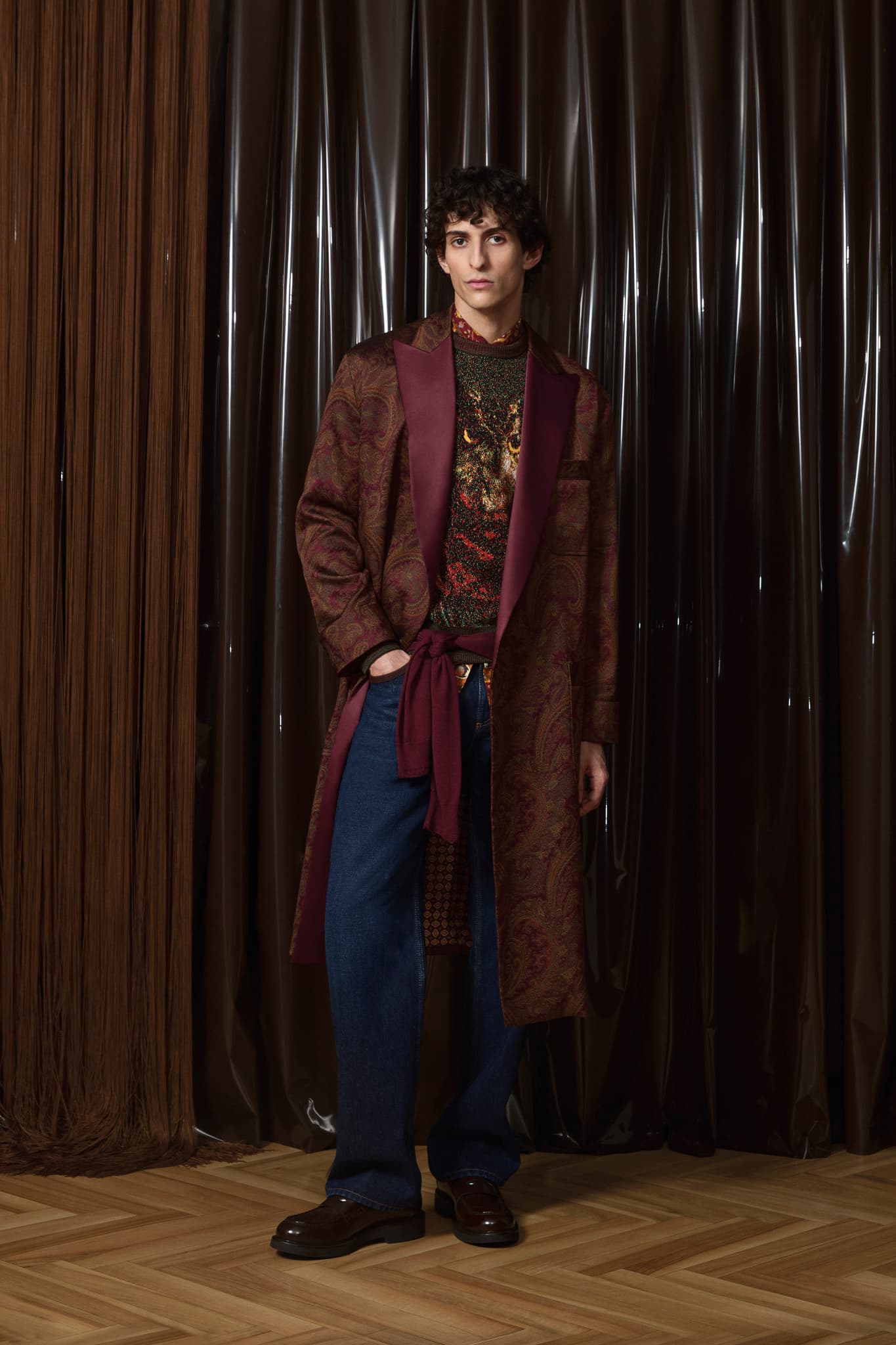
“Extraordinary Journeys,” the Spring/Summer 2027 men’s collection, followed an arc Etro set from India to Milan and onward to other destinations. That story showed up in archive foulard prints, madras, embroidery, 3D check sweaters, printed suede trench coats, laser-cut suede shirt jackets, and double-faced silk dusters.
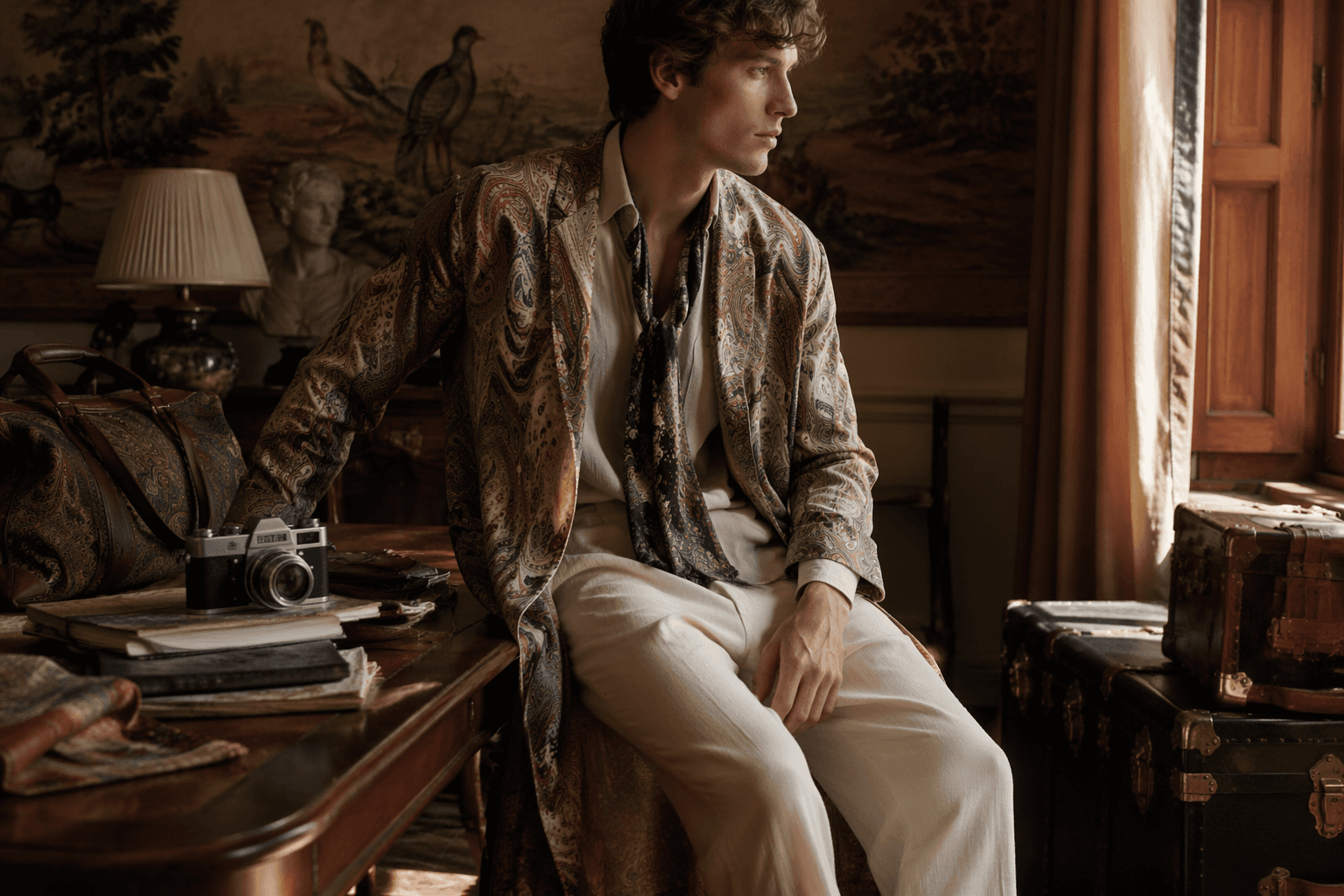
The styling sharpened that message. Suits were relaxed, shirts were allowed to function like jackets, and the look was finished with moccasins, mules, and sandals that kept the whole thing moving. Then came the accessories that made the show feel explicitly traveled: braided scarves, silver jewelry, paper-airplane charms, and raffia caps.
The standout move was the way Etro treated softness as power. Double-faced silk dusters and printed suede trench coats bring a kind of easy drape that old-money dressing often saves for leisure, while the 3D check knits and laser-cut suede give the collection actual depth.
Where the line between inheritance and costume gets thin
Etro’s collection works best when the clothes look collected, not assembled. The archive prints, the madras, and the suede outerwear all read as part of a family vocabulary, the kind of thing that could plausibly live in a private textile room before it reaches a runway. The paper-airplane charms and raffia caps push harder into whimsy, and that is where the look gets close to costume.
Still, the collection never fully tips over because Etro’s whole identity has always sat one step from the expected. The house was built by collectors, not accountants.
The corporate backdrop gives the show more weight
Marco De Vincenzo left Etro’s creative direction on March 12, 2026, after nearly four years, and the brand said the move was part of a new strategic phase. The founding Etro family had already exited ownership in December 2025 after selling its minority stake, leaving L Catterton as the controlling shareholder.
That kind of transition can flatten a house fast, especially one built on a very specific visual identity. Etro answered with a show that doubled down on the signatures that still make the brand recognizable from across a room: paisley, archive prints, saturated color, and textile richness.
This article was produced by Prism’s automated news system from verified source data, official records, and press releases, then run through automated quality and moderation checks before publishing. The system is built and supervised by the people who set the standards it runs under. Read our full AI policy.
Know something we missed? Have a correction or additional information?
Submit a Tip