Everyday Couture: Old Money Wardrobes Embrace High-Low Luxury
One couture piece, everything else quiet: that is the new old-money formula. A sequin top, a cotton trench, dark denim, and loafers can make luxury look inherited.
One couture piece, everything else quiet
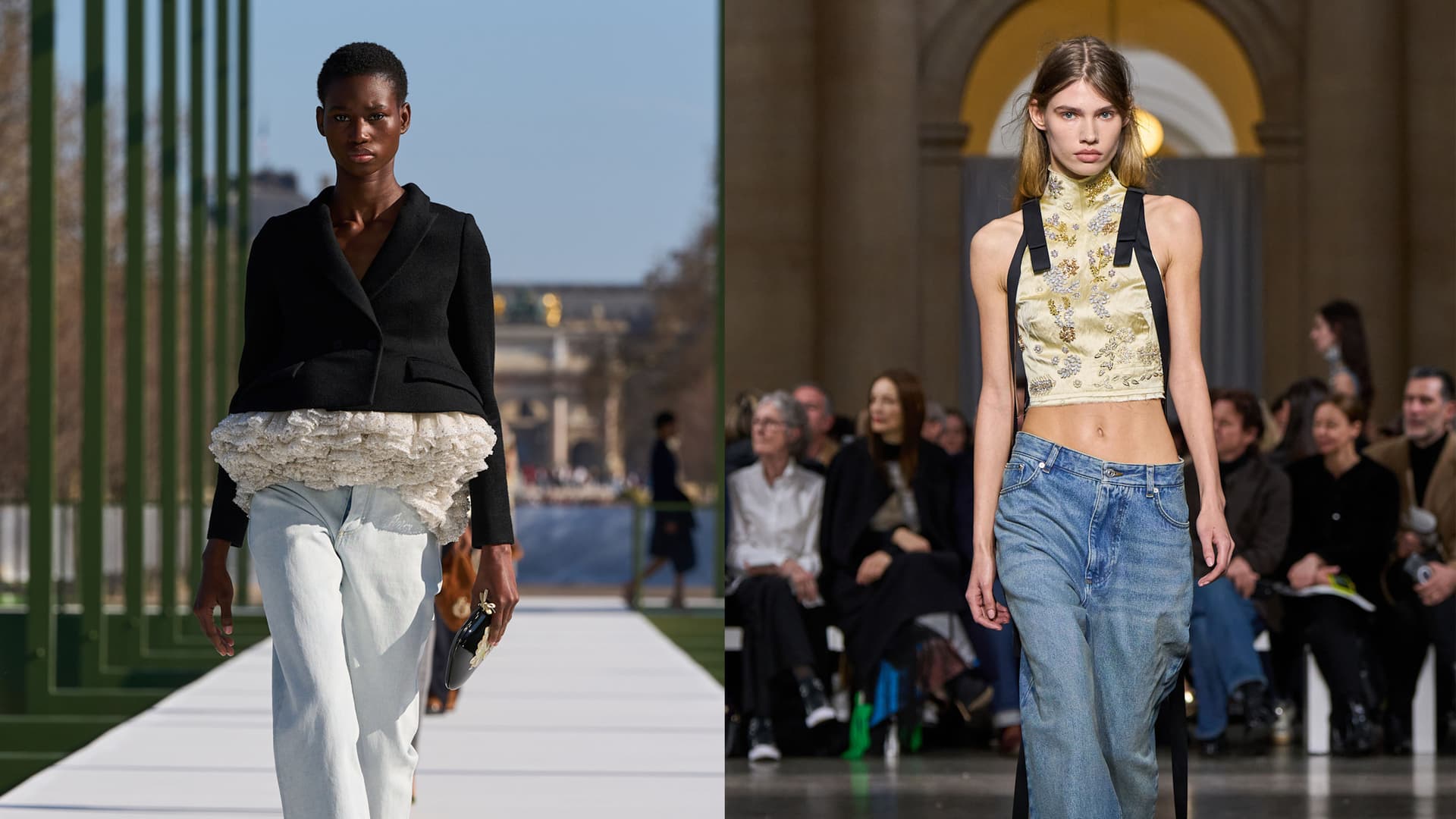
The smartest old-money look right now is quiet, not precious. One couture-level piece does the talking, while the rest of the outfit stays disciplined: sequins under a cotton trench, an embellished top with dark denim, Chanel tweed with a white tee, a tailored jacket softened by trousers. The cheapest way to look old money is not a monogram. It is restraint.
A good formula is simple: choose one item with surface drama, then ground it in pieces that feel lived-in and believable. A sequin T-shirt works because it reads like a wardrobe habit, not a stunt. A satin embroidered top has more presence when it meets straight-leg jeans and loafers. Even Chanel tweed, the most recognizable shorthand for polish, feels fresher when it is worn with a plain tee instead of fussed over with more formality.
Start with the silhouette, not the sparkle
The high-low move only works when the silhouette stays calm. A structured top needs room below, so pair embellishment with denim that is dark, clean, and unforced. A cotton trench is the perfect counterweight to shine because it strips sequins of their red-carpet reflex and gives them the insouciance of a day coat. The same logic applies to tailored jackets: when you wear them with trousers that fall properly, the outfit feels inherited, not engineered.
Chanel remains the clearest reference point because the house built its reputation on making polish look easy. The Metropolitan Museum of Art notes that Coco Chanel made simplicity and comfort central to women’s dress, popularized jersey and menswear-inspired tailoring, and favored soft, loosely woven tweed that allowed ease of movement. That is still the template. Luxury looks richest when it moves like something you have worn for years.
How to wear one couture piece without overdoing it
Think in outfits, not in statements.
- A sequined top under a cotton trench, with straight dark denim and loafers, reads polished enough for dinner and casual enough for the afternoon.
- A Chanel tweed jacket over a white tee and tailored trousers turns a formal fabric into everyday armor.
- An embellished blouse with jeans and a structured bag gives the same effect with less ceremony.
- A satin embroidered piece worn with simple black trousers lets the fabric do the work while everything else stays controlled.
This is where old money style becomes practical. It is not about looking expensive in every inch. It is about letting one piece carry the sense of occasion while the rest of the outfit says you have somewhere to be and know how to get there.
Why Chanel tweed still matters
Tweed is the perfect symbol of this shift because it carries both history and ease. Britannica traces the word back to a 1826 clerical error in Scotland, when a London clerk wrote “tweeds” instead of “tweels.” That little accident now sits at the center of a fabric long associated with refinement, country codes, and polished inheritance.
Chanel made the material feel modern by softening it. The Metropolitan Museum of Art says Chanel’s suits were often made from light, loosely woven tweed and designed for ease of movement. That detail matters now because it explains why tweed still works outside a boardroom or an evening room. It has texture, but no stiffness. It gives a look authority without turning it rigid.
The new couture piece is meant to be worn
Who What Wear describes this moment as “everyday couture,” a marriage of high-low dressing in which singular, heirloom-like pieces are no longer being saved for one-off special occasions. That is the shift readers can actually use. Couture is no longer only a destination look; it is becoming part of the weekday wardrobe.
Conner Ives captures that change neatly. The brand’s satin embroidered tapestry pieces have already struck a chord with the fashion set, and its own site includes a “Demi Couture” line alongside a “Things of Quality” Sequin T-shirt priced at £495. That price point is not impulse territory, but it is also not fantasy in the way a full couture gown is. It sits in the middle ground where investment dressing lives now: special enough to keep, easy enough to wear with denim.
Couture still has rules, even when you dress it down
The appeal of everyday couture is that it borrows the aura of the rare without breaking the discipline of the real world. Haute couture remains a highly selective system in Paris, coordinated by the Fédération de la Haute Couture et de la Mode, which organizes Paris Fashion Week and Haute Couture Week. Its Official Calendar is composed of Members, corresponding Members, and Guest Members selected by committee. That scarcity is exactly why the idea has cachet.
But the market is clearly pushing in the opposite direction from ceremonial dressing. Chanel’s Cruise 2025/26 and Spring/Summer 2026 pieces keep mixing tweed, trenches, jeans, T-shirts, and formal silhouettes, proving that even the most established house is treating luxury as something to be lived in, not only displayed. Tim Blanks has long captured fashion best when it moves from spectacle to behavior, and this is exactly that kind of shift: less runway drama, more wardrobe logic.
Old money style is also a resale story
The old-money high-low look feels especially current because it fits the way people are shopping now. ThredUp’s 2025 Resale Report says the secondhand market continues to grow, and Vestiaire Collective with Boston Consulting Group estimates the resale market at roughly $210 billion to $220 billion, with a potential rise to $360 billion by 2030. High-value categories like bags and jewelry are helping drive that growth.
That matters because it explains why the new polished wardrobe is built around pieces that hold their value, or at least their relevance. A great jacket, a strong bag, a pair of well-cut trousers, a sequined top that can be worn under a trench and then with denim later, these are not one-night items. They are the kind of wardrobe assets that can be styled, restyled, and passed along. In the language of old money, that is the point: longevity looks better than novelty.
The real finish
The old-money wardrobe has always been less about cost than about control. Ralph Lauren built an entire empire around that idea, translating an elite American lifestyle through English aristocracy and sporty East Coast ease. The Ivy League added its own shorthand for academic prestige, and together those references shaped a style language that still reads as aspirational because it never looks strained.
That is why everyday couture is landing now. It gives you the glow of luxury without the noise, the pleasure of embellishment without the insecurity of overstyling. One couture piece, everything else quiet, is not a compromise. It is the most convincing way to make fashion look inherited.
This article was produced by Prism’s automated news system from verified source data, official records, and press releases, then run through automated quality and moderation checks before publishing. The system is built and supervised by the people who set the standards it runs under. Read our full AI policy.
Did this article answer your question?