Old Money Style: How
The old money aesthetic is less about what you buy and more about how you maintain, alter, and wear what you already own.

The Mindset Before the Merchandise
The easiest way to spot someone cosplaying old money is the shopping haul. They have the loafers, the navy blazer, the camel coat purchased in a single weekend, and somehow the whole outfit reads costume. What they're missing isn't another piece. It's the system of habits that makes inherited style look inherited: the relationship with a tailor, the muscle memory of folding a cashmere sweater correctly, the patience to acquire things slowly and deliberately. Old money style is, first and fundamentally, a set of practices. The clothes follow.
This is the manual for those practices.
The Capsule Categories
A functional old money wardrobe runs on 30 to 40 core items organized into five categories. Think of them not as a shopping list but as structural pillars, each one supporting the others.
The first is structured suiting and blazers. A single navy blazer with natural shoulders, a mid-grey suit, and one well-cut trouser in cream or camel will cover most occasions. Classic silhouettes here mean A-line skirts and straight-leg trousers for women, single-break trousers and unpadded blazers for men. Nothing architectural, nothing that telegraphs a specific season.
The second is refined knitwear. A fine-gauge cashmere crew neck, a merino polo, and at least one piece in ivory or hunter green form the layering core. These are the workhorses of the wardrobe and, significantly, the pieces most likely to need eventual repair. Buy them to last.
The third category covers outerwear. A dark trench with a removable liner earns its place across three seasons. A wool or cashmere overcoat in camel or charcoal handles the rest. Invest 60 to 70 percent of your initial budget here and in suiting: these are the silhouettes people actually see.
Fourth is shoes, and the choice is almost always a leather loafer, a clean brogue, or a sleek derby. Nothing chunky, nothing logoed, nothing that requires a trend to make sense. Loafers in tan or cognac leather are the single most transferable piece in this wardrobe.
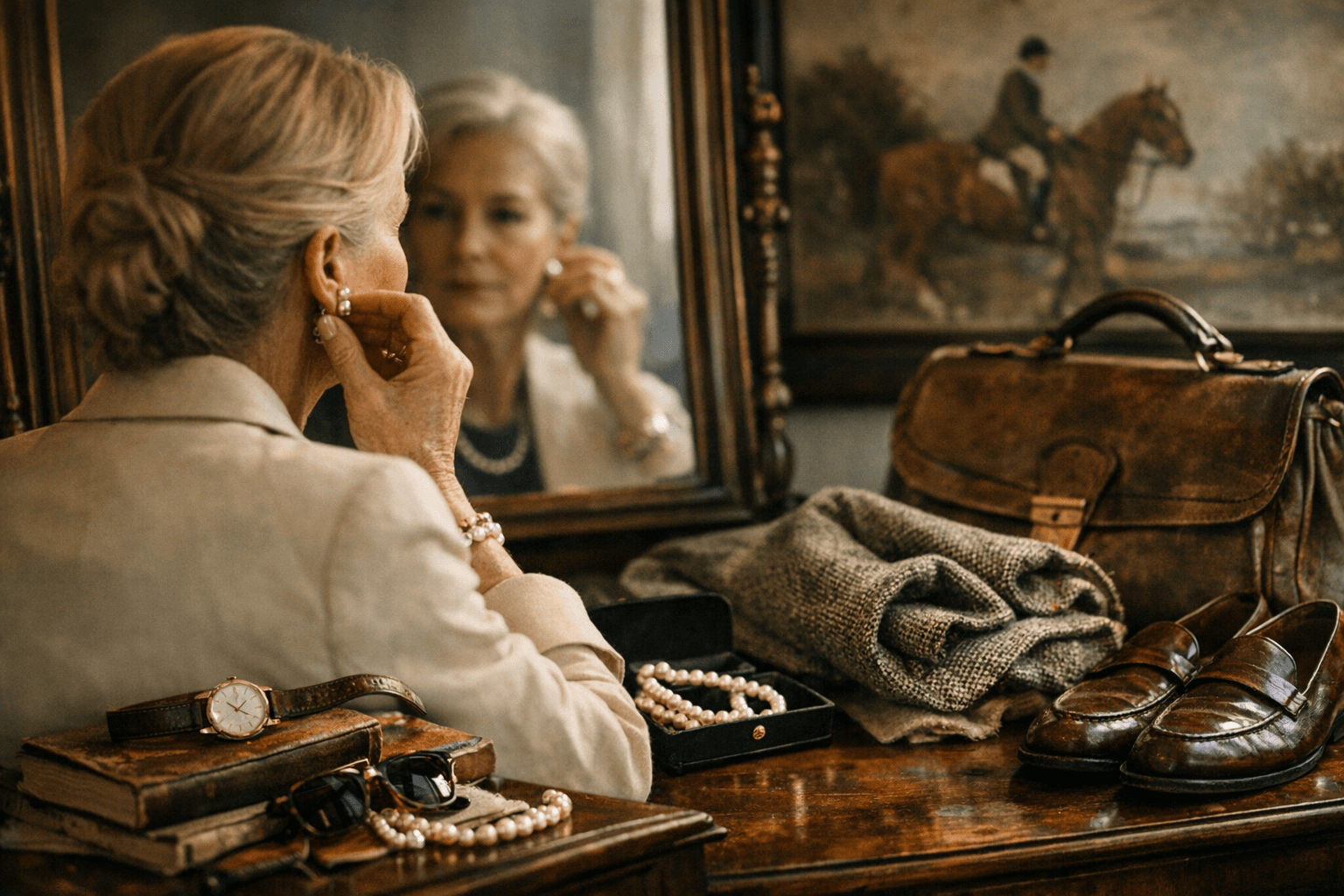
Fifth is accessories, kept to a strict few: a simple-dial watch on a leather strap, pearl earrings or a thin gold chain, a silk scarf, a signet ring. Brands like Goyard, Valextra, and Charvet occupy this territory without visible branding. The rule is function first, then beauty. If a piece serves no clear purpose, it stays home.
Fabric Literacy
The old money wardrobe is built almost exclusively on natural fibers, and understanding why is half the battle. Cashmere, wool, silk, linen, and tweed not only feel better than synthetics; they age better. A well-maintained cashmere sweater develops a softness over years that no acrylic approximates. A linen shirt pressed and hung correctly holds its character wash after wash.
The palette is equally legible once you understand the logic: soft whites, pale blues, subtle greens, navy, cream, camel, and earth tones. These colors work together without effort and photograph without flash. They are also, not coincidentally, the colors that show fabric quality most clearly. A beautifully woven herringbone tweed announces itself in taupe. It would disappear in neon.
For those not ready to invest at the level of Loro Piana, whose cashmere blazers open at around $4,995, or Brunello Cucinelli, whose soft tailoring occupies similar territory, accessible alternatives exist. COS, Massimo Dutti, Quince, and Uniqlo all offer natural fiber basics at a fraction of the price. The discipline is not the budget; it's choosing the right fiber and avoiding polyester regardless of the label.
Tailoring: The Non-Negotiable
Basic alterations, including hemming trousers, adjusting sleeve length, and suppressing waists, typically run $20 to $60 per garment. That's the number to hold onto. A $200 blazer tailored perfectly looks superior to a $2,000 blazer worn off the rack.
The specifics matter. Old money men pay for sleeve adjustments so one-half inch of shirt cuff shows; old money women hem skirts to mid-calf for graceful movement. Shoulders must not droop. Trousers should break gently at the shoe, neither bunching nor hovering. Waist suppression should be subtle: enough to suggest a shape without pulling. These are not vanity adjustments. They are the difference between wearing clothes and wearing your clothes.
Find a tailor and use them consistently. This is not a one-time errand. As your body changes, as pieces age and reshape, the tailor relationship keeps the wardrobe functional. Treat it as a standing appointment, not a last resort.
Garment Care and Repair
This is where performative old money collapses entirely. Buying the right pieces and then tumble-drying cashmere is not old money. It's expensive carelessness.
Dry clean wool and cashmere only when necessary, store silk in breathable garment bags, and avoid over-washing to maintain fiber integrity. For cashmere specifically, hand washing is best to preserve its delicate fibers, using mild detergents and specialist cleaning products. A tweed coat needs neither: brush it, air it, and it will outlast most garments in your wardrobe. Steam rather than iron where possible. Wooden hangers, not wire.
Repair is equally central. Knitwear develops pulls, moth holes, and snags over time. The old money response is not to discard; it's to mend. Visible mending techniques like darning and patching can restore a cashmere piece while adding character. Professional knitwear repair is almost always less expensive than replacing a high-quality garment, and the restored piece often holds more meaning than its replacement would. Building this repair habit into your wardrobe routine is, more than any single purchase, what separates a curated closet from a consumption cycle.
The 12-Month Acquisition Plan
The most common mistake is trying to build this wardrobe all at once. Don't. Old money style accumulated over generations for a reason: slow acquisition produces coherence. Here is a working framework:
- Months 1 to 3: Audit what you own. Have one or two pieces you already wear regularly tailored properly. Note which fabric categories you lack entirely.
- Months 4 to 6: Invest in outerwear. This is the visible category, the one that frames everything underneath. Buy one coat that will last a decade. Sale seasons in spring and autumn are your best entry points for full-price quality at reduced cost.
- Months 7 to 9: Add structured layering. A well-cut blazer, a fine knitwear piece, a silk blouse or a crisp Oxford shirt. Again, buy through end-of-season sales; classic cuts do not expire.
- Months 10 to 12: Close the gaps in shoes and accessories. A leather loafer or brogue, a watch that works across occasions, one bag that functions as an everyday and a dinner option.
The point of the 12-month structure is not rigidity; it's deliberateness. Each acquisition should answer a specific gap, not an impulse.
Etiquette and the Interior Life
Old money style has always carried a behavioral dimension, and ignoring it produces a convincing costume rather than a convincing person. Manners, reserve, and a certain quality of attention to others are as much a part of the aesthetic as the clothes. This means putting your phone away at dinner, holding doors without fanfare, and speaking without performing. It means listening.
The home carries its own signals. Old money interiors favor worn leather, inherited silver, and art that was acquired slowly rather than decorated quickly. None of this needs to be expensive. A well-organized bookshelf, unscented candles, and a single good vase communicate more than a maximalist display. The through-line from wardrobe to interior is the same: restraint applied with care.
Real vs Performative: The Checklist
Before any purchase, run through this:
- Does this piece require a brand name to make sense, or does the fabric and cut justify it entirely?
- Can I care for this properly? Do I know how to wash, store, and repair it?
- Does this fit me now, or would it require tailoring I haven't arranged yet?
- Is this filling a genuine gap in my wardrobe, or is it replicating something I already own?
- Will I still want to wear this in five years?
The old money mindset is not a mood board. It is a relationship with objects rooted in responsibility: buy less, buy better, maintain obsessively, and repair before you replace. The wardrobe that results from those habits will read as inherited wealth whether or not it cost any. That, in the end, is the only trick worth knowing.
This article was produced by Prism’s automated news system from verified source data, official records, and press releases, then run through automated quality and moderation checks before publishing. The system is built and supervised by the people who set the standards it runs under. Read our full AI policy.
Did this article answer your question?