Old Money Style Starts at the Feet, Shoes That Signal Quiet Wealth
Old money reads first in the shoe: repairable construction, slow-rich patina, and leather that deepens instead of shouting. Start with a loafer, derby, and boot.
The clearest old-money tell is underfoot
The old-money signal is not the watch peeking from a cuff or the coat thrown over a shoulder. It is the shoe that improves with age, a loafer burnished by miles, a blucher with a civilized crease, a boot that has been resoled instead of replaced. Quiet wealth lives in restraint, and nowhere is that restraint more legible than in leather that looks lived-in, not loud.
The buying test: leather, last, welt, repair path
Start with the construction before you fall for the color. The basic principle behind Goodyear welted shoes traces to an 1862 invention by Auguste Destouy, with later improvement in 1869, which is why the method became shorthand for durable, serviceable footwear that can be taken apart and rebuilt. Alden still frames its shoes and boots around Goodyear welt construction and a tempered steel shank, while G.H. Bass’s Weejuns lean into hand-stitched, resoleable builds that are meant to stay in rotation rather than disappear after one season.
Leather quality is the second filter, and shell cordovan remains the most persuasive old-money material signal in the room. Horween Leather Company, founded in Chicago in 1905, makes Genuine Shell Cordovan from a specific part of horsehide, and the process takes at least six months, which explains both the dense luster and the limited supply compared with calf. That slow, labor-heavy finish is why shell cordovan does not look painted on. It looks concentrated, almost liquid, with a depth that plain calf leather takes years to earn.
The last shape matters just as much. A beautiful leather shoe can still read wrong if the toe is too blunt, too bulbous, or too aggressively pointed, because the old-money eye wants discipline in the silhouette. Alden’s Barrie last is widely noted as running big, so fit is part of the aesthetic: a shoe that sits correctly on the foot looks calmer, longer, and more expensive than one that is fighting its own proportions.
Loafers first, because they do the most work
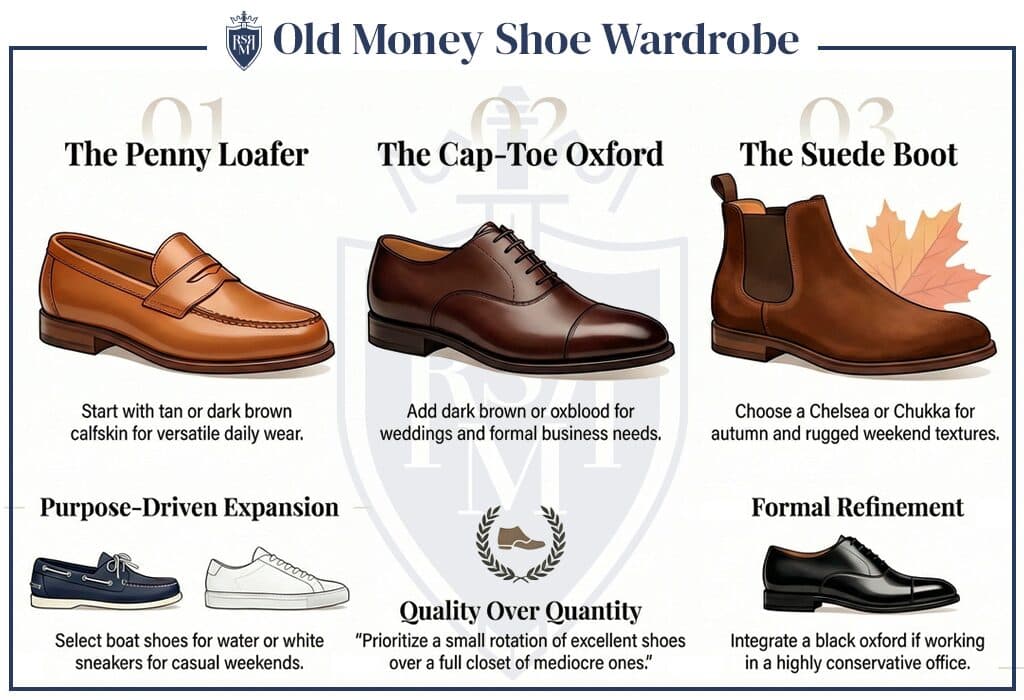
If you want the purest old-money casual shoe, begin with loafers. G.H. Bass dates Weejuns to 1936, and that penny slot has become a lasting American signal precisely because it bridges campus polish, club formality, and everyday ease. A classic Weejun today still gives you the essential ingredients, premium leather, hand-stitched construction, and a clean silhouette, while Alden’s full-strap and tassel loafers push the category into dressier, more composed territory.
The tassel loafer deserves special respect. One widely circulated version of its modern American history ties the style to Alden, with the classic tassel moccasin often dated to 1952 and Brooks Brothers later carrying a version in 1957, which helped cement its country-club vocabulary. In practice, the tassel softens a tailored look without collapsing into casual wear, which is exactly why it works with flannel trousers, summer suits, and the kind of navy blazer that never needs explaining.
For price context, a G.H. Bass Larson Weejun sits around $175 to $195, while Alden’s shell cordovan loafers live in the very different $967 to $1,022 range. That gap is the difference between a handsome entry loafer and a true heirloom-grade pair, and both have a place if you are buying intentionally.
Bluchers and Oxfords are the spine of formalwear
When the dress code tightens, the Oxford and the derby do the heavy lifting. The Oxford’s history is usually traced to the Oxonian, a half-boot associated with Oxford University, though the origin story is not singular, which suits the shoe’s temperament: conservative, not decorative. The derby, with its more open lacing, reads a touch less severe, and in old-money dressing that difference matters because one shoe suggests ceremony and the other suggests ease.
This is where black calf or dark brown calf earns its keep. A plain-toe blucher in a restrained shape can move from tailoring to denim without changing character, and Alden’s 9901 plain-toe blucher at $989 shows exactly how elevated that lane can become when the construction and leather are serious. If you are choosing one formal pair first, let it be the one that can survive a decade of wear, a few resoles, and all the occasions that actually matter.
The sneaker exception, not the rule
The sneaker lane belongs at the end of the lineup, not the beginning. Common Projects launched the Achilles in 2004 by Flavio Girolami and Peter Poopat, and its whole appeal is the refusal to shout, the monochrome upper, the minimal branding, the clean line that slips under tailoring without hijacking it. At Nordstrom, Common Projects’ men’s Achilles sits around $505 to $598, which places it firmly in luxury territory rather than everyday sneaker pricing.
If you want a more democratic reference point, adidas’ Stan Smith is currently listed at $100 and remains the court shoe that made understatement mainstream. The heel tab and perforated 3-Stripes are now so familiar they read almost like punctuation, which is why the shoe works best when the rest of the wardrobe is already doing the talking.
The first three pairs roadmap
Build the closet in this order, and do not overcomplicate it:
- Loafer: Start with a G.H. Bass Weejun or Larson Weejun if you want the classic American entry point around $175 to $195, then move to Alden’s shell cordovan loafers when you want something that ages into a richer, more specific patina.
- Blucher or derby: Choose a plain-toe pair in black or dark brown calf for maximum versatility, or go straight to Alden’s 9901 if you want the benchmark version in the $989 range. This is the pair that makes tailoring look calm instead of fussy.
- Boot: Make the boot the most serious shoe in the closet. Alden’s shell cordovan boots sit roughly in the $1,006 to $1,030 range, and that kind of spend only makes sense if you expect repairs, not replacement.
What to ask a cobbler before you buy
Before you hand over money, ask the questions that separate a good purchase from an expensive mistake:
- Can this shoe be resoled cleanly, and how many times?
- Is the sole leather, rubber, or a mixed build, and will it need heel taps or toe plates to hold its shape?
- If the instep is snug, can it be stretched safely without distorting the silhouette?
- Does the welt leave enough room for future repairs, or is the shoe built so narrowly that maintenance will be difficult?
- If the model is shell cordovan, what should the polishing and brushing routine be to preserve the finish?
That conversation matters because some shoes are made to be worn down and reborn, while others are made to be replaced. G.H. Bass explicitly builds resoleable loafers, and Alden’s welted construction is designed for the long road, which is exactly the kind of infrastructure quiet wealth rewards.
Patina should look like depth, not damage
Good patina is not random wear. On shell cordovan, it should look like the leather has gathered a richer, more even glow across the toe and vamp, the kind of polish that settles into the shoe instead of sitting on top of it. Alden says its genuine shell cordovan only improves with polishing, deepening over time, and that is the standard worth chasing: a surface that softens, darkens, and gains character without cracking into fatigue.
Stretch when the pressure point is local, resole when the outsole is tired, and replace only when the upper has failed beyond rescue. That is the old-money rhythm, not because it is precious, but because it understands that the finest shoes are not consumed by wear, they are edited by it.
This article was produced by Prism’s automated news system from verified source data, official records, and press releases, then run through automated quality and moderation checks before publishing. The system is built and supervised by the people who set the standards it runs under. Read our full AI policy.
Did this article answer your question?