Palm Beach's Old Money Rituals Shape a Quiet Luxury Ecosystem
Palm Beach's Worth Avenue drew $243M in property investment in March 2026 alone, proof that the island's old money ecosystem is not a relic but a living, spending market.
The Geography of Discretion
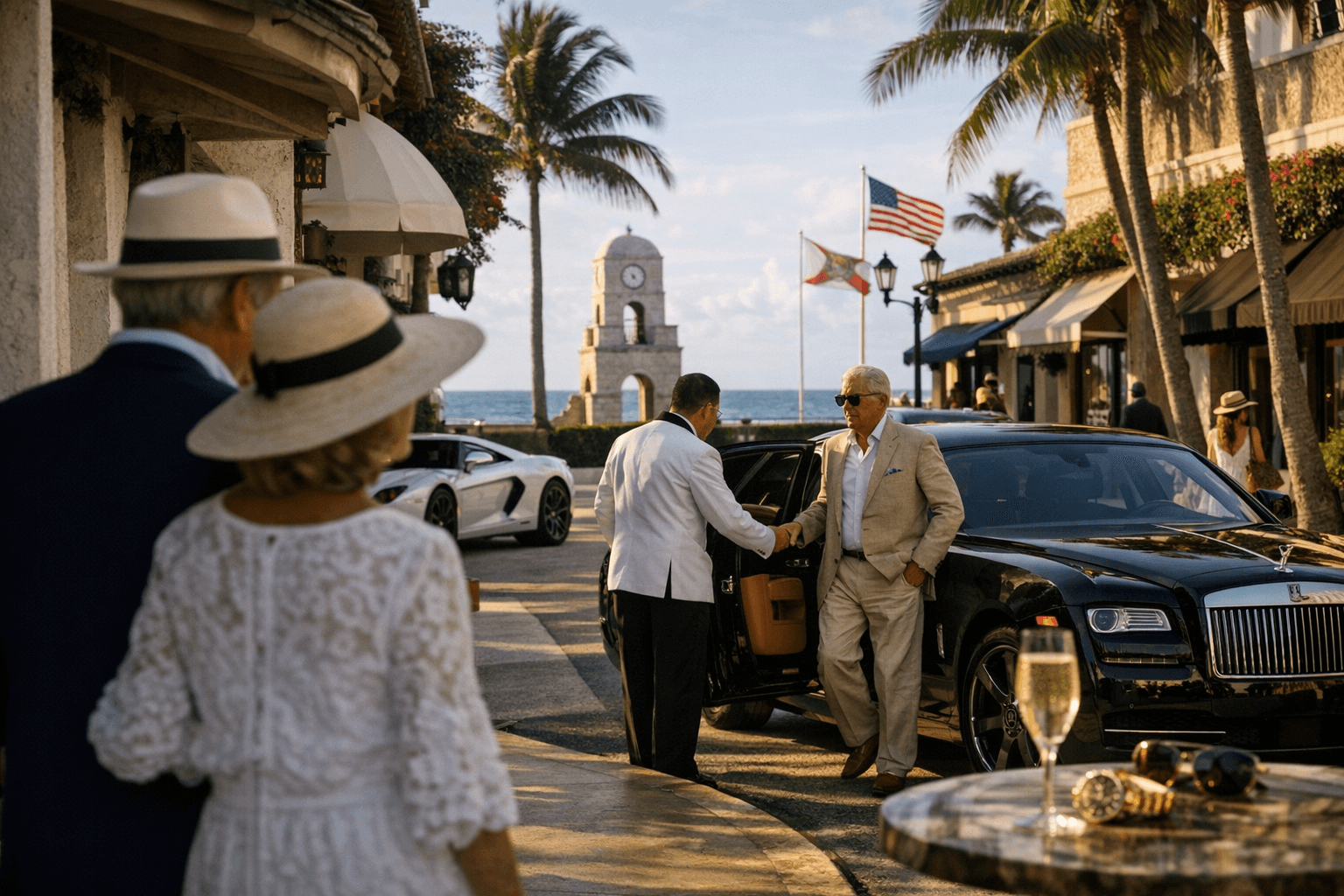
Palm Beach is a 10.4-square-mile island where the rules of engagement are written in architecture before they are ever spoken aloud. Three royal palm-lined boulevards and Ficus-hedged perimeters greet every arrival, and what lies within is governed not just by taste but by statute. The town's Architectural Commission, ARCOM, evolved directly from the Art Jury established in the 1920s with a singular mandate: protect the built environment from vulgarity. Strict zoning laws coded into Palm Beach's early 20th-century charter ensure that no facade, signage, or renovation can disturb the Mediterranean Revival cadence that Addison Mizner locked in more than a century ago.
Mizner, who designed 67 structures on the island alone, set the visual tone with his first major commission: the Everglades Club, which opened in January 1919. That "gorgeous pink stucco palace, with arcades, wrought-iron balconies, and terra-cotta-tile roofs" did not merely house the wealthy; it trained their eye. His aesthetic, later described as "Bastard-Spanish-Moorish-Romanesque-Gothic-Renaissance-Bull-Market-Damn-the-Expense," was less a style than a philosophy of beautiful excess restrained by proportion. The result is a townscape that does the work old money prefers not to do itself: it signals status without announcing it.
Worth Avenue and the Retail Architecture of Restraint
Worth Avenue runs precisely three blocks, from the Atlantic to the Intracoastal, and in those three blocks manages to be both the only real rival to Rodeo Drive south of the Mason-Dixon and one of the most architecturally coherent retail streets in the country. The hidden vias, narrow pedestrian passages that thread between buildings, are themselves Mizner-designed, built between 1923 and 1925 to evoke the sensation of stumbling into a centuries-old European quarter. The boutiques that line them, Hermès, Cartier, Chanel, Louis Vuitton, are housed within structures that do not permit neon, garish display windows, or the visual aggression of conventional luxury retail. This is quiet luxury enforced by zoning.
The investment community has been paying attention. In March 2026, the Reuben Brothers paid $200 million for the Esplanade at 150 Worth Avenue, a 128,779-square-foot property occupying nearly a full block, whose tenants include Emilio Pucci, Akris, and Hublot. Days later, Acadia Realty Trust acquired 225 Worth Avenue for $43 million. The combined $243 million in a single month is not speculative bet-making; it is a conviction play on the durability of a consumer who does not respond to flash sales or seasonal promotions. The Esplanade transaction has also prompted quiet speculation about future uses, including the possibility of a private members' club entering the Worth Avenue corridor, a development that would further blur the line between retail destination and social institution.
The Wardrobe of the Winter Season
The Palm Beach season runs roughly November through April, and the wardrobe that sustains it has its own internal logic. Neutral tailoring anchors everything: cream linen blazers, camel trousers, navy cotton shifts that read as casual but are cut with the precision of something considerably more expensive. These are not pieces that declare themselves. They are pieces that hold their shape on a terrace at the Breakers, in a gallery on Worth Avenue, or courtside at a club match, without adjustment or apology.
Equestrian influence runs through the entire visual register, not as costume but as cultural grammar. Hermès, whose founding heritage is in saddlery and harness-making, remains the dominant house in this ecosystem precisely because its aesthetic never fully departed from the paddock. Leather goods with bridle hardware, silk scarves printed with equestrian themes, riding-cut trousers adapted for social wear: these are the grammar of a wardrobe that communicates membership in a world where horses are not a hobby but a season. The house's Chaîne d'Ancre bracelet, created in 1938 and rooted in equestrian bucklery, has been on Palm Beach wrists for decades without ever looking dated, which is exactly the point.
Heritage accessories carry the remainder of the visual load. Cartier, which closed its Palm Beach location in 2017 and returned after a pop-up proved the demand was undiminished, understands this market viscerally. The women named in Palm Beach's 2025 Women of Style profiles cite Cartier's craftsmanship and heritage, not its novelty. That distinction matters enormously: in Palm Beach, longevity is the luxury.
Polo, Clubs, and the Social Infrastructure of Style
Fifteen miles west of Worth Avenue, in Wellington, the National Polo Center operates as one of the world's largest polo clubs and functions during the winter season as the social fulcrum of equestrian Palm Beach. Grand Champions Polo Club, a 102-acre private facility with 212 stalls across nine barns, draws international players and devoted spectators every Sunday. The Pavilion brunch has become as ritualized as the match itself, a weekly gathering where the dress code is unwritten but universally understood: crisp white linen, a well-chosen hat, wedges over stilettos because the grass demands practicality. The field-side styling is neither showy nor negligent. It is the visual language of someone who belongs here and has no need to prove it.
The private clubs of Palm Beach island operate on the same principle but with the additional authority of genuine exclusivity. The Everglades Club, Mizner's original commission, remains among the most restricted in the United States. The Bath and Tennis Club controls its own piece of the ocean-facing shore. Membership at either is not purchased; it is conferred. The dress codes within these institutions are never publicized because they do not need to be. The wardrobe that gains entry is assembled over years and across generations, not assembled in a single retail transaction.
How Place Reinforces Brand
What makes Palm Beach genuinely useful as a study in quiet luxury is the feedback loop between architecture, retail, and social ritual. The town's strict controls on signage and facade mean that luxury brands must signal quality through product and service rather than through visual volume. A Hermès boutique on Worth Avenue cannot compete for attention through its storefront; it competes through the weight of its leather and the precision of its stitching. This is an environment that systematically selects for brands whose value is intrinsic rather than projected.
That selection pressure has produced a retail ecosystem with unusual long-term stability. Louis Vuitton's new Worth Avenue flagship features an exclusive hand-painted stack of luggage created by an in-house artisan, a gesture entirely consistent with the local expectation that craft, not commerce, drives the conversation. The Royal Poinciana Plaza, another retail node on the island, opened six new stores in recent seasons, including direct-to-consumer apparel brand Hill House Home, whose founder Nell Diamond chose the location specifically because Palm Beach's population was already "well-versed in luxury and quality." That fluency, built over decades by architecture and social ritual, is the ecosystem's most durable product. The $243 million invested in a single March month on Worth Avenue is simply the market catching up to what the island has always known about itself.
Know something we missed? Have a correction or additional information?
Submit a Tip