Savile Row tailors, the quiet architecture of old-money style
Savile Row is where old-money polish gets built: 27-measurement bespoke, hand-cut cloth, 21 tailors, and houses like Henry Poole and Huntsman.
Savile Row is not just a street in Mayfair. It is the backstage system that keeps old-money dress looking effortless, with a lineup of tailors who still build jackets around a body instead of pulling one off a rack. Walk it right and you are looking at clean shoulders, a balanced waist, and cloth that falls with intention rather than flexing for attention.
The Row is the address, but the craft is the point
London Museum places Savile Row parallel to Regent Street in Mayfair and dates its reputation for top-quality men’s tailoring to the 1800s. The street itself was first built in 1750, and British History Online’s Survey of London folds it into the Cork Street and Savile Row area, a men’s tailoring center through the nineteenth century. That split matters: the street is older than the tailoring story, but the tailoring story is what made the address magnetic.
Today, The Gentlemen’s Journal says the Row houses 21 individual tailors. That number is the whole game in miniature. Savile Row is still a compact, name-driven ecosystem rather than a giant luxury boulevard, and that concentration is exactly why the street keeps its authority. A suit here is not a logo exercise. It is a craft object made inside a very small world that still knows who cut what, who fitted whom, and which house likes a softer shoulder versus a more rigid English line.
What makes bespoke feel like bespoke
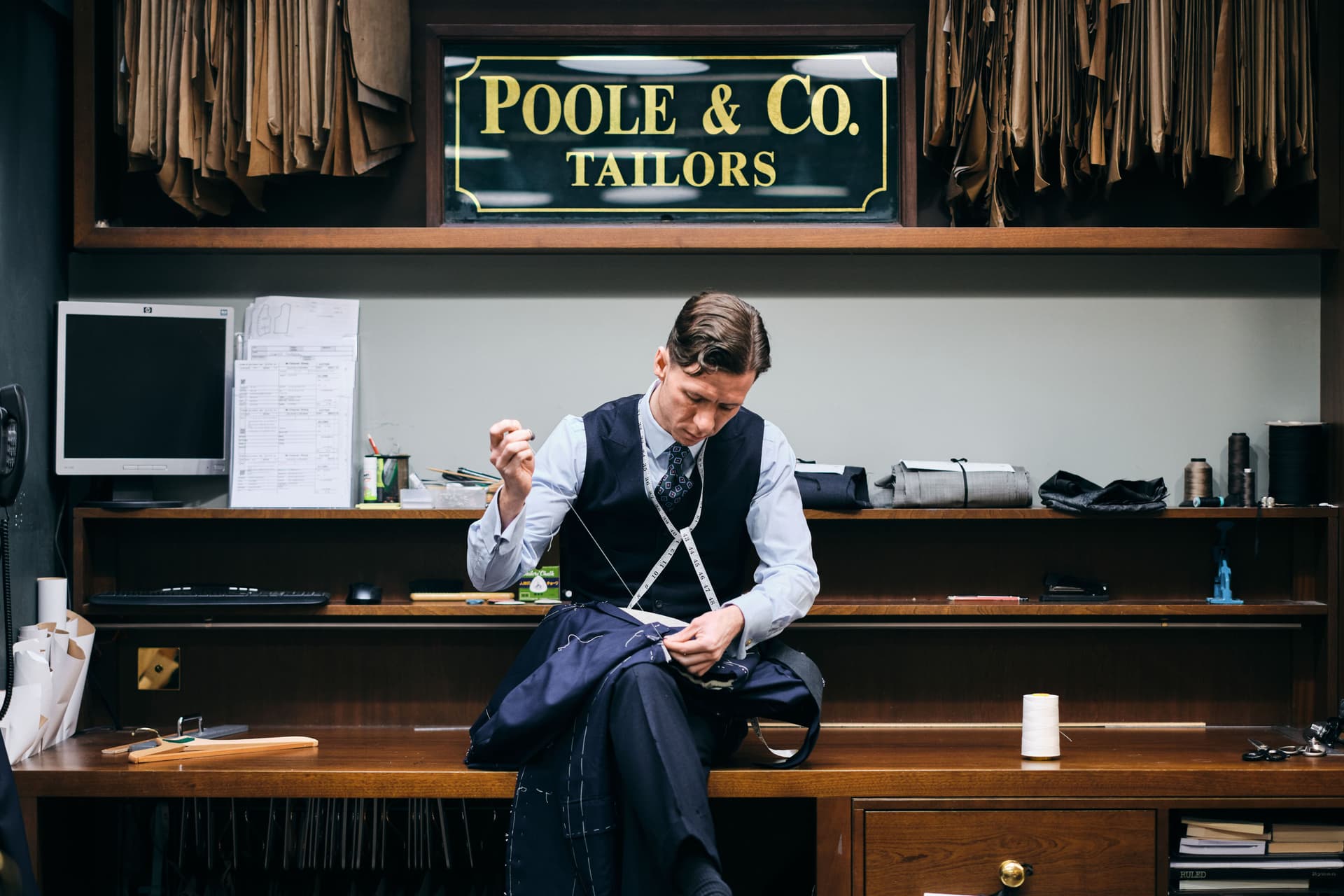
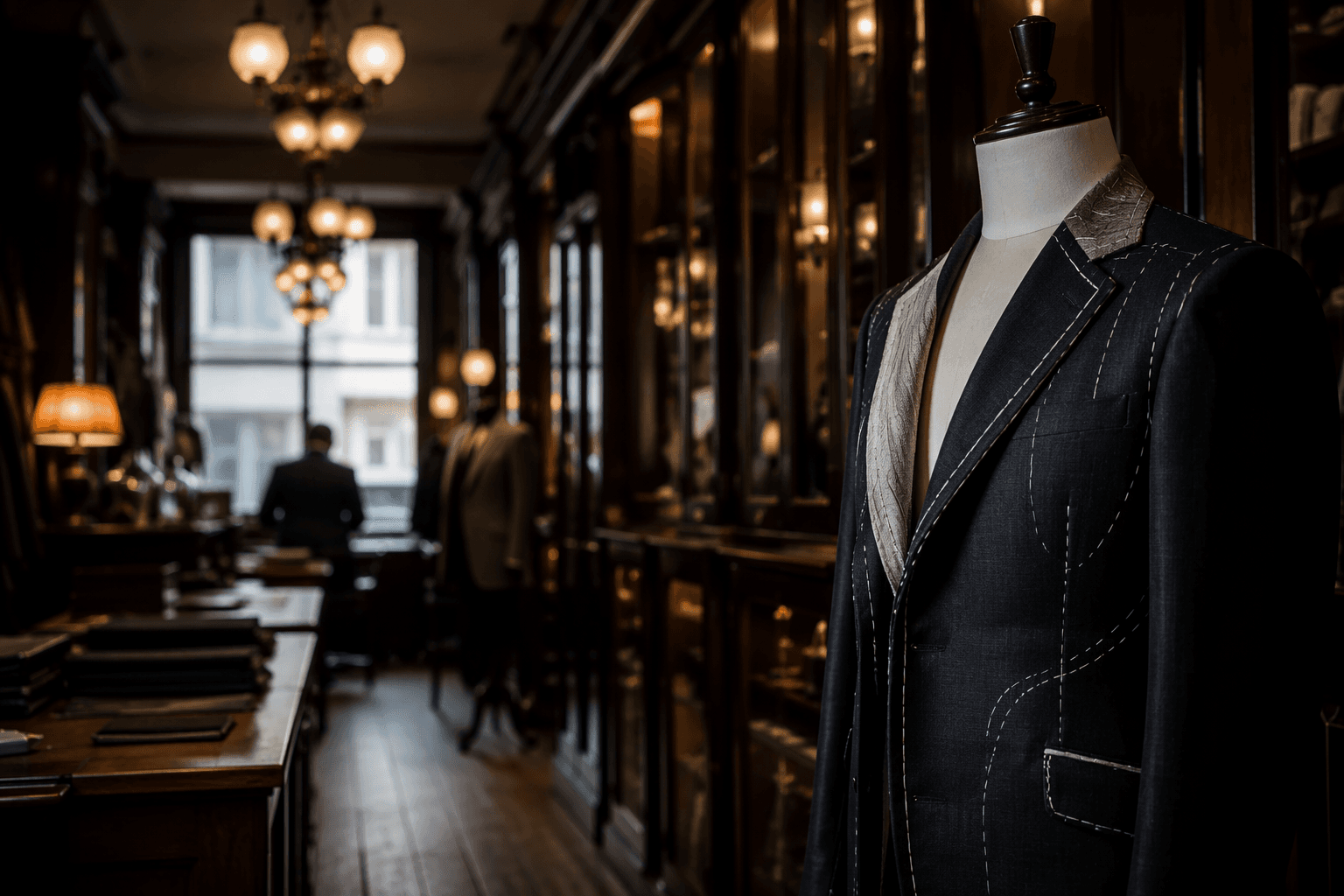
The difference between off-the-rack tailoring and true bespoke starts before cloth is even cut. On Savile Row, the suit is built around the wearer through multiple fittings, beginning with a basted stage where the garment is temporarily assembled so the tailor can correct balance, posture, and proportion. The result is not just tighter fit. It is a jacket that sits naturally on the shoulder, skims the chest without pulling, and lands with the kind of drape that looks boring in the best possible way.
Construction is the tell. Canvassed jackets, not fused shortcuts, give the chest shape and life over time. The classic English silhouette tends to read more structured, with a firmer shoulder and a cleaner line through the torso, while some houses favor a softer drape that eases the body rather than boxing it in. That difference is why Savile Row still feels like infrastructure, not marketing: the house style shows up in the architecture of the garment, not in a campaign slogan.
If you want the quick read on whether a suit belongs in old-money territory, look for these cues:
- a shoulder line that sits cleanly without puckering
- a waist that is shaped, but not cinched into trend territory
- a trouser break that kisses the shoe instead of pooling on it
- cloth that moves with weight and recovery, not shine
- finishing that disappears into the silhouette instead of calling attention to itself
The houses that define the street
Henry Poole is the anchor name. It is repeatedly described as foundational on Savile Row, and one heritage reference calls it the “Founder of Savile Row.” That kind of status is earned by longevity, not branding tricks. When people talk about the Row as the private engine behind establishment dress, Henry Poole is one of the houses sitting right at the center of that conversation.
Huntsman, established in 1849, carries a different kind of authority, sharper and more sporting in its reputation. Richard Anderson, based at 13 Savile Row, adds another point on the map and reminds you the street is not a museum row of dead names. It is a working address where modern bespoke still gets done. Savile Row Bespoke, the association representing member houses and associate members, reinforces that this is a network of specialist craft businesses, not a single monolith.
The useful move for anyone trying to understand old-money polish is to stop treating Savile Row as shorthand and start treating it as a directory. The names matter because the houses have distinct silhouettes, fitting habits, and house attitudes. That is the real luxury here: not just price, but authorship.
How the bespoke process actually works
A 2025 Museum of Modern Art video description about Anderson & Sheppard lays out a detail that tells you everything about the patience of the process: a master cutter begins a bespoke three-piece suit with 27 measurements, 20 for the jacket and 7 for the trousers. From there, paper patterns and cloth are cut by hand. That is not an embellishment. It is the difference between tailoring and engineering a garment from scratch.
Those measurements are why Savile Row suits feel so different from luxury pieces that merely borrow the vocabulary of tailoring. You are not buying an expensive shell with a label on the inside. You are entering a sequence of fittings where the garment gets corrected against your posture, your stance, and even the way you carry your shoulders. The result is a suit that can look almost invisible in a room full of flashier clothes, which is exactly the point.
The Row still changes, even when it looks frozen
This is not some sealed-off relic. A Westminster planning document dated 2024-04-02 covering 18-20 Savile Row and 17 Savile Row includes proposals for demolition, basement excavation, and redevelopment into an eight-storey building. That tells you the street is still a live commercial and heritage battleground, where preservation, money, and development keep colliding under the same polished facades.
At the same time, Savile Row still functions as a place where elite dress gets made for heads of state and superstars, which London Museum notes alongside its historical framing. The street’s power comes from that overlap: it serves ceremony, status, business, and social uniform all at once. Heritage is part of the appeal, but the real hook is that people are still using the place for the exact thing it was built to do.
The old-money read is in the details
Old-money style looks quiet because Savile Row makes sure the important things happen under the surface. The shoulder sits right, the waist feels settled, the cloth behaves over time, and the suit carries itself without screaming. That is why the Row still matters more than any generic “quiet luxury” mood board: it is the operating system behind the look, and the best-dressed people know the difference between something expensive and something built properly.
Savile Row survives because it keeps producing garments that read like restraint and wear like authority. In a fashion cycle addicted to spectacle, that kind of polish still comes from the same narrow stretch of Mayfair.
This article was produced by Prism’s automated news system from verified source data, official records, and press releases, then run through automated quality and moderation checks before publishing. The system is built and supervised by the people who set the standards it runs under. Read our full AI policy.
Did this article answer your question?